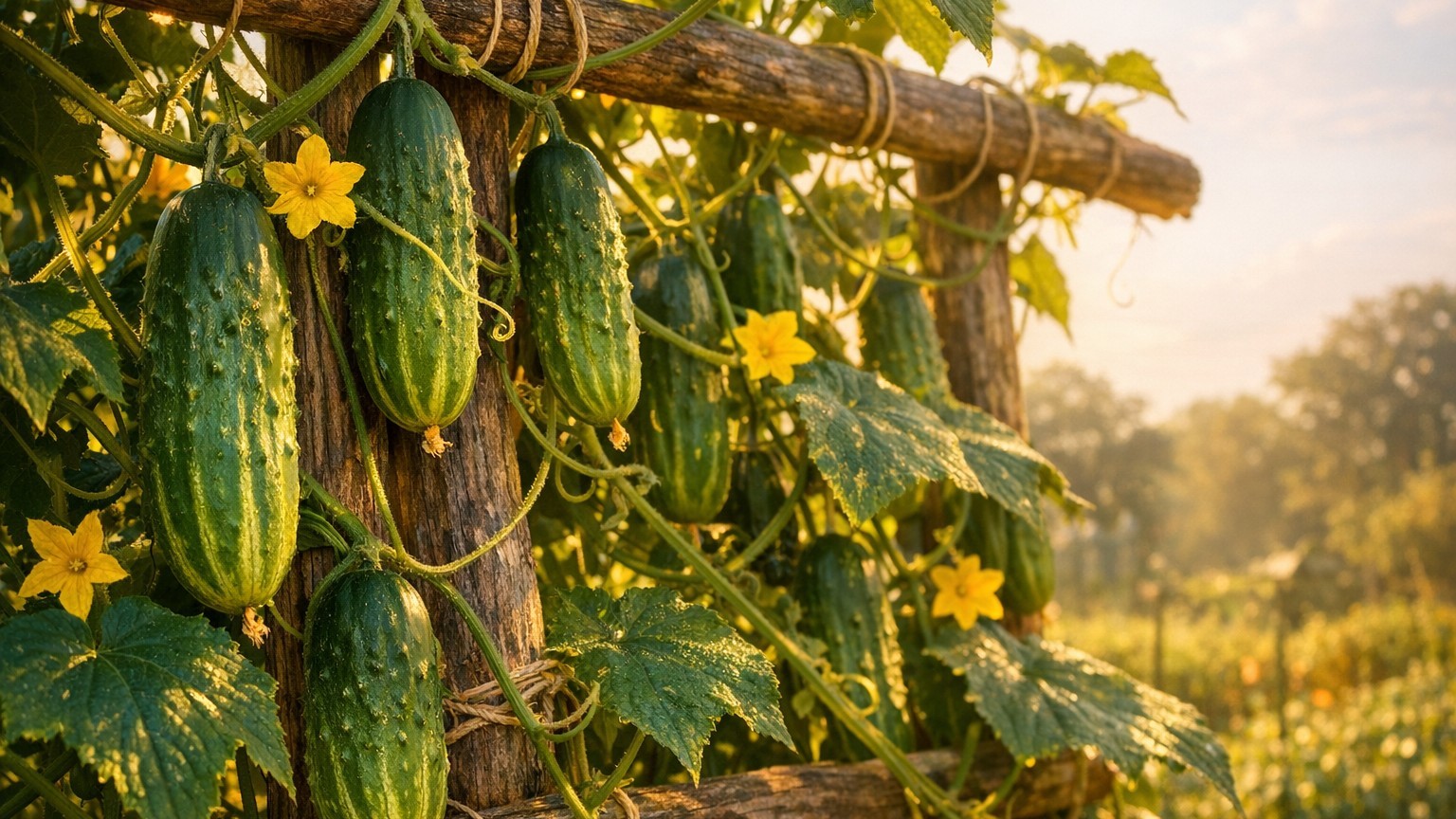

Georgia gardeners get a long window for cucumbers, often long enough for two full plantings, but the state’s heat load changes which types actually finish well. Slicing and pickling varieties bred for heat and disease tolerance outperform anything marketed simply as “productive” once August humidity and 90-degree stretches set in.
The short answer for Georgia
Georgia’s frost-free window runs from roughly March 11-29 in spring to November 13-December 1 in fall, based on NOAA’s 1991-2020 normals for the Atlanta reference station. That’s a stretch of eight months or more without a freeze in most years, which is plenty of room for two cucumber crops: one seeded after the last spring frost date passes, and a second started in mid to late summer for a fall harvest before the first frost arrives.
The number that actually decides which types belong in that window is 35.8, the average number of days per year that hit 90 degrees Fahrenheit or higher at the Atlanta station. That’s a heavy heat load spread mostly across June, July and August, and cucumbers respond to it in specific ways: pollen viability drops, blossoms can abort, and fruit set slows during the hottest stretches. Types bred for heat tolerance and continued fruit set under stress, whether slicing, pickling, or the long burpless types often grown in humid climates, hold up better through a Georgia July than standard varieties selected mainly for cool-climate yield.
Space and disease pressure matter almost as much as heat. Georgia’s summer rainfall, about 13.6 inches across June through August, keeps humidity high even in a dry stretch, which favors powdery mildew and downy mildew on cucumber foliage. Varieties bred with resistance to those two diseases specifically are worth prioritizing over ones chosen for size or novelty alone. Vining types trained up a trellis get airflow that bush types sitting close to wet soil don’t, so the growth habit you choose interacts directly with the humidity problem, not just with how much garden space you have.
Put plainly: for most of Georgia, the working formula is a heat-tolerant, disease-resistant slicing or pickling type, planted after the last frost date for your area and trellised where possible, with a second sowing in mid to late summer timed to mature before the first fall frost. The exact cultivar names that perform best change from year to year and from county to county as new trials come in, so the University of Georgia Cooperative Extension is the source for which specific varieties are currently recommended, not a general guide like this one.
What will not work here

Long-season cucumber types that need an extended stretch of mild, moderate weather to mature don’t fail because Georgia’s frost-free window is too short, it isn’t, they fail because they’re still trying to set fruit in the hottest weeks of July and August, when the 35.8 annual days above 90 degrees cluster most heavily. A plant that would finish comfortably in a cooler climate can stall out here, dropping blossoms during the peak heat instead of converting them to fruit.
Watering on a weekly schedule
Georgia’s summer rainfall averages only 4.3 to 4.75 inches per month across June, July and August, with August, the hottest stretch, being the driest of the three. That rain rarely arrives as a steady soak. It tends to come as thunderstorms that dump water fast enough to run off rather than sink in, especially on compacted or clay soil. Combine that pattern with 35.8 days a year of 90-degree heat driving evaporation, and a cucumber bed watered once a week on a fixed schedule will run short during exactly the stretch when the plant needs consistent moisture most, right as fruit is sizing up. Cucumbers with shallow root systems show stress fast under that kind of gap, going bitter or misshapen.
Tight spacing on the ground
Humidity from that same summer rainfall doesn’t evaporate quickly once it settles into a dense planting. Bush-type cucumbers spaced close together, with vines resting directly on wet soil, create the still, damp air that powdery mildew and downy mildew both need to spread. A trellised vine with space around it dries out within an hour or two of a storm; a tangle of bush plants on the ground can stay damp for a day. That’s the difference between a plant that shrugs off a wet August and one that’s defoliated by mid-summer.
Sowing a second crop too late compounds all of this. Seed dropped in early July has to survive the worst of the heat load just to germinate and flower, right when blossom drop is most likely. Waiting until temperatures ease slightly in later summer, while still leaving enough days before the first fall frost around November 13 to December 1, is the narrower and more reliable window.
What changes across Georgia
Georgia is not one garden, and the numbers above don’t apply evenly from the mountains to the coast. The USDA Plant Hardiness Zone Map places the state across zones 6a to 9b, a spread built entirely on average annual extreme minimum winter temperature. That’s a wide enough range that a planting decision timed for one end of the state can be flatly wrong for the other.
The frost dates cited here come from the Atlanta reference station, and Atlanta sits in an urban heat island that runs warmer than much of the surrounding state. North Georgia and the mountain counties, generally the cooler end of that 6a to 9b range, see their first fall frost arrive several weeks earlier than the Atlanta date and their last spring frost linger later. A second summer planting timed off the Atlanta window can get caught by an early frost up there before it ever finishes.
The coastal plain, at the milder end of the range, runs the opposite direction. Frost arrives later in fall and clears earlier in spring, stretching the usable window well beyond what the statewide average suggests and giving more room for a later second sowing or an earlier first one.
There is no single planting date, or single best type, that fits both ends of that spread. A gardener in the mountains is working with a shorter season and cooler nights even in midsummer, which eases heat stress on cucumbers but shortens the calendar for getting two harvests in. A gardener near the coast has more calendar room but a longer stretch of heavy heat load to manage. Neither of those adjustments comes from this page. They come from knowing which end of the 6a to 9b range a given county sits in, and that’s a question for the hardiness zone map, not a guess based on which region sounds warmer.
Where to check this for your own county
The University of Georgia Cooperative Extension is where the state-level ranges in this article get replaced by county-specific numbers. That’s the meaningful difference: this page describes Georgia as a whole, using one reference station’s frost dates and one statewide hardiness zone range, but a county office works from local trial data and local frost records that this page simply doesn’t have.
Two things are worth pulling from the extension site specifically. First, the local planting calendar for vegetables, which will adjust the spring and fall sowing windows described here to the actual frost pattern of your county rather than the Atlanta station’s. That adjustment matters most for anyone in the mountains or along the coast, where the statewide frost dates cited earlier can be off by weeks in either direction. Second, the list of cucumber varieties currently recommended from county-level trials. Those lists change as breeders release new disease-resistant lines and as older ones fall out of favor, so a variety recommendation from a few years back may already be outdated even if the general type, slicing versus pickling, vining versus bush, still applies.
A county extension office can also answer questions this article can’t: which specific powdery mildew or downy mildew pressure has shown up locally in recent seasons, and which resistant varieties have actually performed under it nearby. That’s the kind of on-the-ground detail that a statewide page, built from climate normals and a hardiness zone map, was never going to have. Treat this article as the broad framework and the county office as the correction.
Checking this against your own garden
None of the dates or averages above beat what’s actually happening in a given yard, and cucumbers give a gardener three fairly obvious signals worth checking before trusting a calendar over the plant itself.
Soil warmth by feel is the first. Cucumber seed germinates poorly in cold soil no matter what the calendar says about the last frost date having passed. Pushing a finger a couple of inches into the bed and finding it consistently warm, not just sun-warmed on the surface, is a better sign that germination will go well than the date on a seed packet.
The first flush of male flowers is the second. Cucumbers typically produce male blossoms before female ones, and a heavy early show of males with no females yet is normal, not a failure. It signals the plant is gearing up but not yet ready to set fruit, which matters for judging whether a heat wave arriving that week is going to hit the plant during a vulnerable pollination stage or before it’s even started flowering.
The appearance and vigor of the first true leaves, the ones that show the characteristic cucumber shape rather than the rounder seedling leaves, is the third. Slow, pale true leaves after a normal germination usually point to a microclimate issue, cold soil, poor drainage, or too much shade, that no amount of adjusting planting dates will fix. That’s the plant reporting on conditions specific to that exact bed, which is information no regional average can offer.