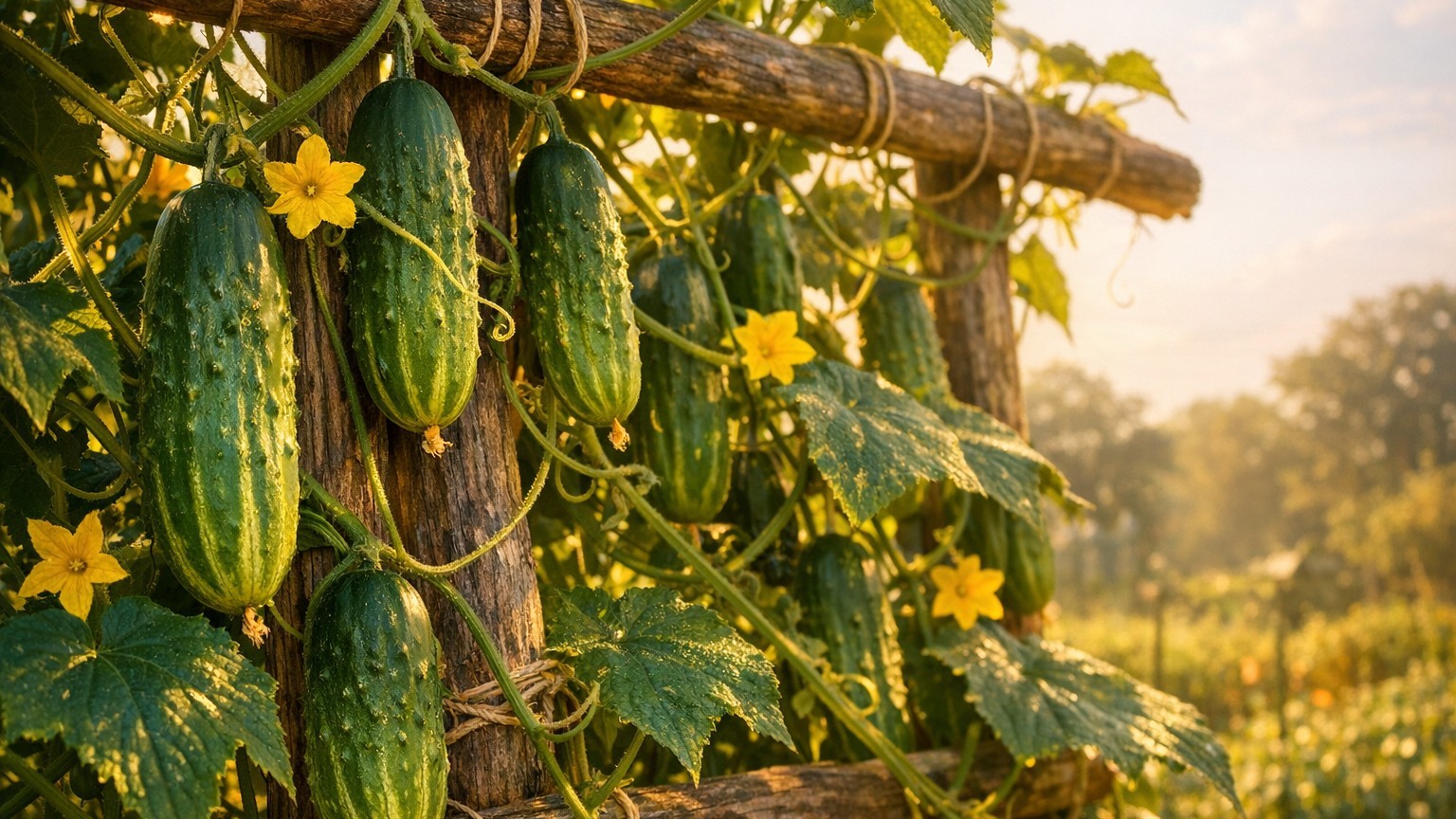

The right cucumber choice for Indiana comes down to type, not brand name. With a frost-free window that typically runs from late April to late October and a moderate heat load, most home gardeners here do best with a mix of a compact bush type for containers or raised beds and a trellised vining type for volume, chosen with humidity management in mind.
The short answer for Indiana
Indiana’s growing season gives cucumbers plenty of room to work. The last spring frost at the Indianapolis reference station falls somewhere between April 9 and April 21, and the first fall frost arrives between October 21 and October 30. That’s a probability band, not a guarantee, but even at the tighter end, a garden here gets roughly six months of frost-free weather. Cucumbers don’t need anywhere close to that much time, so season length isn’t the constraint that should drive variety selection in this state. Heat and humidity are.
The reference station logs an average of 14.6 days a year at 90F or hotter. That’s a moderate heat load, enough to stress cucumber vines during a dry stretch but not the punishing, weeks-long heat of the Deep South or the Southwest. Combine that with roughly 12.6 inches of rain across June, July and August (June and July each bring close to 5 inches, August drops to about 3.2), and the picture is a summer that’s warm but not brutally hot, with rain that’s plentiful early and thinner by August.
Given that pattern, the decision by type looks like this. A bush-type pickling cucumber makes sense for anyone gardening in a raised bed, a large container, or a small backyard plot, because its compact habit keeps foliage more open to air movement, which matters when June and July are delivering nearly 5 inches of rain apiece. A vining slicing cucumber trained up a trellis or cage suits gardeners with more space and gives better airflow around the leaves than letting vines sprawl on damp ground. A parthenocarpic type, meaning one that sets fruit without pollination, is worth considering for an early planting under row cover, since it can go out slightly ahead of the last frost date without needing pollinators to be active yet. Burpless or Asian-style long-fruited types do fine here too, provided they get consistent moisture through the driest weeks of August.
None of these are brand names, and that’s deliberate. The specific varieties that perform best in a given Indiana county change from one seed catalog year to the next, and the state’s own extension service tracks which ones hold up in local trials. What doesn’t change is the logic: pick the type that matches your space and your tolerance for disease pressure, then let Purdue Extension point you to the named variety that’s proven itself locally.
What will not work here

Season length isn’t Indiana’s problem, so don’t let a supposed shortage of time push you toward a compressed, rushed planting schedule. The mistake that actually costs gardeners a harvest here is mismatching cucumber habit to the rainfall pattern. June and July each bring close to 5 inches of rain at the reference station. A bush-type cucumber sprawled directly on soil, with fruit and lower leaves sitting in near-constant contact with wet ground through those two months, is exactly the setup that invites powdery mildew and downy mildew. Both diseases thrive where humidity lingers on foliage, and Indiana’s early-summer rain totals create that environment reliably enough that “just let it sprawl” is a bad plan for anyone without excellent air circulation.
Weekly watering schedules also tend to fail in this state, but not for the reason gardeners expect. August, the hottest stretch when several of those 14.6 annual 90-degree-plus days cluster, is also the driest summer month, averaging only about 3.2 inches. A cucumber plant that’s been coasting on abundant June and July rain can hit a wall in August when rainfall drops by roughly a third and evaporation is at its yearly peak. A once-a-week watering habit built during a wet June won’t carry a plant through a dry, hot August without stress, blossom drop, or bitter fruit.
Direct-seeding cucumbers on the earliest edge of the frost-free window is another way to lose a planting. Purdue’s own data flags roughly a 10% chance of a 32F freeze event even after the published spring frost date passes. Cucumbers are frost-tender at every growth stage; a tender seedling caught by that lingering 10% risk simply dies. Anyone planting early, whether to get a jump on the season or to double-crop, needs row cover on hand and a plan to use it, not just an optimistic reading of the calendar.
Finally, a cucumber type bred for arid, low-humidity climates, chosen because a catalog description sounds appealing, is a poor fit for Indiana’s wetter early summer. That’s a decision better left to a trial list from a local source, covered next.
What changes across Indiana
Indiana is not one garden, and the hardiness zone data makes that plain. The USDA Plant Hardiness Zone Map places the state across a spread from 5b to 7a. That’s a meaningful range built on a single measurement, the average annual extreme minimum temperature, and it tells a gardener in the far north of the state to expect a colder winter low than a gardener near the Ohio River. There is no single answer for “when is it safe to plant” that covers both ends of that spread.
The frost dates cited earlier come from the Indianapolis reference station, roughly in the middle of the state. But the caution attached to that data is direct: southern Indiana runs earlier in spring and later in autumn than the north by a fortnight or more. A gardener near the Kentucky border can often set cucumbers out something like two weeks ahead of a gardener near Michigan’s border, and can expect the growing season to stretch two weeks longer into fall as well. That’s close to a month of difference in usable growing time between the state’s two ends, which is a bigger swing than most gardeners assume when they picture “Indiana” as a single climate.
This matters most for the early-planting decisions covered above. A gardener in the northern tier weighing a parthenocarpic type under row cover for an early start should expect that gamble to carry more risk than the same gamble made in the southern third of the state, purely because the frost window closes later there in spring. None of this means a reader should try to guess their own zone from a state-level range. The zone spread here spans two full USDA zones and part of a third; the only way to know which end of that spread applies to a specific address is to check the map directly rather than infer it from a regional description.
Where to check this for your own county
Everything in the section above is a state-level picture, built on one reference station and a statewide hardiness range. A county-level recommendation will always beat it, and Indiana has one available through Purdue Extension. That’s the address to bookmark, not a generic search result.
Two things are worth looking for once there. The first is a local planting calendar, since county-level offices and the county-specific pages Purdue publishes often refine the statewide frost window into something tighter and more useful for a specific address, especially valuable for anyone gardening near the northern or southern edge of the state where the fortnight-or-more spread described above actually plays out. The second is a list of cucumber varieties trialled in Indiana conditions, which is exactly where the specific cultivar names this page deliberately avoided should come from. Extension trial data reflects actual disease pressure, actual humidity, and actual local growing seasons in a way a seed catalog description never can.
This distinction matters more for cucumbers than for many crops, because the disease pressure discussed above, powdery and downy mildew driven by Indiana’s wetter early summer, varies by county depending on local humidity, soil drainage, and even how tightly gardens are packed together in a neighborhood. A variety that resists mildew well in one trial region may perform differently thirty miles away. County-specific guidance accounts for that in a way a statewide answer structurally cannot. Treat this page as the broad framework, and treat the county-level page as the actual planting plan.
Checking this against your own garden
None of the dates or averages above outrank what a gardener can observe directly on their own soil, and cucumbers give clear, low-tech signals worth learning to read.
Soil warmth by feel is the first and most reliable check. Cucumber seed germinates poorly in cold soil, regardless of what the calendar says about the last frost date having passed. Pressing a hand into the planting bed each morning for a week gives a real sense of whether the ground has actually warmed past the point of sluggish, uneven germination, which matters more in a cool, wet spring than any fixed date does.
The first flush of male flowers is the second signal, and it tells a gardener something the frost data can’t: whether the plant itself considers conditions favorable enough to begin reproducing. Cucumbers typically produce a run of male flowers before the female flowers, with their tiny embryonic fruit visible at the base, appear. A long delay between the two, or male flowers that drop without female flowers following, often points to heat or moisture stress rather than anything wrong with the seed or variety.
The appearance and condition of the first true leaves, the leaves that emerge after the rounded seed leaves, is the third check. Pale, slow-to-expand true leaves usually mean the soil was still too cool or nutrient-poor when the seed went in, while true leaves that emerge with dark, dry margins during a hot stretch are an early warning that watering needs to increase before August’s drier stretch arrives, not after.