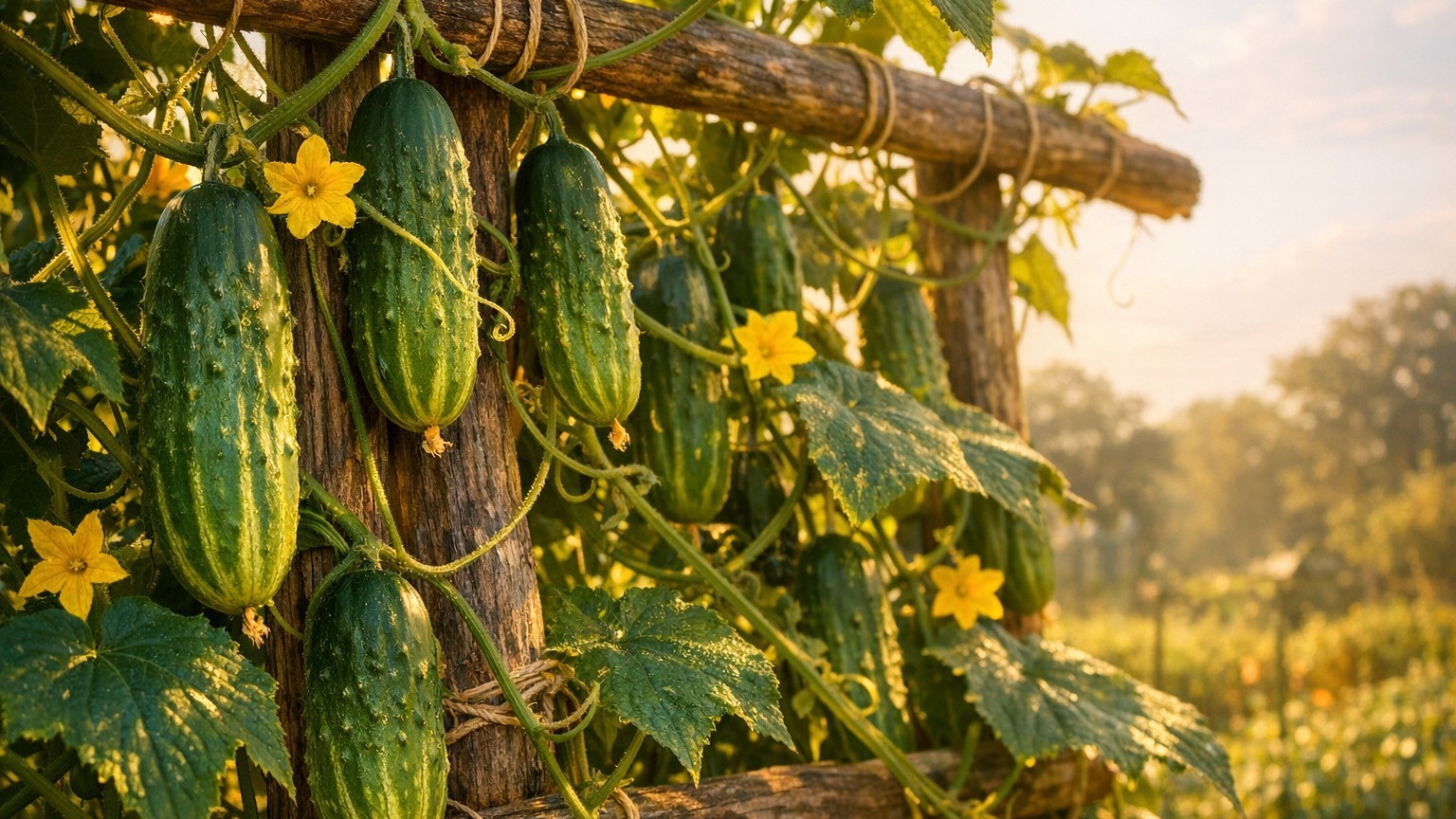

Kansas summers push cucumbers hard, and that’s what should drive variety choice more than anything else. Pick heat-tolerant slicing, pickling or burpless types, favor bush forms for small beds and containers, and lean on parthenocarpic types when pollinators disappear during the hottest stretches. Check K-State Research and Extension for the specific names trialled in your county.
The short answer for Kansas
Season length isn’t the limiting factor
At the reference station, the last spring frost falls between April 4 and April 18, and the first fall frost arrives between October 23 and November 2. That’s a window of roughly 189 to 212 days between the two dates, more than enough time to mature almost any cucumber type sold in the region, whether it’s a quick pickling cucumber or a longer slicing type. So season length is not what should decide your choice in Kansas. Something else is.
Heat load is what actually decides
The reference station averages 57.6 days a year at or above 90F. That’s the number that separates a productive cucumber patch from a frustrating one. Cucumber plants stop setting fruit reliably once daytime heat climbs past that threshold for stretches at a time, and existing fruit can turn bitter or misshapen under sustained heat stress. This is why the smarter approach is to think in types rather than names:
- Bush types for raised beds, containers, or anywhere space and airflow are limited, since a compact plant is easier to keep watered evenly through a heat spell.
- Pickling types if you want a shorter, more concentrated harvest window that finishes before the worst of midsummer heat sets in.
- Slicing types bred or selected for heat tolerance, since standard slicers can shut down fruit set once daytime highs stay elevated for days running.
- Parthenocarpic (self-fruiting) types that don’t depend on bee pollination, useful because pollinator activity often drops during the hottest afternoons of a Kansas July or August.
None of these categories are guesses. They follow directly from the 57.6-day heat figure. What they don’t tell you is which specific variety performs best in your soil, your slope, your microclimate. That’s a local trial question, and it belongs to K-State Research and Extension, not to a statewide article. A second, staggered planting timed to mature after the hottest weeks can also help you dodge the worst of the heat load rather than fighting through it with a single spring planting.
What will not work here

Long-season types bred for cooler climates
Cucumber varieties developed for regions with mild, cloudy summers (the kind common in parts of the Pacific Northwest, for instance) are often selected for flavor and disease resistance under moderate heat, not for holding up through weeks that top 90F. Planted in Kansas, these types can drop blossoms mid-summer, produce fewer fruit per plant, and turn bitter under stress even when watered adequately. The problem isn’t the calendar. It’s the thermometer. With 57.6 days a year crossing that 90F line, a variety that’s never been tested against that kind of heat load is starting at a disadvantage before it even germinates.
A once-a-week watering habit
Summer rainfall across June, July and August averages about 13.2 inches at the reference station, with July running driest at just 3.98 inches. That sounds like a reasonable cushion until you factor in the heat load. Days above 90F increase evaporation fast, and rain that falls as a single thunderstorm tends to run off rather than soak into the root zone, especially on compacted or clay-heavy soil. A gardener watering once a week on the assumption that “13 inches over the summer” is enough will often find fruit turning bitter, curling, or stopping growth altogether, because the soil dried out days before the next watering. Cucumbers have shallow, thirsty root systems, and in a dry July stretch they need moisture checked more like every two to three days, not once a week, particularly in sandy soil that drains fast.
Dense planting with no airflow
Letting vining types sprawl thick across the ground, packed close together, traps heat at soil level and slows airflow around the leaves. Combined with the heat stress already discussed, that setup makes plants more prone to powdery mildew and stalled fruit set during the hottest weeks of summer. Trellising, even for vining types, gives better air movement and easier access for watering and harvest.
What changes across Kansas
A three-zone spread, not one climate
Kansas spans USDA Hardiness Zones 5b through 7a, using the USDA Plant Hardiness Zone Map system, which is built on one variable: the average annual extreme minimum winter temperature. That’s a wide spread for one state, and it means there is no single frost date, no single “safe to plant” moment that applies everywhere from the state’s coolest corner to its warmest. The frost dates cited earlier come from one reference station; a garden in a cooler zone within the state should expect a later last spring frost and an earlier first fall frost than that reference point, sometimes by a week or two, and more at higher elevation.
What shifts for a reader at the cooler end
If your area sits toward the cooler end of that 5b-7a range, or at higher elevation, plan on a shorter effective growing season than the reference station’s 189 to 212 day window, and hold off starting seedlings outdoors until soil has reliably warmed. If your area sits toward the warmer end, you’re closer to the reference figures, but you may also see the heat-load days climb even higher than the 57.6-day state figure, making the water-management point above even more pressing. Neither end of that range can be assigned by this page. The USDA map itself is the tool for placing your own garden inside that 5b-7a spread; this article can only describe the range, not tell you where inside it you fall.
Where to check this for your own county
K-State Research and Extension is the next step
Everything above is built from statewide and reference-station data. A county-level recommendation from K-State Research and Extension will beat this page every time, because it accounts for your local soil, your local frost history, and the varieties that have actually been trialled near you rather than at an airport weather station somewhere else in the state.
What to look for once you’re there
Search for your local county extension office’s vegetable planting calendar, which will give a sowing window built from local frost data rather than the reference-station range cited here. Also look for any variety trial results or recommended-variety lists specific to vegetable gardens in your county; these are the closest thing to a tested answer for cucumbers in your exact conditions, and they’ll go further than any type-based guidance this page can offer. If your county office doesn’t publish its own list, K-State’s statewide horticulture publications are the next best source, still a step more detailed than a general territory page like this one.
Checking this against your own garden
Three things worth watching before you trust any calendar
No planting date or variety type on this page outranks what your own garden tells you. Three signs are worth tracking by hand, without any special equipment:
- Soil warmth by feel. Cucumber seed germinates poorly in cold soil. If a handful of soil at planting depth still feels cool and damp rather than warmed by the sun, wait, regardless of what the calendar says.
- The first flush of male flowers. Cucumbers typically produce male blossoms before female ones. Watching for that first flush tells you the plant has shifted into reproductive growth, and it’s a better real-time signal of readiness than a date on paper.
- The timing of the first true leaves. The first set of leaves after the seedling’s initial round leaves marks the point the plant is drawing more seriously on soil moisture and nutrients, a useful cue for when to start a regular watering rhythm rather than sporadic checks.
Track these two or three seasons running on your own plot, and you’ll have a more reliable, site-specific calendar than any reference-station frost date can offer, no matter how carefully sourced.