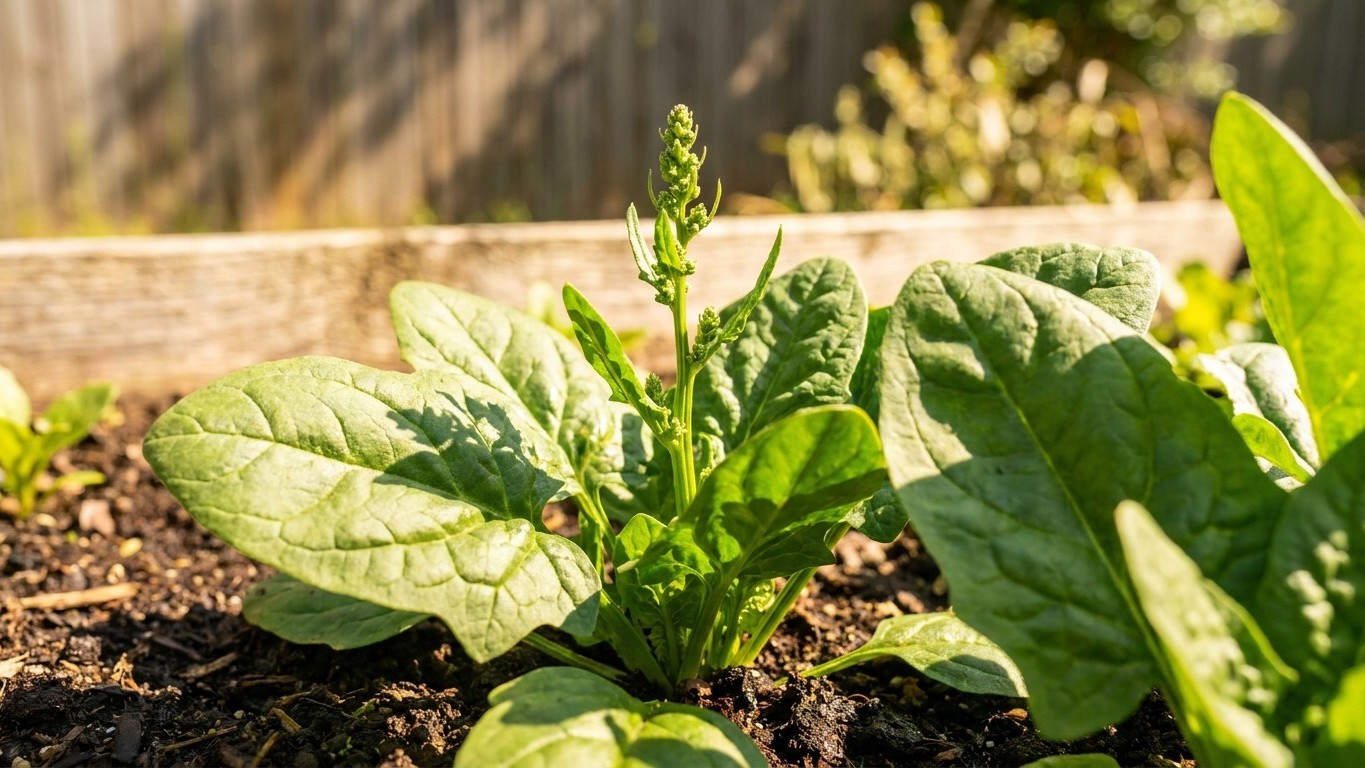

Two insects in Connecticut have any real business on a spinach leaf: cutworms that sever young seedlings near the soil line, and four-lined plant bugs that stipple older leaves with small sunken spots. Cutworms strike close to the last spring frost, four-lined plant bugs later as the plant nears its bolting point. UConn Extension documents no other insect feeding on this crop in the state’s home gardens.
Which pests attack spinach in Connecticut

UConn Extension documents ten pests across the state’s home gardens: Allium leafminer, Brown marmorated stink bug, Colorado potato beetle, Cutworms, Four-lined plant bug, Japanese beetle, Lily leaf beetle (Lilioceris lilii), Squash bug (Anasa tristis), Squash vine borer (Melittia cucurbitae), and Striped cucumber beetle (Acalymma vittata). That is the full list for the state. It is not a spinach list, and most of it has no connection to a spinach bed at all.
Allium leafminer tunnels in onions, garlic, and leeks, plants that share nothing with spinach botanically or in leaf structure, so there is no route from that insect to a spinach row. Colorado potato beetle is tied to nightshades: potato, eggplant, tomato. Squash bug, squash vine borer, and striped cucumber beetle all need cucurbits, squash, cucumber, melon, and simply have no reason to cross into a leafy green bed. Lily leaf beetle is a specialist on true lilies and fritillaria; it will strip a lily plant bare and ignore everything else in the same garden. Brown marmorated stink bug and Japanese beetle both have broad host ranges on paper, fruiting crops and orchard trees for the stink bug, roses and grapevines for the beetle, but neither is documented feeding on spinach’s thin, low-growing rosette.
That leaves cutworms and four-lined plant bugs as the two pests on this list with any documented reason to visit spinach. Cutworms are generalist soil-dwelling caterpillars that clip seedling stems of many vegetables, spinach included, at ground level. Four-lined plant bugs feed on a wide range of soft-leaved herbaceous plants, and spinach leaves fit that profile. Neither is a spinach specialist. Both are opportunists that happen to include spinach in a much longer host list.
The short list is worth sitting with for a moment. It does not mean spinach in Connecticut is pest-free, it means the extension service has not built a documented record here beyond these two. A bed can still show unfamiliar damage that simply has not been catalogued at the state level, which is a separate problem from the one this page can answer.
When each one shows up, and what it does first
Cutworm damage tracks the earliest planting window, the stretch right after the state’s last spring frost, which falls between April 2 and April 12 at the reference station (earlier inland and in the northwest hills). Spinach seed goes in as soon as soil can be worked around that date, and cutworms are active in the same soil at the same time. The first sign is not a chewed leaf, it is a missing plant: a seedling that stood the evening before is lying flat, or gone, with the stem severed cleanly at the soil surface. Check at night with a flashlight or dig an inch of soil around a felled seedling; the caterpillar is usually still there, curled.
Four-lined plant bug shows up later, as the plant bulks up toward its bolting point rather than at the seedling stage. Spinach grows best where temperatures stay under 75 F, and that same 75 F line marks where the crop turns bitter and starts to bolt under long days. The plant bug’s feeding window overlaps that stretch of the season, on established leaves rather than seedlings. The first sign is small, round, translucent spots on the upper leaf surface, almost like a spray pattern, that dry out and turn brown or papery within a day or two. Damage tends to cluster on a few leaves rather than spreading evenly across the plant.
The fall crop follows a different clock. Utah State University Extension’s guidance is to sow spinach 50 to 75 days before the date you want to harvest, counting backward from the first fall frost window of October 28 to November 10. That planting has to wait for soil to cool, since germination drops once soil runs above 80 F, so the fall sowing date moves with the end of summer heat, not with a spot on the calendar. Cutworms can turn up again around that fall seeding if the soil is still warm and moist enough to hold them; four-lined plant bug activity generally tapers as day length shortens.
Telling the damage apart from everything else
Spinach fails in more ways than two insects can explain, and the least useful thing a gardener can do is blame a bug for something a bug never touched. Bolting is the biggest false alarm: long days combined with warmth push the plant to send up a tall central stalk with arrowhead-shaped leaves and a bitter taste, and it has nothing to do with insect feeding. No pest produces that stalk-and-flower shape.
| What you see | Likely cause | What sets it apart |
|---|---|---|
| Seedling toppled, stem cut at soil line | Cutworm | Stem severed cleanly; larva often found in surrounding soil |
| Small round translucent-then-brown spots on upper leaves | Four-lined plant bug | Spots stay round and clustered, not spreading edges |
| Tall central stalk, arrowhead leaves, bitter flavor | Bolting from long days and heat | No chewing marks, no missing tissue, whole plant changes shape |
| Yellowing on older, lower leaves first | Nutrient deficiency | Progresses evenly leaf by leaf, no holes or spots |
| Wilting despite moist soil, thin leaf texture | Heat or water stress | Recovers overnight when temperatures drop |
| Torn or shredded leaf edges | Wind, hail, or foot traffic | Damage matches direction of weather or contact, not a feeding pattern |
None of this is a substitute for a look at the actual plant. A torn leaf, a discolored spot, and an insect bite can resemble each other in a photo far more than they do in person, and a local extension office sees far more of this than any general description can cover.
What actually works here, and what is a waste of time
Timing beats intervention on a season this short. A floating row cover set over the bed at the moment of seeding or transplanting, and left on through the seedling stage, keeps cutworm moths from laying eggs near young plants and blocks four-lined plant bugs from landing on leaves later. Spinach does not rely on pollinators to set seed for eating, so the cover can stay on longer than it could on a fruiting crop that needs bees to reach the flowers. A simple stem collar, a strip of cardboard or a cut can pushed an inch into the soil around each seedling, stops cutworms cold without covering the whole bed.
Checking soil temperature before the fall sowing is worth more than any spray decision later. Since germination drops once soil runs above 80 F, sowing into soil that has not cooled is a wasted planting regardless of what pest pressure looks like. Utah State University Extension names four spinach varieties for home gardens, Bloomsdale, Melody, Teton, and Olympia, but publishes no days-to-maturity figures or pest-resistance data for any of them, so switching varieties will not change the pest picture described here.
What wastes time: treating a bolted plant as though it were pest-damaged. Bolting is a physiological response to day length and heat, not something a treatment reverses, and by the time the central stalk appears the plant’s eating quality has already dropped. This site does not name pesticide products or active ingredients for this crop; what is legal to use in Connecticut, and on what schedule, is a question for a licensed source, not a garden article.
Where to check this for your own county
The record behind this page comes from UConn Extension, and that is the right first call for anything specific to a Connecticut garden. The state-level list of ten pests says what has been documented somewhere in Connecticut, not what is present in any one yard, and a county’s coastline, elevation, and soil can shift that picture noticeably. The reference frost dates used here come from a Long Island Sound coastal station, the mildest part of the state; inland and northwest Connecticut freeze earlier in fall and thaw later in spring, which shifts both the seeding window and the stretch when cutworms are active.
A county extension office can confirm whether cutworm or four-lined plant bug activity has actually been reported nearby this season, and can look at an actual leaf or seedling rather than a general description. That local check is worth more than any state-wide list, including this one, because pest pressure moves county to county and even bed to bed within the same yard.
The next step is straightforward: bring a sample, or a clear photo, to the local UConn Extension county office before assuming which of the two documented pests, if either, is responsible.
Common questions
Do slugs or snails attack spinach in Connecticut?
Neither appears in the pest list UConn Extension documents for the state. A gardener seeing ragged holes with slime trails should treat that as a separate question for the local extension office, since it falls outside what this page can confirm.
Can spinach be grown right through a Connecticut summer?
No. Spinach bolts under long days and warmth and grows best under 75 F, and the state’s summer daylight runs to 14 hours 58 minutes on the longest day, well past the length that triggers flowering in this crop. Spring and fall, framed by the frost windows above, are the workable stretches.
Cutworm control has nothing to do with soil temperature; a collar around the stem works whether soil is warm or cool.
Does row cover need to come off for spinach to produce a crop?
Not for the reason it would on a squash or cucumber bed. Spinach does not need insect pollination to be harvested as a leaf crop, so a cover can stay in place through the seedling and growing stage without blocking yield.
Is a mid-summer spinach planting worth trying in a cooler pocket of the state?
The bolting trigger is day length as much as heat, so a shadier or cooler spot delays but does not cancel it. The more reliable path is the fall sowing, timed 50 to 75 days ahead of the first frost window, once soil has cooled below the point that slows germination.