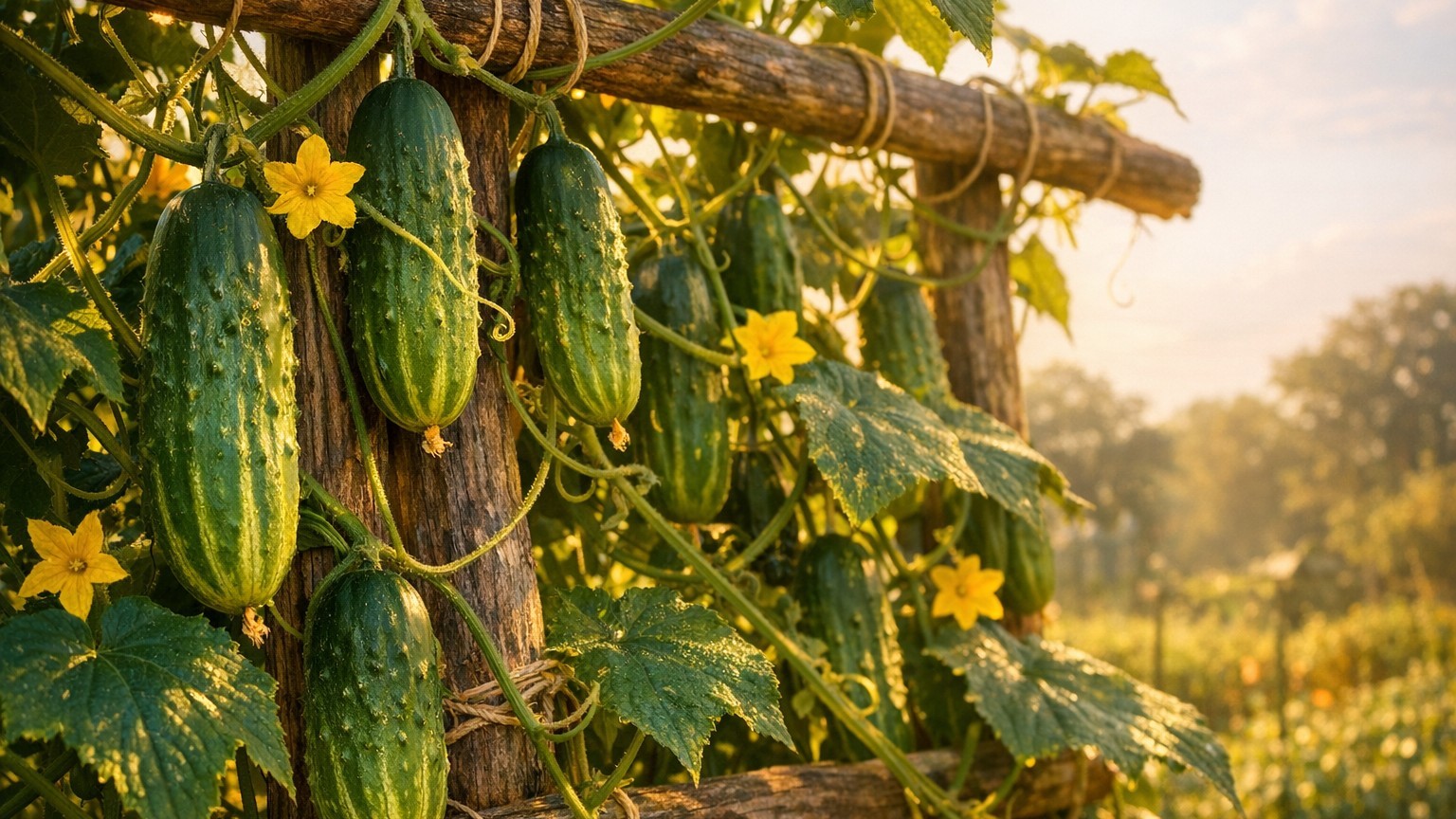

The best cucumber types for Massachusetts are pickling and bush varieties for gardeners with a shorter inland season, and full-size vining slicers or burpless types for anyone gardening near Boston or the coast, where the frost-free window runs longest. The right pick depends less on flavor and more on how many warm days your yard actually gets.
The short answer for Massachusetts
Start with the two numbers that matter most: the frost dates and the heat load. NOAA’s 1991-2020 climate normals put the last spring frost in the Boston area between April 1 and April 8, and the first fall frost between November 3 and November 14. That’s a frost-free window that can stretch past seven months at the mildest station. But that station, Logan, sits on the waterfront in the warmest corner of the state, and inland yards or higher ground will see spring frost linger later and fall frost arrive earlier, shrinking that window from both ends.
The heat side of the equation tells a different story. Boston averages only 10.2 days a year at or above 90°F. That’s a moderate heat load, nowhere near what a Deep South garden handles. Cucumbers set fruit poorly once nighttime temperatures stay too warm for too long, but that’s simply not a Massachusetts problem. The limiting factor here is season length, not heat stress.
Put those two facts together and the type of cucumber matters more than the name on the seed packet. Full-size vining slicers, the kind that need a trellis and a long run of warm weeks to size up, do fine anywhere close to the coastal frost dates above. Inland gardeners working with a shorter window between frosts should lean toward bush or pickling types, which set fruit faster and don’t need as many weeks on the vine.
Burpless and Asian-type cucumbers, usually grown on a trellis, are worth considering specifically because of the state’s rainfall pattern discussed below: getting the vine up off the ground reduces the fungal pressure that comes with humid summers. Parthenocarpic types, which set fruit without pollination, are useful for gardeners who want to get an early start under row cover while spring frost risk is still active, since they don’t depend on outdoor pollinators being active yet.
None of this is a cultivar recommendation. Seed catalogs change their lineups every year, and the specific varieties that perform well in a Springfield garden aren’t necessarily the ones trialed for the Cape. The move is to pick the type that fits your season length and heat load, then check the UMass Extension trial results for named varieties proven in your part of the state.
What will not work here

Cucumber types bred for long, blazing-hot growing seasons struggle here, and the mismatch is a numbers problem, not a taste problem. A vine that expects weeks of 90-plus heat to size its fruit properly gets only 10.2 such days a year in the Boston reference data. Inland and upland spots likely see fewer. The fruit sizes slowly, foliage stays under fungal pressure longer than it should, and by the time the vine hits full stride, the season’s already turning.
Long-maturity vining types are a real risk for anyone gardening away from the coast. The frost-free window at the reference station runs from early April to early-to-mid November, but that’s the mildest spot in Massachusetts. Push inland or up in elevation and both ends of that window close in: spring frost lingers longer, fall frost shows up earlier. A cucumber that needs its full run of warm weeks to finish sizing can get caught by a hard frost before the harvest is done, especially in a cooler pocket of the Berkshires or a low-lying inland valley.
Sprawling ground-grown types are a poor match for this state’s summer rainfall pattern. June through August normals run 3.89, 3.27, and 3.23 inches respectively, which sounds modest, but that rain rarely falls as a gentle soak. It tends to arrive as thunderstorm bursts that run off rather than sink in, leaving foliage wet and soil surface humid in between. Vines left flat on the ground, with leaves and developing fruit in contact with damp soil, are exactly the setup that invites powdery mildew, downy mildew, and fruit rot in a humid Northeast summer. That’s a stronger argument for a trellis in Massachusetts than it would be in a drier climate.
A once-a-week watering habit also fails here more often than gardeners expect. August, the driest summer month at 3.23 inches, combined with those 10.2 days of 90-plus heat, means evaporation demand can outpace a weekly soak, particularly on sandy soil that drains within a day. A single storm that dumps an inch doesn’t erase a week-long dry stretch that follows it.
Finally, seeding any cucumber type too early, before soil has actually warmed past the last frost risk, rots the seed in the ground regardless of what type it is. The April 1-8 window is a 30-70% frost probability band, not a guarantee, and jumping ahead of it is a season-length problem no variety solves.
What changes across Massachusetts
Massachusetts is not one garden, and the USDA hardiness zone data makes that plain: the state spans zones 5a through 7b. That’s the range built from average annual extreme minimum winter temperatures, not a growing-season measurement on its own, but it’s a useful marker of how differently the state’s regions behave. A 5a pocket in the Berkshires and a 7b spot on Cape Cod or the Islands are, climate-wise, closer to different states than to each other.
The practical effect for cucumber growing shows up at both ends of the season. In the colder, higher-elevation western zones, expect the last spring frost to run later than the April 1-8 window recorded at the coastal reference station, and the first fall frost to arrive earlier than the November 3-14 window. That combination trims real growing weeks off both ends, which pushes those gardeners further toward bush and pickling types, plus tools like black plastic mulch or row cover to bank a few extra warm days.
Closer to Boston and along the southeastern coast and Islands, in the milder 7b range, the frost-free window runs closer to the full stretch the reference data shows, and full-size vining slicers have room to finish their season without a frost cutting them off early.
There’s no single answer for “Massachusetts,” because the zone spread is too wide to average into one recommendation. A gardener in a warmer coastal zone can generally follow the reference-station dates fairly closely. A gardener at higher elevation or further inland should treat those dates as optimistic and build in a buffer on both ends. The right move is checking the USDA Plant Hardiness Zone Map for your specific location rather than assuming which end of the 5a-7b range you fall into.
Where to check this for your own county
UMass Extension, at ag.umass.edu, is the land-grant extension service for Massachusetts, and it’s the right next stop after this page. A state-level page like this one can only work from statewide climate normals and hardiness zone ranges. It can’t tell you what actually performed well in a garden two towns over from yours, and that’s precisely the gap county-level extension data fills.
Look for two things once there. First, a county or regional planting calendar, which will translate the frost-date ranges above into dates adjusted for your specific area, rather than the coastal reference station used in this article. Second, cucumber variety trial results from UMass research farms or county Master Gardener programs, which name specific cultivars that have actually performed under Massachusetts growing conditions, something this page intentionally avoids doing since a state-level page can’t verify which named varieties are currently sold or perform well in every county.
A county recommendation beats a state one every time, for the simple reason that it’s built on data closer to your actual soil, elevation, and microclimate. This page works from statewide averages spanning a hardiness zone range of 5a to 7b, which is useful for understanding the overall pattern but too broad to substitute for local trial data. If your county extension office publishes a planting calendar or a vegetable variety guide, that document should override the general guidance here whenever the two disagree.
It’s also worth calling or emailing your county extension office directly if the online resources feel thin. Extension agents typically know which cucumber types have given local gardeners trouble with disease or short seasons, information that rarely makes it into a published calendar but often shapes what actually grows well down the street from you.
Checking this against your own garden
Climate normals describe an average year. Your yard is having one specific year, and it will tell you more than any date on this page if you know what to watch for.
Soil warmth by feel is the first check. Push a finger a couple inches into the bed where you plan to seed. Cucumber seed sits and rots in cold, wet soil no matter what the calendar says, so if the soil still feels cold and heavy rather than warming toward room temperature, that’s a sign to wait regardless of how close you are to the April 1-8 frost window for your area.
The first flush of male flowers is the second signal. Cucumbers produce male flowers before female ones, a normal early pattern rather than a failure to fruit. Seeing male flowers open tells you the plant has settled in and started its reproductive cycle. It’s not a problem to fix. It’s just the plant’s clock, running slightly ahead of or behind the general timeline depending on how warm your particular spot has been.
Watching for the first true leaves, the serrated ones that emerge after the smooth seed leaves, is the third check. That’s the point where the seedling has shifted from living off its seed reserves to actually photosynthesizing and growing, and it’s a more honest measure of “the plant has really started” than counting days from the seeding date. A slower-than-expected appearance of true leaves, especially after a stretch of cool or cloudy weather, is your own garden’s version of the state’s climate data telling you the season is running a little behind this year.