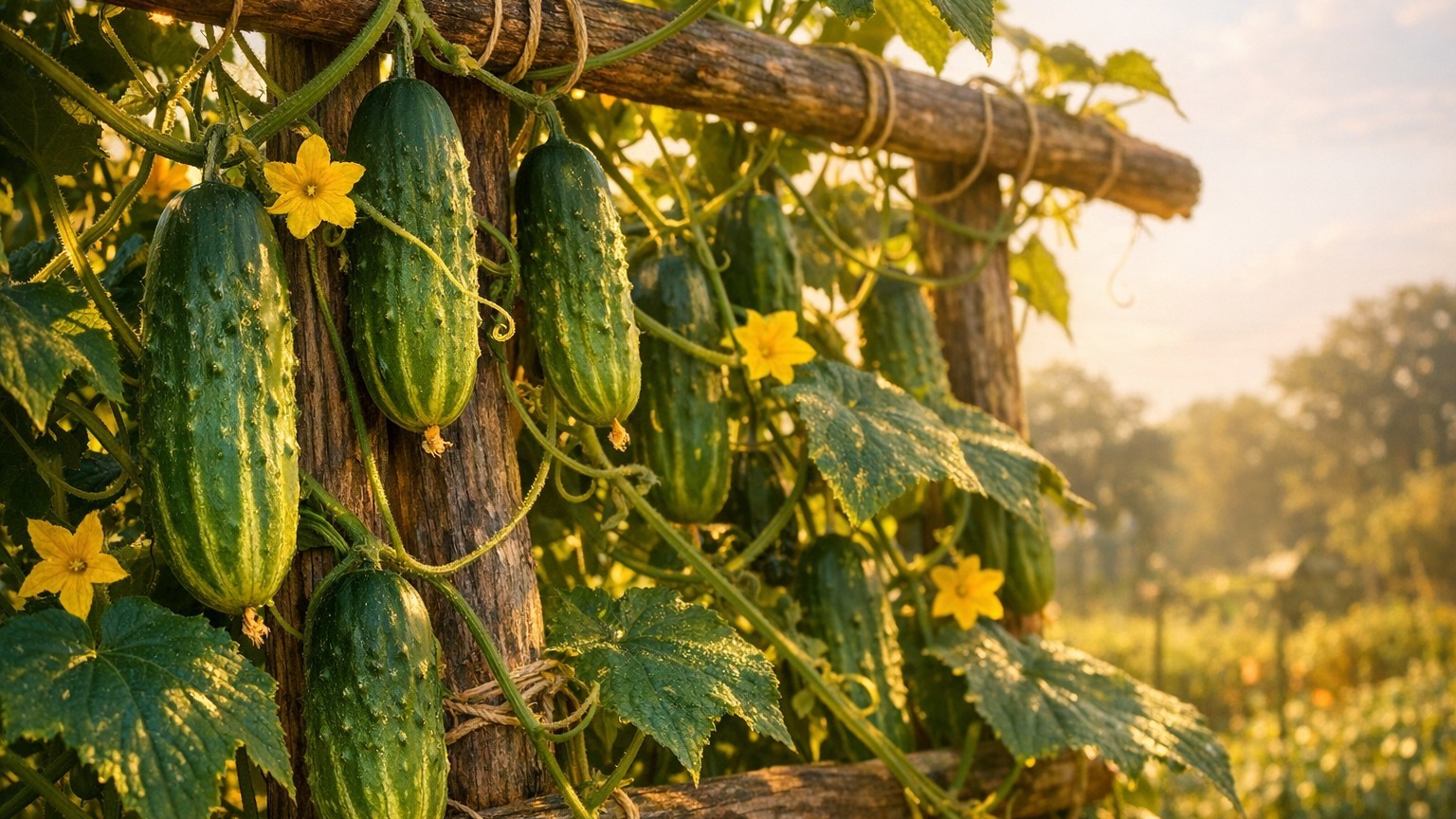

Short-season, fast-maturing cucumbers win in New Brunswick: bush and pickling types built for compact gardens, parthenocarpic or burpless types that set fruit without pollinators under a cover, and slicers chosen for early maturity rather than size. Long-season vining slicers bred for hot, long summers are the wrong bet here.
The short answer for New Brunswick
The frost record for the reference station at Moncton puts the average last spring frost at May 23 and the average first fall frost at October 2. That’s a mean gap of roughly four months, but it’s a mean, not a guarantee: in one year out of two, the last frost falls later than May 23. Treat that date as the middle of a window, not a green light to plant. It’s also worth remembering the Canadian normals behind this figure run 1981-2010, an older baseline than the 1991-2020 window used for US comparisons on this site, so don’t stack the two together.
What that frost window means for cucumbers is simple: the safe outdoor growing stretch is shorter and less certain than in warmer provinces, so every extra week a variety needs to mature is a week of risk. Add to that a summer with zero days a year averaging 90F or above at the reference station, and you have a garden that never gets the heat spike that pushes vining slicers to size up fast. Cucumbers are heat-loving by nature; without those hot days, growth is steadier but slower, and fruit set can lag.
That combination, a compressed season and a summer without real heat, favors three broad types over any specific brand or cultivar:
| Type | Why it fits New Brunswick | Best use |
|---|---|---|
| Bush cucumbers | Compact habit finishes fast, less foliage to manage in a short season | Small beds, raised beds, containers |
| Pickling types | Bred for earlier, more concentrated fruit set than large slicers | Succession harvest for canning or fresh eating |
| Parthenocarpic / burpless types | Set fruit without pollinators, often used under row cover to add warmth early in a cool season | Extending the effective season at both ends |
None of these are guaranteed by name here, because a state-wide page can’t source what performs county by county. What it can do is point you toward the type of cucumber that matches this climate, and toward the local trial data that names names. That data lives at the extension link further down this page.
What will not work here
Long-season vining slicers, the kind bred for regions with weeks of 90-plus-degree heat, are the clearest mismatch. Moncton’s normals show zero days a year averaging 90F or higher. Those varieties depend on sustained heat to push sugar development and rapid sizing; without it, they mature slowly, if at all, before the average October 2 fall frost arrives. A cucumber that needs a long run of hot days simply doesn’t get one here.
Direct-seeding too early is the second trap, and it’s a timing error, not a variety error. Cucumber seed wants genuinely warm soil to germinate reliably, and a mean last-frost date of May 23 doesn’t mean the soil is warm on May 24. Because that date is only a 50-percent probability, a grower who sows right on it is taking a coin-flip on a killing frost, and cold soil on top of that slows or rots seed regardless of which type was planted.
Humidity and spacing
The third failure point is spacing on wet ground. Summer rainfall across June, July and August averages about 10.5 inches, with June the wettest month at 3.73 inches and August the driest at 3.18. That’s a moist summer overall, and cucumber foliage sitting close to damp soil, especially varieties left to sprawl rather than trellised, invites the fungal problems, powdery and downy mildew among them, that thrive in humid, still air. A trellised planting with airflow underneath handles that same rainfall far better than a dense, ground-hugging patch.
Put together, a short season without real heat and a summer with regular rain doesn’t punish New Brunswick gardeners the way drought or scorching heat punishes other regions. It punishes patience: the varieties and habits built for someplace hotter and longer simply run out of time or run into damp air before they deliver.
What changes across New Brunswick
The 5a hardiness rating in these facts, in the Canadian system, belongs to the reference city, Moncton, and nothing else. That system is built from seven climate variables, not the single minimum-temperature measure the USDA uses, and Natural Resources Canada itself warns there’s no simple conversion between the two. A single Canadian zone can straddle multiple USDA zones. So this number describes one station, not the province.
New Brunswick is not one garden. Areas closer to the Bay of Fundy and the coast tend to run milder and more moderated than inland or upland districts, where colder air pools and frost lingers longer into spring and arrives sooner in fall. That shifts both ends of the frost window this page relies on, and it shortens the already tight growing stretch further the farther a garden sits from the coast or the higher it climbs in elevation. None of that changes which type of cucumber makes sense, but it can change how much row cover or how much of a head start under plastic is worth using.
This page can’t tell an individual reader which zone their own yard falls into, and it shouldn’t try. Natural Resources Canada maintains the plant hardiness map for exactly that purpose, searchable by location, and it’s the right next stop for anyone who needs their own number rather than Moncton’s.
Where to check this for your own county
A provincial or state-level page like this one gives a starting point, not a final answer. The right next step is the extension service that tracks what actually performs where a reader lives, county by county. New Brunswick’s own provincial agriculture site currently blocks automated verification, so the working, confirmed link is the federal agriculture department instead: Agriculture and Agri-Food Canada.
Once there, two things matter more than anything on this page. The first is a local planting calendar, if one exists for the reader’s district, because it will reflect the frost pattern of that specific area rather than the Moncton average used here. The second is any list of varieties trialled in that county or region, since those are the names this page deliberately avoids inventing. A trial result from a grower’s own county carries more weight than any general recommendation, because it was tested against that area’s actual soil, wind exposure and microclimate, not a reference station miles away.
Treat this page as the province-wide baseline and the county-level source as the correction. Where the two disagree, follow the county data. It’s closer to the ground the reader is actually planting in.
Checking this against your own garden
Dates and averages get a gardener to the starting line. What happens after that is decided by the actual plot, and three signs tell more than any calendar entry.
Soil warmth by feel is the first. Cucumber seed wants soil that feels genuinely warm to bare skin, not just frost-free air above it. A garden that still feels cool and damp a week after the average frost date is telling the grower to wait, regardless of what the calendar says.
The first flush of male flowers is the second. Cucumbers typically produce a wave of male blooms before the female flowers, the ones with a tiny fruit already visible at the base, arrive. Seeing male flowers first is normal and not a sign of failure; it’s a sign the plant is gearing up.
The first true leaves are the third. The initial round seed leaves aren’t the real indicator of establishment; the jagged, characteristically cucumber-shaped leaves that follow are. Their appearance, and how quickly they show up after germination, says more about that particular garden’s warmth and light than any regional average ever could.