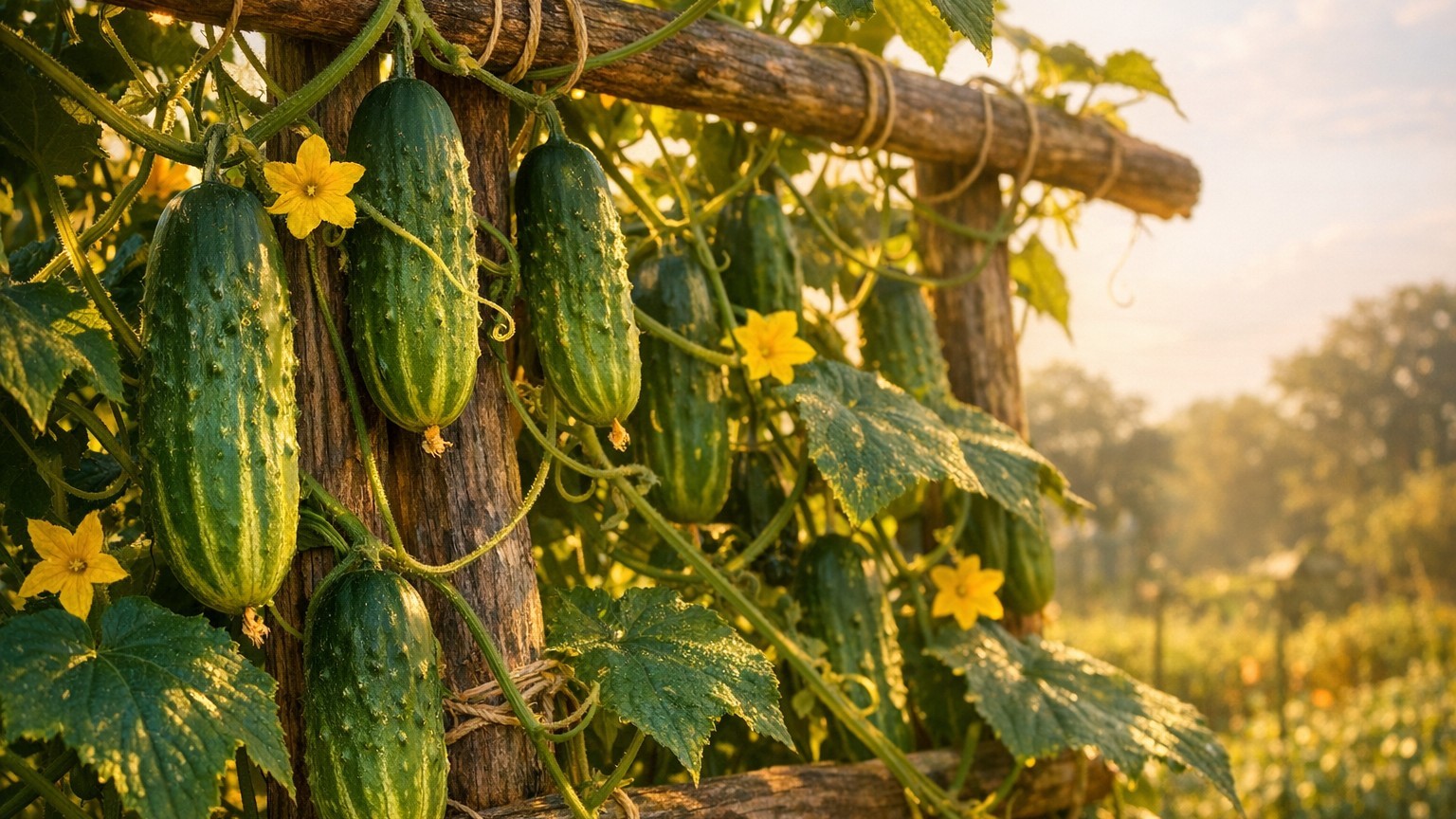

Cucumbers need heat to set fruit and a long enough season to ripen it, and Newfoundland and Labrador is short on both. The safest bet here is a quick-maturing, cold-tolerant type grown under some form of protection, not a long-season vining slicer bred for a hot inland summer.
The short answer for Newfoundland and Labrador
Start with the number that decides everything: 0.0 days a year above 90°F at the St. John’s reference station. Cucumbers are a heat-loving crop that stalls below roughly 60°F at night and thrives when daytime temperatures push into the 80s. A summer that never reaches 90°F even once, on average, is not hostile to cucumbers, but it is unforgiving of any variety that expects a real heat surge to push fruit through its final ripening stage.
The frost window matters just as much. The mean last spring frost at St. John’s A falls on May 30, and the mean first fall frost on October 17. That is roughly 140 days between two average dates, which sounds workable, but these are mean dates, not safe ones: in one year out of two, frost arrives later than May 30 in spring or earlier than October 17 in fall. A gardener planning around the mean alone is planning around a coin flip. The practical season for a heat-loving crop like cucumber is shorter than the raw frost-to-frost number suggests, because the weeks right after May 30 are still cool, and soil needs to warm well past the air-frost date before cucumber seed will germinate reliably.
Given that combination, cool summers with zero reliable heat spikes and a frost-free window that is generous on paper but risky at both ends, the types worth choosing are these: fast-maturing pickling cucumbers, compact bush types suited to containers or raised beds that warm faster than open ground, and parthenocarpic (self-fruiting) varieties that set fruit without needing pollinator activity, which is useful when cool, damp weather keeps bees grounded. Burpless or Asian-type slicers bred for greenhouse or cool-climate production are worth asking about locally, since many were selected specifically for shorter, cooler seasons.
| Type | Season length needed | Best fit for this climate |
|---|---|---|
| Long-season vining slicer | Long, heat-dependent | Poor fit without a heated structure |
| Compact pickling type | Short | Good fit, especially under row cover |
| Bush/container type | Short | Good fit, warms faster in a raised bed or pot |
| Parthenocarpic type | Short to moderate | Good fit when pollinator activity is unreliable |
None of these are cultivar names. This page cannot source a specific variety for Newfoundland and Labrador, and naming one would be a guess. The right move is to ask which specific cultivars within these types have actually been trialled locally, a question the province’s own agriculture service can answer better than any general guide.
What will not work here
The clearest failure mode is choosing a long-season vining slicer selected for a hot continental summer. Those varieties are bred to ripen against a backdrop of repeated 90°F-plus days, heat this station records zero of in an average year. Fruit set slows, growth stretches out, and by the time the plant is ready to produce heavily, October 17 is closing in. A gardener who direct-sows a long-season slicer in early June and expects a full harvest by late August is fighting a climate that simply does not deliver the heat units that variety was bred around.
Sowing too early is the second trap, and it is the mirror image of the first. Because the mean last frost is May 30, and that date is only a 50/50 marker, cucumber seed put into the ground in mid-May sits in cold, often waterlogged soil that will rot it before it germinates. Cucumber seed wants soil consistently warmer than the air temperature typically available right around the mean frost date here. Waiting past the mean date, not planting to it, is the safer habit.
Humidity changes the disease math
Summer rainfall runs about 11.4 inches across June, July and August, with even the driest month, July, still delivering 3.61 inches. That is not a drought-prone climate; if anything it is one where cucumber foliage stays damp longer after each rain, and fog off the coast adds to leaf wetness on many mornings even without rain falling. Cucumber varieties and layouts that rely on tight spacing and sprawling ground growth are the ones that suffer most, since dense, low foliage holds moisture and invites powdery and downy mildew. A trellised plant with airflow underneath handles this rainfall pattern far better than one left to sprawl on bare soil.
Put together, the varieties and habits that fail here share one trait: they were designed for a climate with more heat and less standing moisture than this station actually records. That mismatch, not any single planting mistake, is what sinks most cucumber crops in this province.
What changes across Newfoundland and Labrador
The hardiness zone figure available for this page, 6a in the Canadian system, applies specifically to St. John’s, the reference city, not to the province as a whole. That distinction matters more here than almost anywhere else in Canada. Newfoundland and Labrador stretches from the mild, ocean-moderated Avalon Peninsula to the interior and far north of Labrador, and a province with that kind of geographic spread cannot have one growing season.
The Canadian hardiness system NRCan uses is built from seven climate variables, not the single minimum-temperature measure the USDA system uses, so 6a in this system is not comparable to a USDA zone number a reader might know from elsewhere. It only describes conditions at the reference station, St. John’s. A garden in interior Labrador, at higher elevation, or well inland from the moderating effect of the Atlantic will run measurably colder and later than what this figure implies, with a shorter frost-free window than the St. John’s dates suggest and possibly less of the fog-driven humidity that shapes coastal disease pressure.
There is no single answer for “when is it safe to Plant Cucumbers in Newfoundland and Labrador,” because the province is not one climate. A coastal Avalon garden and an inland Labrador garden are working with different frost windows, different soil-warming rates, and potentially different disease pressure from moisture. This page cannot tell an individual reader which zone their own property falls into. Natural Resources Canada’s Plant Hardiness site lets a reader check their own location against the mapped zones directly, and that check is worth doing before assuming St. John’s dates apply to a garden fifty or a hundred miles away.
Where to check this for your own county
The Newfoundland and Labrador Department of Fisheries, Forestry and Agriculture publishes provincial agriculture guidance. That is the place to look next, and it beats anything a general guide like this one can offer, because it is built around conditions in this specific province rather than averaged national figures.
Two things are worth hunting for on that site specifically. First, a local planting calendar, one that reflects actual regional frost patterns rather than the single-station means used here. St. John’s A gives a mean last frost of May 30, but a calendar built from wider provincial data, or from a station closer to a reader’s own district, will likely show a different, more locally accurate window. Second, look for any list of cucumber cultivars that have actually been trialled or recommended for home gardens in this province. Local agriculture services often maintain exactly this kind of list, built from real trial results rather than a general description of “types” like the one this page has offered.
That second point is the honest limit of a page like this one. It can explain why zero days above 90°F favors quick, cool-tolerant cucumber types over long-season vining slicers, and why 11.4 inches of summer rain argues for trellising over ground sprawl. What it cannot do is hand over a variety name verified to perform in St. John’s, Corner Brook, Happy Valley-Goose Bay, or any other specific community, because that verification only exists at the provincial or county level, not at the level of a province-wide climate normal. A county or regional recommendation will always outrank a provincial one, and this page is, deliberately, the provincial one.
Checking this against your own garden
Every date and average on this page describes a mean, not a promise, and the most reliable check available is still a gardener’s own observation of their own soil. Three things are worth watching before trusting a calendar over what is actually happening in the bed.
Soil warmth by feel comes first. Cucumber seed wants soil that feels genuinely warm to the hand, not just frost-free, before it will germinate without rotting. If the soil still feels cool and damp well after the mean May 30 frost date has passed, that is a sign this particular garden, whether shaded, low-lying, or simply slower to warm than the regional average, needs more patience than the calendar suggests.
The first flush of male flowers is the second signal. Cucumbers typically produce male flowers before female ones, and a strong early show of male blooms indicates the plant has settled in and started reproductive growth in response to real conditions on site, not just the calendar date. A long delay in flowering, even after weeks of apparently warm weather, points to a cooler local microclimate than the provincial averages describe.
Third, watch how fast the first true leaves develop after the seedling stage. Quick, sturdy true-leaf growth signals warm enough soil and adequate light; slow, pale growth suggests the site is running cooler or shadier than expected, and that protection, whether row cover, a cold frame, or simply a later succession sowing, will do more for that garden than chasing an earlier date on paper.