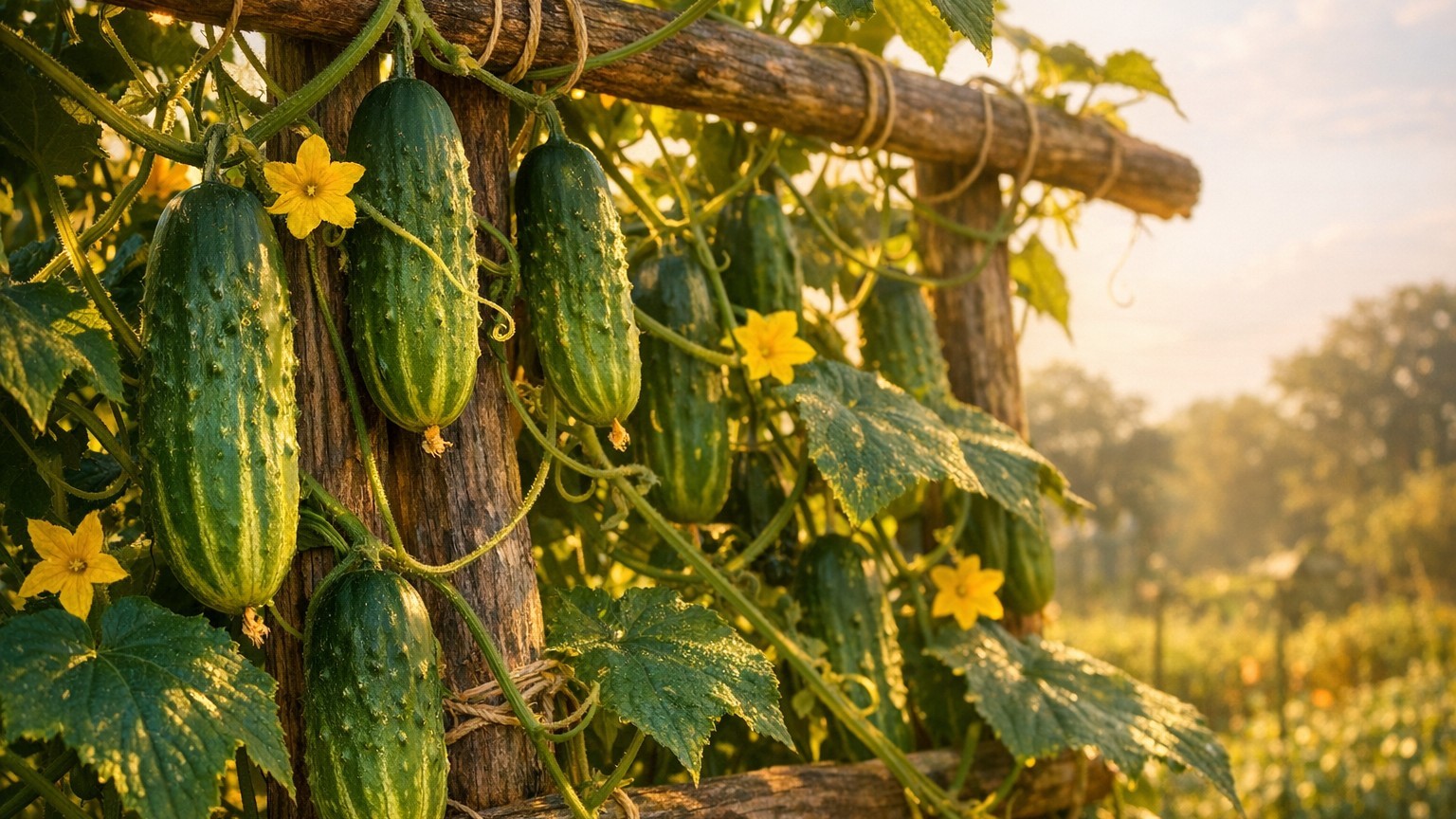

Bush and pickling types beat long-vine slicers in most South Dakota gardens, and the state’s short, hot-and-dry-in-July season is the reason. This page works through why, what fails here specifically, how much the answer shifts between the eastern and western halves of the state, and where to find the county-level variety data that should have the final word.
The short answer for South Dakota
Bush and pickling types beat long-vine slicers here, and the reason comes straight from the calendar. At the reference station used for South Dakota’s climate normals (USW00014944), the last spring frost lands somewhere between April 29 and May 9, and the first fall frost arrives between September 24 and October 4. That’s a frost-free window of roughly 138 to 158 days at that one station, and most home gardens across the state run shorter than that, often by one to two weeks on both ends. Once you subtract for a slow, cool spring soil warm-up, the practical growing stretch for cucumbers in a lot of South Dakota yards lands closer to four months than five.
That’s enough time for cucumbers that finish fast. It gets tight for the long, thin-skinned slicing and burpless types bred for a longer, steadier warm stretch. Pickling cucumbers, which tend to run compact and bush-habited, close out their cycle faster and tolerate the kind of interrupted, cooler stretches that show up in a South Dakota June. Bush-habit slicing types split the difference: less sprawl to manage, a shorter path to first fruit than a full vining slicer trained up a trellis.
Parthenocarpic types (ones that set fruit without needing a pollinator to visit the flower) earn a look here too, mainly because they pair well with row cover or a low tunnel. Covering the bed for the first few weeks after the average frost-free date buys extra soil warmth on the front end, worth doing when the spring frost probability band stretches into the second week of May. A parthenocarpic type keeps producing under that cover without waiting on bees to find the flowers.
Heat is the secondary factor, not the deciding one. South Dakota’s reference station averages 13.8 days a year at or above 90°F, enough to slow fruit set and turn a stressed cucumber bitter if watering lapses, but nowhere near the heat load of the southern Plains. The heat question here isn’t about picking a variety bred for scorching summers. It’s about not letting the vine dry out during the handful of hot stretches that do show up, whatever type is planted.
So the type decision for South Dakota comes down to season length first, heat management second. For the exact varieties trialled and recommended county by county, that’s a question for South Dakota State University Extension, not a statewide guess.
What will not work here
Long-season vining slicers planted the standard way, seed straight into the ground on the last frost date, are the clearest mismatch for this state. If you wait for the safe window (April 29 to May 9 at the reference station, later in a lot of real gardens) and then direct-seed a slicing type bred for a long, unbroken warm run, you’re often asking it to finish inside 130 days or fewer once the actual first fall frost shows up. That’s a narrow margin for a type that wants every one of those days.
Planting too early fails just as often as planting too late. Cucumber seed wants warm soil to germinate, and South Dakota’s spring frost probability holds into early May at the reference station and later inland. Seed put in the ground in mid-April, on the theory that a warm afternoon means it’s safe, typically just sits and rots before the soil catches up. Waiting for the actual frost-free window, not a warm-looking week, is the fix, and that’s a real trade against the season-length problem above. It’s exactly why fast types and cover-assisted starts matter more here than in a longer-season state.
Watering on a fixed weekly schedule, on the assumption that South Dakota’s roughly 10.8 inches of summer rain (June through August) covers the crop, is another common failure. That rain doesn’t arrive evenly. July, the driest of the three summer months at 3.25 inches, is also usually the month with the most 90°F days. Combined with prairie clay soils that shed a hard summer thunderstorm as runoff rather than absorbing it, a cucumber bed can go dry for a stretch even in a summer that finishes with normal rainfall totals on paper. Vines that dry out and then get soaked tend to produce bitter or misshapen fruit, whatever type is planted.
Skipping wind and cold-snap protection at the western edge of the state is a fourth failure specific to South Dakota’s numbers. The state’s hardiness zone spans 3b to 5b, and the colder end of that range means a late, sharp cold snap after transplant is a real risk in a way it isn’t at the reference station used for the frost dates above. A transplant set out on the reference station’s schedule, with no cover on hand, is exposed if the local frost date runs later, which it often does away from town.
What changes across South Dakota
A hardiness zone range of 3b to 5b (USDA Plant Hardiness Zone Map, 2023 edition) is a wide spread for one state, and it means there’s no single cucumber calendar that fits all of South Dakota. That’s roughly a two-and-a-half zone difference between the coldest pockets and the mildest, and USDA zones are built on just one number, the average annual extreme minimum winter temperature, so the range describes winter cold, not directly summer length. But the two tend to move together: places that land at 3b generally also see a shorter frost-free stretch in practice than the reference station’s 138 to 158 days.
The frost dates and rainfall normals cited on this page come from a single reference station (USW00014944), which sits toward the milder, warmer end of the state’s range. A reader gardening toward the colder end, more common in the northern tier and at higher elevation in the west, should expect the safe planting date to land later than early May and the first fall frost to arrive earlier than late September. Both of those push the already-tight cucumber season shorter still, which strengthens the case for fast bush and pickling types over long-vine slicers the farther a garden sits from the reference station’s conditions.
Elevation matters here in a way it wouldn’t in a flatter state. Ground that sits higher, which describes a fair amount of West River South Dakota, cools faster at night even in mid-summer, and that alone can stall a cucumber vine’s growth without a frost ever touching it. None of this resolves at the state level. The zone range is wide enough, and the difference between the coldest and mildest parts of South Dakota real enough, that the only honest next step is checking the USDA hardiness zone map for a specific location rather than assuming the reference station’s numbers apply everywhere.
Where to check this for your own county
South Dakota State University Extension (extension.sdstate.edu) is the source built for the question this page can’t answer: which specific cucumber varieties actually perform in a given county. The frost dates, rainfall normals and hardiness zone range above come from statewide and single-station climate data. They’re useful for deciding between a bush pickling type and a long vine slicer in general terms, but they can’t tell you what did well two counties over last summer, and they were never meant to.
Extension tracks that at the county level, through the state’s cooperative extension network and its master gardener programs. What to look for once there is fairly specific. First, a county or regional planting calendar, which will adjust the frost-date window this page pulled from a single airport station to something closer to local conditions, whether that’s earlier in the southeast corner of the state or later up north and at elevation. Second, any variety trial results or recommended lists published for vegetable gardens in that area, since those reflect actual seasons grown under South Dakota conditions rather than a seed catalog description written for the whole country.
A county-level recommendation beats a state-level one every time, for the simple reason that it’s closer to the soil the reader is actually planting into. This page works at the state scale on purpose, to lay out the reasoning behind picking a type of cucumber for South Dakota’s season length and heat load. It isn’t a substitute for the county-specific calendar and variety list that extension offices maintain, and it shouldn’t be treated as one. Calling the local extension office, or checking whether the county runs a master gardener program with office hours, is the fastest way to turn the general reasoning on this page into a specific list of varieties worth planting.
Checking this against your own garden
None of the dates on this page beat what’s actually happening in the bed. Three signs are worth watching, and each one says something different about a garden’s own microclimate, separate from whatever the reference station recorded.
Soil warmth by feel is the first. Cucumber seed wants soil that’s warmed through, not just a warm afternoon air temperature. Pushing a finger a couple of inches into the planting row in the morning, before the sun’s had a chance to warm the surface, gives a rough read: soil that still feels cold and damp at that depth is telling you germination will be slow no matter what the calendar says, and it’s worth waiting, even past the reference station’s early-May frost window.
The first flush of male flowers is the second. Cucumbers typically put out a run of male flowers before the female flowers (the ones with the tiny fruit already visible behind the petals) show up in any number. A vine covered in male blooms with few or no females yet isn’t a problem, it’s a normal stage, but it’s a signal that fruit set is still a bit off, useful to know before assuming a planting has stalled.
The first true leaves are the third. The two rounded leaves that appear first on a cucumber seedling aren’t true leaves, they’re cotyledons. The next set, the ones that actually look like a cucumber leaf, mark the point where the plant has real reserves to grow from. A bed where true leaves show up quickly after germination is running warmer and faster than the reference station’s normals would suggest, and a bed where they’re slow to appear is running behind them, whatever the date on the calendar says.