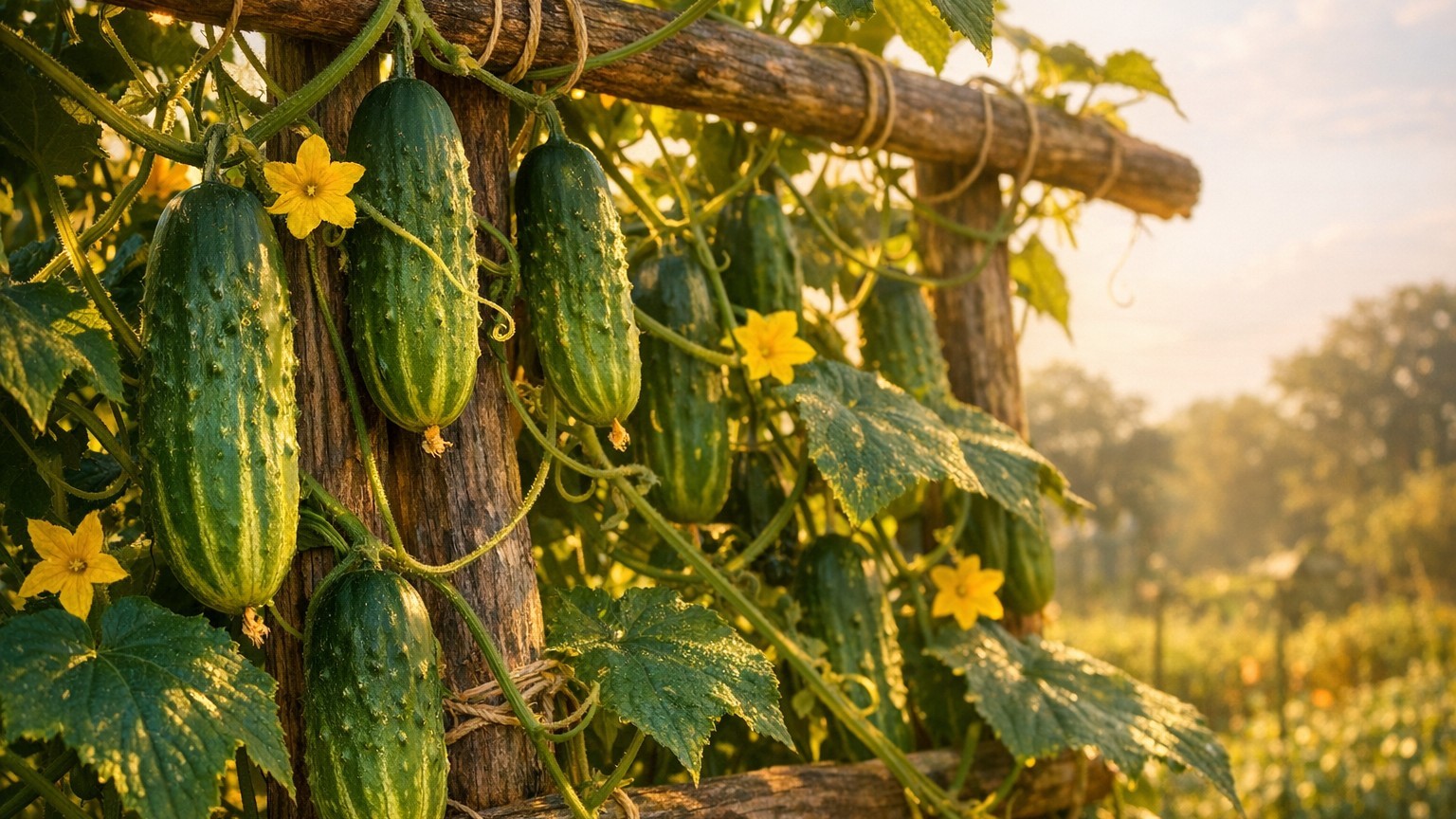

Cucumbers thrive across Tennessee, but the state’s long frost-free window and heavy midsummer heat point growers toward heat-tolerant vining and pickling types over slow, heat-shy varieties. The real decision isn’t which brand-name seed to buy. It’s which growth habit and fruiting style survive a Tennessee August.
The short answer for Tennessee
Start with the calendar. Tennessee’s last spring frost falls between March 31 and April 12, and the first fall frost doesn’t arrive until October 28 to November 8, both figures from NOAA’s 1991-2020 climate normals at the state’s reference station. Stack those dates and you get a frost-free window that stretches past six months in a typical year. That’s more than enough time for any cucumber type, pickling, slicing, or burpless, to mature and produce a second or even third planting.
So maturity length isn’t what should drive the choice here. Heat is. The reference station averages 40 days a year at or above 90F, concentrated in July and August. That’s the number that actually decides which cucumber types perform in this state. Vining cucumbers bred for continuous production tend to hold up better through a Tennessee heat plateau than compact bush types, which often set one heavy flush and then stall when nighttime temperatures stay warm and pollen viability drops.
Parthenocarpic types, the ones that set fruit without pollination, deserve real consideration for Tennessee gardens specifically because of that heat load. When daytime highs push past 90F for weeks at a stretch, bee activity in the garden often slows during the hottest midday hours, and blossom drop becomes common on standard varieties. A parthenocarpic type sidesteps that dependency, which matters more here than in a cooler state where 90F days are rare.
For pickling growers, the same heat logic applies but with a spacing twist worth flagging now and explaining fully in the next section: pickling types are usually grown at tighter spacing for a concentrated harvest, and tight spacing plus Tennessee’s summer humidity is a combination that needs airflow management, not just variety choice.
Bush cucumbers still have a place here, particularly for containers or raised beds on a patio, but treat them as a convenience trade-off rather than a top performer. They mature fast and take less space, but their shorter vine and lower leaf canopy give fruit less shade during the hottest stretch of the 40-day heat count, which can mean more sunscald and bitter fruit late in summer. None of this is a brand recommendation. It’s a case for choosing by growth habit and fruiting mechanism first, then checking which named varieties in that category have actually been trialled near you (more on that below).
What will not work here
Long-season melon-style cucumber types bred for cool, short-summer climates struggle in Tennessee, not because the season is too short (it isn’t) but because the plant hits sustained 90F-plus stress before it would in a northern garden, and growth simply shuts down rather than pushing through. Tennessee’s 40-day heat count means a cucumber vine planted for a cool-summer region often stops setting fruit right when a Tennessee gardener expects the main harvest.
Weekly watering schedules fail here too, and the rainfall numbers explain why. Summer rain totals about 12.3 inches across June, July, and August, but it isn’t spread evenly: June brings 4.36 inches, July 4.16, and August drops to 3.79, the driest of the three months and the one that overlaps most with the peak of the 90F-plus stretch. A cucumber vine losing water to evaporation on a 90-degree August afternoon, with rainfall already thinning out, will show blossom drop and misshapen fruit within days if watering is left on a once-a-week routine rather than adjusted to soil feel.
Dense, ground-sprawling spacing is the other common failure point, and it’s a humidity problem more than a heat problem. Tennessee’s summer rainfall pattern, even at its driest in August, still arrives as convective thunderstorms typical of the Southeast, and that combination of warm nights and periodic heavy rain keeps foliage wet longer than in a drier climate. Cucumbers planted close together on the ground in that environment are far more prone to fungal leaf disease than the same variety trellised with airflow underneath. This isn’t a variety flaw. It’s a spacing and structure decision that either works with Tennessee’s humidity or fights it.
Finally, skip any cucumber type marketed purely for early, once-and-done harvest in a short window. Tennessee’s frost-free season, running from early-to-mid April into late October or early November, rewards succession planting and continuous producers far more than a single-flush variety. A gardener who plants only one heat-vulnerable, short-window type is leaving most of that six-month window unused.
What changes across Tennessee
Tennessee is not one climate wearing one label. The USDA Plant Hardiness Zone Map places the state across zones 5b to 8a, a spread built entirely on average annual extreme minimum winter temperature, not on summer heat or rainfall. That’s a wide range for one state, and it means the frost dates and heat totals cited above, drawn from a single reference station, describe a middle-of-the-state pattern rather than a statewide constant.
East Tennessee and the Cumberland Plateau run cooler and later in spring than the Nashville-area reference station used for the frost and heat figures in this article. A gardener at higher elevation in the eastern part of the state should expect the last frost to land later than the March 31 to April 12 window given here, and the first fall frost to arrive earlier than the October 28 to November 8 range. That shortens the usable frost-free season on both ends, which matters most for any cucumber type on the slower end of its category.
The likely effect on the 40-day heat count runs the other direction: higher, cooler elevations in East Tennessee typically see fewer days at or above 90F than the Middle Tennessee reference point, while the lower-elevation valleys of West Tennessee, closer to the Mississippi River, tend to run hotter and more humid through midsummer. Neither of those regional patterns is quantified in the frost and heat data cited here, which come from one station, so treat the direction of the shift as the useful takeaway rather than a specific number.
| Region | General spring pattern | General summer pattern |
|---|---|---|
| East TN / Cumberland Plateau | Later last frost than Middle TN | Likely fewer 90F+ days at higher elevation |
| Middle TN (reference station) | March 31 to April 12 last frost | 40 days/year at 90F+ on average |
| West TN / river valleys | Similar to or slightly earlier than Middle TN | Likely higher humidity load in midsummer |
Given a hardiness zone spread of 5b to 8a, there is no single planting date or single “safe” cucumber type for the whole state. The direction to shift is clear (later planting and more heat tolerance in the east, earlier heat stress and humidity management in the west), but the exact dates for any one garden depend on where in that zone range the garden actually sits, which is a question for the map, not for this page.
Where to check this for your own county
The University of Tennessee Institute of Agriculture Extension is the state’s land-grant extension service, and its site at utia.tennessee.edu/extension is where a county-level answer replaces the state-level one given here. This article works from a single reference station’s frost and heat data plus a statewide hardiness zone range. County extension offices work from local trial data, local frost records, and years of grower feedback specific to that soil and elevation.
Two things are worth pulling from the extension site specifically. The first is the local planting calendar for the reader’s own county, which will narrow the March 31 to April 12 last-frost window cited here down to a tighter, elevation-adjusted date, and do the same for the fall frost range. That narrower date range is what actually should set a transplant or direct-seed date, not the statewide range in this article.
The second is the list of cucumber varieties the local extension office has actually trialled in Tennessee conditions. Extension trials test named varieties for disease resistance, heat performance, and yield under the specific humidity and rainfall pattern of the region, which is exactly the kind of variety-level detail this article deliberately avoids inventing. This page can responsibly describe growth habits (vining versus bush, parthenocarpic versus standard) because those categories are stable facts about how a plant grows. It can’t responsibly name which specific cultivar performed best in a University of Tennessee field trial last season, because that list changes as new trials run and older varieties get dropped or added.
A county recommendation beats a state one every time, for the same reason a local weather forecast beats a regional almanac. This page has given the mechanism (frost dates, heat load, rainfall pattern, hardiness zone spread) that explains why Tennessee favors heat-tolerant, continuous-producing cucumber types over short-window or cool-climate ones. The county extension office turns that mechanism into a specific planting date and a specific variety list for one particular piece of ground.
Checking this against your own garden
Every date in this article is a normal built from thirty years of station data, and normals describe an average year, not this year. A reader’s own garden will tell them more about actual planting readiness than any calendar, and three simple checks do most of that work.
Soil warmth by feel is the first and most direct check. Cucumber seed germinates poorly in cold soil, and a gardener who reaches into the top few inches of a bed and finds it still cool and damp, even after the calendar says the last frost has passed, is looking at soil that hasn’t caught up to the air temperature yet. Waiting a few more days for that soil to feel consistently warm through the day protects against the slow, uneven germination that costs more time than it saves.
The first flush of male flowers is the second signal, and it tells a gardener something the frost date can’t: whether the plant considers conditions stable enough to begin reproducing. Male flowers typically appear before female flowers on a cucumber vine, and a burst of them followed by warm, settled days is a much better sign that fruit set is imminent than any date on a chart.
The appearance and color of the first true leaves is the third check. Pale, slow-to-expand true leaves after the initial seed leaves suggest either a cool snap the plant hasn’t shaken off or a nutrient gap in the bed, either of which is worth addressing before investing in trellising or heavy watering. Together, these three observations, soil feel, first male flowers, and true-leaf vigor, read a garden’s actual microclimate than any regional average, including the ones in this article.