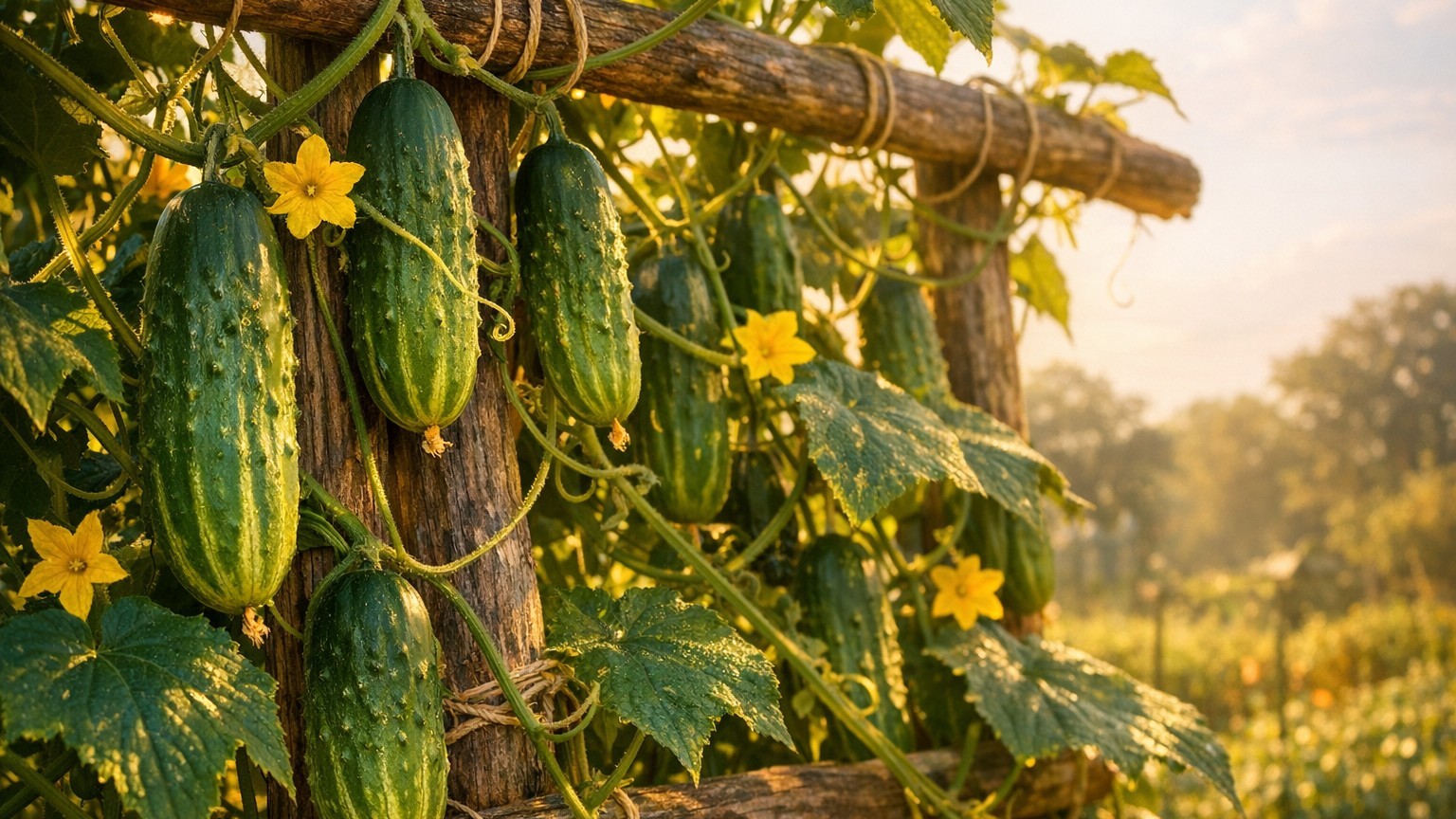

Western Washington‘s cool, damp spring and mild summer favor fast, self-fruiting cucumber types over long-season vining ones. East of the Cascades, where summers run hotter and drier, vigorous slicing and pickling vines have more room to work. The right choice depends less on which cucumber looks good on a seed rack and more on how much heat and daylight your side of the state actually delivers.
The short answer for Washington
The frost data this page can verify comes from a station in western Washington, where the last spring freeze falls somewhere between February 27 and March 18, and the first fall freeze lands between November 13 and November 30. On paper that’s a long window. In practice, cold soil and low spring light push the real cucumber start much later than the frost date suggests, since cucumbers stall in soil that hasn’t warmed regardless of what the thermometer says overnight.
Add to that a summer that averages only 3.0 days a year at or above 90F. That single number does more to shape the variety decision than anything else on this page. Cucumbers that need a long stretch of real heat to size up and ripen simply don’t get it here most years. The types that consistently perform in this climate are the fast-maturing, compact or bush-type cucumbers, and parthenocarpic varieties, meaning they set fruit without needing heavy pollinator activity, which matters in a cool, often overcast spring when bee flights are inconsistent. Burpless slicing types bred for shorter, cooler seasons also have a track record in maritime gardens, as do pickling types grown for a string of small, frequent harvests rather than one big flush.
What this page cannot do is hand you a statewide answer. The hardiness zone range for Washington spans 4a to 9a, an enormous spread for one state, and the frost and heat figures above describe the mild, marine-influenced west side only. East of the Cascades sits a high desert climate with a much shorter, hotter, drier growing season, and this page does not have verified frost or heat normals for that region. A gardener in Spokane or the Columbia Basin is working with a different plant calendar entirely, and should treat the numbers here as describing Seattle’s climate, not their own backyard.
So the type-level answer for the wetter, cooler west: short-season, parthenocarpic, bush or compact vining cucumbers, in both slicing and pickling forms. For the drier, hotter east, standard vining slicers and pickling types have more of the heat they need, but confirming which specific varieties perform well there means checking locally rather than relying on this page.
What will not work here
Cucumber varieties bred for long, hot growing seasons are the first casualty of a Puget Sound summer. A vine that needs weeks of sustained heat above 85F to fill out fruit is working against a climate that only reaches 90F on three days a year, on average, and often less. These varieties may vine vigorously and flower well, then stall at fruit set or produce misshapen, slow-swelling cucumbers because the heat units simply aren’t there. This is a different failure than frost damage. The plant survives fine; it just never finishes the job.
Watering on a weekly schedule is the second common mistake, and it runs against what the rainfall numbers actually show. Summer rain here totals only about 3.0 inches across June, July and August, with July delivering just 0.6 inches, the driest month of the year. Cucumbers have shallow, thirsty root systems, and a week without water in a dry July stresses the plant enough to trigger bitter fruit and blossom drop. A gardener who assumes Washington’s reputation for rain will keep the cucumber bed hydrated through summer is working from the wrong season. Spring and fall are wet here. Summer, especially July, is not.
The third failure point is spacing. It’s tempting to think a low-humidity, drier summer means fungal disease isn’t a concern, but the region’s overall dampness (nearly 40 inches of rain across the year, even with a dry summer) leaves lingering moisture in the soil and air during the shoulder seasons when cucumbers are getting established. Vines planted too close together, or left to sprawl directly on damp ground rather than trellised, trap moisture around the leaves and invite powdery mildew, a common problem in maritime gardens. Trellising isn’t cosmetic here. It’s airflow management, and it matters more in a cool, humid spring than most gardeners expect.
What changes across Washington
A hardiness zone range of 4a to 9a is not a rounding error. It’s one of the widest single-state spreads in the country, and it means there is no single planting date or variety recommendation that fits Washington as a whole. Zone 9a describes a mild coastal or Puget Sound pocket where frost is rare and brief. Zone 4a describes high-elevation or far-eastern ground where hard freezes arrive early and stay late. A cucumber schedule built around the Seattle frost dates cited above would badly mislead a gardener working land in a colder zone.
Elevation matters as much as latitude here. Gardeners at higher elevation, even within western Washington, typically see a shorter frost-free window than the Seattle-area normals suggest, because cold air pools and lingers longer at altitude. The practical shift is to push the transplant date later, lean harder on season-extension tools like black plastic mulch to warm the soil faster, and choose the fastest-maturing types available rather than anything marketed as a long-season variety.
Gardeners in the north of the state, closer to the Canadian border, and those east of the Cascades face a different set of adjustments again, generally a shorter season with more heat concentrated in summer, favoring earlier transplanting once soil warms and possibly larger yields from standard vining types that struggle on the west side. This page cannot tell an individual reader which zone applies to their own property. That determination comes from the USDA Plant Hardiness Zone Map itself, not from a state average.
Where to check this for your own county
The Washington State University Extension service is the right next stop, and it exists specifically to fill the gap this page can’t: county-level detail. State-level climate normals, like the ones cited above, describe a reference station in one location. They are a starting point, not a substitute for what’s been tested on the ground where you actually garden.
Two things are worth looking for once there. First, a local planting calendar for your specific county, which accounts for elevation, rain shadow effects, and microclimate differences that a statewide frost date average simply cannot capture. Second, variety trial results or recommendation lists specific to your region, since WSU Extension offices across the state’s different growing zones, from the San Juan Islands to the Yakima Valley, publish guidance based on what has actually performed in local trial plots, not just what’s theoretically hardy for the zone.
A county recommendation beats a state recommendation every time, for a simple reason: it’s built on data closer to your own soil, your own rainfall pattern, and your own frost timing. This page works from statewide and single-station climate normals. Extension offices work from local trial gardens and grower reports gathered over multiple seasons. When the two disagree, defer to the county source.
Checking this against your own garden
Every number on this page is a regional average pulled from decades of climate data. Your own garden will confirm or contradict it faster than any calendar can, and three simple observations tell you more than a printed frost date ever will.
Start with soil warmth, checked by hand rather than by date. Push a finger a few inches into the bed where cucumbers will go. If the soil still feels cold and damp rather than mild to the touch, the plant will sit and sulk no matter what the calendar says, since cucumber roots simply won’t grow in cold soil regardless of air temperature.
Next, watch for the first male flowers, the smaller blooms that appear before the female flowers with the tiny swollen base. Their arrival signals the plant has shifted from vegetative growth into reproduction, a sign the plant has enough warmth and daylight to move forward, even if fruit set is still a week or two off.
Finally, track the first true leaves, the second set that emerges after the rounded seed leaves and actually looks like a cucumber leaf. Slow, stunted true-leaf development after transplant usually points to soil that’s colder or wetter than it looks, a common issue on the west side of the state even after the calendar frost date has passed. All three signs together tell you more about your own microclimate than any regional average, including the ones in this article.