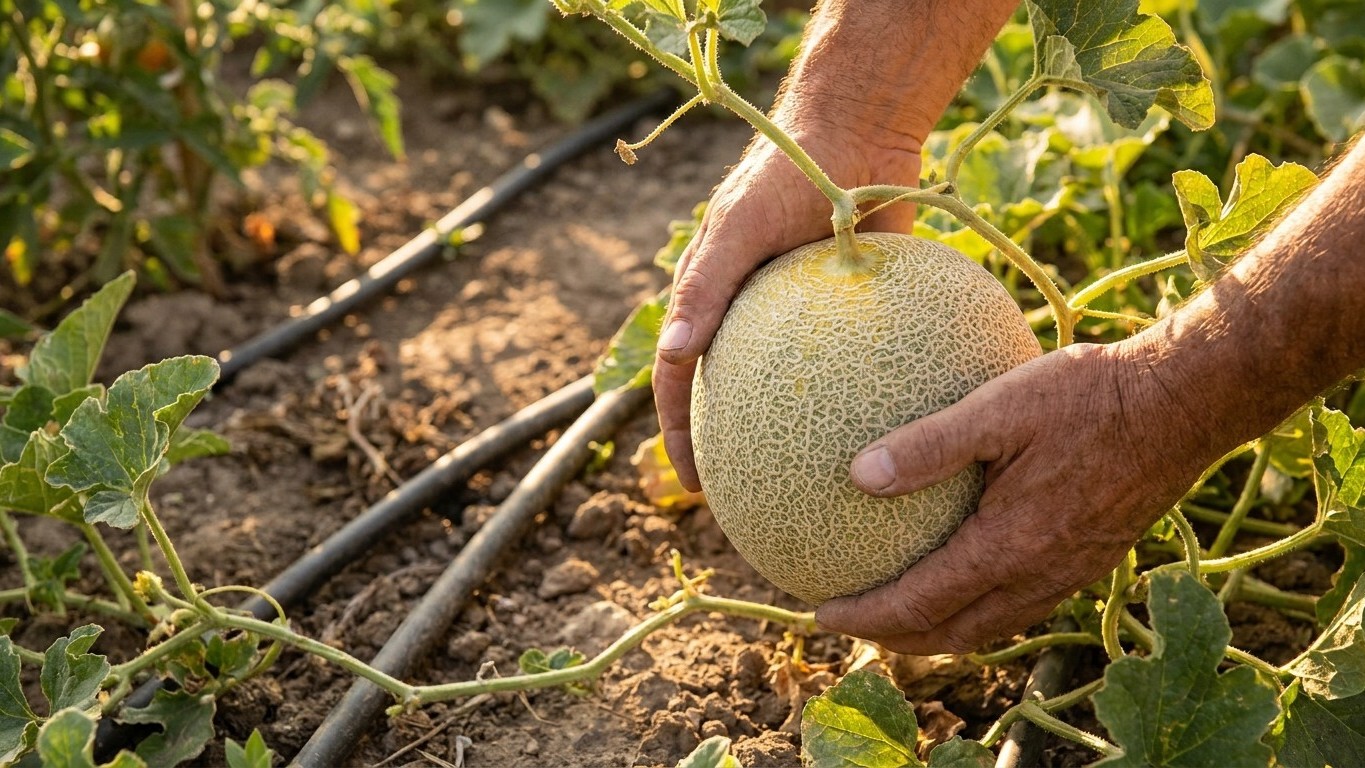

A melon plant succeeds or fails on three things: enough accumulated heat to ripen the sugars, water that’s generous early and stingy late, and a gardener who reads the specific ripeness signal for that type of melon rather than guessing. Miss any one of the three and the vine looks fine while the fruit disappoints.
What a melon plant asks for
Melons have a reputation among home gardeners as the least forgiving common crop in a short growing season, and that reputation is earned for a specific reason: what matters isn’t the number of days since transplant, it’s the amount of heat the plant has actually banked along the way. Extension services measure this as accumulated heat units, sometimes called growing degree days, and a cool, cloudy stretch in July can push a melon’s ripening back by a week or more even though the calendar hasn’t moved. A tomato plant shrugs off a chilly week. A melon vine remembers it.
That heat dependency is why the same seed packet performs completely differently in a warm inland valley versus a coastal garden fifteen miles away, and why a gardener in a short-season northern state needs a different approach to season length than someone in the Southeast. Rather than naming a specific variety here, the more useful move is to think in types, muskmelon versus watermelon versus honeydew, and then check the state extension service for the cultivars actually trialled in that climate. Extension trial lists exist precisely because a variety that thrives in one region can sulk two states north, and inventing a name here would send readers chasing seed that was never tested where they garden.
Water asks for the opposite discipline than most vegetables. Melons want steady, generous moisture while the vines are running and the fruit is sizing, then a deliberate taper as the fruit approaches ripeness. Keep the soil evenly damp the whole way through and the flavor stays diluted and the rind stays vulnerable to splitting. Cut water off too abruptly and the plant stresses in ways that show up as poor sugar development too.
The third demand, reading ripeness correctly, trips up more first-time growers than heat or water combined, largely because the signal is different for every type of melon and a technique that works on a cantaloupe will mislead a gardener holding a honeydew.
| Demand | What happens when it’s not met | Where it’s treated |
|---|---|---|
| Sustained heat / accumulated heat units | Vines stall, fruit sets late or not at all, sugars never fully develop even if the fruit looks full-sized | Heat and season length for melons |
| Water heavy early, tapered near ripening | Split fruit, watery or diluted flavor, rot where the fruit touches damp soil | Watering melons through the season |
| Correct, type-specific ripeness read | Picked too early: starchy, sometimes hollow. Picked too late: mealy or fermented at the core | Reading ripeness by melon type |
Muskmelon, honeydew, watermelon and the rest
Choosing which type of melon to grow is the decision that shapes everything downstream, because the three major types differ in how the fruit is built, how they announce ripeness, and how long a warm season they need to get there. This is worth sorting out before seed goes in the ground, not after the first fruit is sitting on the vine and nobody’s sure whether it’s ready.
The muskmelon group, the netted, orange-fleshed melon most Americans call a cantaloupe, is built with a natural separation layer where the stem meets the fruit. That layer is why muskmelons announce themselves so clearly: the fruit actually slips loose from the vine with a gentle lift, a trait called “full slip” in extension literature. No other common melon behaves this way, which makes muskmelon the easiest type for a beginner to judge by feel rather than guesswork.
Honeydew and the smooth-skinned melons in its family don’t have that separation layer, so the vine holds on even when the fruit is fully ripe. Waiting for a honeydew to slip is waiting for something that mostly won’t happen. Instead, growers watch the rind color shift from a matte, slightly greenish white to a creamier, waxier yellow-white, and they check for a faint softening at the blossom end. It’s a subtler signal, and it rewards a grower who’s handled a few of these melons before.
Watermelon plays by yet another rulebook. The fruit gives no useful signal on top at all; the tell is underneath, where the melon rests on the soil. That contact spot, often called the ground spot or field spot, shifts from pale white or greenish to a buttery yellow as the fruit ripens. Growers also listen for a duller, deeper thud when they tap the rind, though extension guidance is consistent that the ground spot is the more reliable of the two.
Beyond those three, a handful of other melons, casaba, canary melon, and crenshaw among them, generally follow the no-slip pattern of honeydew, relying on rind color and a light give at the blossom end rather than a clean separation from the vine.
| Type | How it’s built | Ripeness signal | Season length needed |
|---|---|---|---|
| Muskmelon (cantaloupe type) | Netted rind, natural separation layer at the stem | Slips cleanly from the vine with gentle pressure | Moderate; among the more forgiving melons for shorter seasons |
| Honeydew | Smooth rind, no separation layer | Rind shifts from matte greenish-white to waxy cream; slight give at blossom end | Longer, steady heat than muskmelon |
| Watermelon | Thick rind, no separation layer | Ground spot underneath turns from pale to buttery yellow | Longest sustained heat of the common types |
| Other types (casaba, canary, crenshaw) | Smooth or ribbed rind, no separation layer | Rind color change plus slight blossom-end softening | Similar to honeydew; check local trial data |
Whichever type looks like the right fit for a given garden, the cultivar itself should come from a state extension trial list rather than a general seed catalog description, since regional trials are the only source that reflects how a variety actually performs against the local heat and humidity pattern.
Reading a melon crop that is going wrong
A melon vine that isn’t performing usually shows one of a handful of recognizable symptoms, and while none of them point to a single certain cause, they narrow the search considerably. Treat the list below as a starting point for troubleshooting, not a diagnosis.
Plenty of flowers but no fruit forming is one of the most common complaints, and it’s often simpler than it looks: melon plants produce far more male flowers than female ones early in bloom, and female flowers, recognizable by the small swelling at the base, may not appear in numbers for a week or two. Poor pollinator activity during that window compounds the problem.
Fruit that splits or cracks on the vine is almost always a watering story, specifically a dry spell followed by a sudden heavy watering or rain that the fruit can’t absorb without its rind giving way.
Pale, watery, or flavorless flesh usually traces back to insufficient heat accumulation or a fruit picked before it had fully matured, since sugar development in melons is one of the most heat-dependent traits in the vegetable garden.
A hollow or cracked center, seen most often in watermelon, tends to follow uneven growing conditions, alternating stress and abundance that cause the flesh to grow faster than the core can fill in.
White, powdery coating on the leaves is the visible sign of powdery mildew, a fungal disease that thrives in humid conditions with poor airflow between vines.
A vine that looks fine one evening and is collapsed and wilted the next morning points toward a fast-moving problem at the root or stem base, commonly vine borers, bacterial wilt spread by cucumber beetles, or root rot from waterlogged soil.
| What you see | Likely cause | Where it’s treated |
|---|---|---|
| Flowers but no fruit | Pollination timing or lack of pollinator activity | Pollination in melons |
| Fruit splits | Irregular watering, especially dry-then-heavy cycles | Watering melons through the season |
| Pale, flavorless flesh | Insufficient heat accumulation or early picking | Heat and season length for melons |
| Hollow center | Uneven growing conditions, common in watermelon | Reading ripeness by melon type |
| White powder on leaves | Powdery mildew, favored by humidity and poor airflow | Common melon diseases |
| Vine wilts overnight | Vine borers, bacterial wilt, or root rot | Melon pests and vine problems |
Why the answer changes with where you garden
Melons are the crop where regional advice matters more than almost anywhere else in the vegetable garden. A watermelon type that’s a routine, reliable choice in a long, hot growing region can be a genuine gamble two states north, not because the seed is different but because the heat accumulation simply isn’t there to finish the fruit before frost. The same is true in reverse: a shorter-season muskmelon bred for cooler summers can underperform, or split from excess moisture, in a humid southern climate it was never suited for.
This is exactly why naming a specific cultivar on a general page is more likely to mislead than help. A variety that performs well in a university trial plot in one state may never have been tested against the soil, humidity, and pest pressure a reader is dealing with three states away. State extension services run these trials precisely to answer that local question, testing multiple types side by side under local conditions and publishing which ones held up.
Practically, that means the most useful next step after understanding heat, water, and ripeness in general terms is to look up the land-grant university extension service for a specific state, search its vegetable garden guide for melons, and check the current list of recommended varieties for that region. Many extension offices also publish county-level guidance, since a coastal county and an inland county in the same state can face different enough conditions to change the recommendation again.
A national page can lay out the mechanics: how heat accumulates, how water needs shift over the season, how a muskmelon signals ripeness differently than a watermelon. What it can’t responsibly do is tell a reader in Minnesota and a reader in Georgia to plant the same thing and expect the same results. That last decision belongs to whoever has looked at the local trial data, and it’s worth the extra ten minutes it takes to find it.