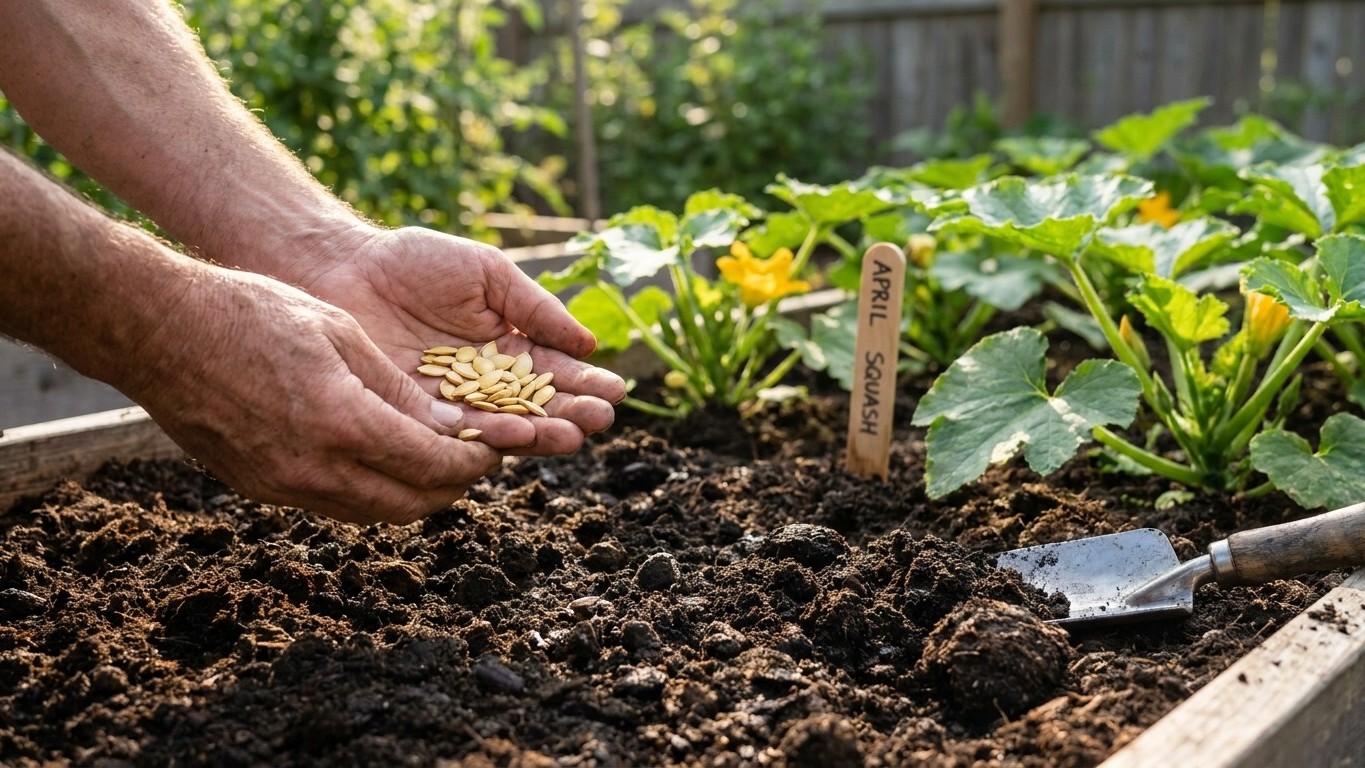

Summer squash goes into the ground here from mid-May through early June, once soil has had real time to warm well past the region’s mean last-frost date of March 18. That date, drawn from Vancouver’s climate record, is a midpoint, not a guarantee: squash tolerates zero frost, so the calendar has to bend around a number that’s wrong half the time.
The short answer for British Columbia
Start with what the frost dates actually say. Environment and Climate Change Canada puts the mean last spring frost at Vancouver Int’l A on March 18, and the mean first fall frost on November 10. Those are averages pulled from three decades of data, which means in roughly half of all years, frost shows up later than March 18. Summer squash has no frost tolerance at any growth stage, so gardeners here don’t plant on the average date. They plant weeks after it, once the soil itself has caught up.
In practice that pushes direct seeding to mid-May through early June for most coastal gardens, with transplants started indoors three to four weeks earlier for those who want an edge on the season. The gap between the two mean frost dates works out to about 236 days, which is far more runway than summer squash needs. Most varieties reach harvest in 45 to 55 days from seed, so season length is not the constraint driving this calendar. Frost timing and cool spring soil are.
Why heat isn’t part of this decision
The Vancouver reference station logs an average of 0.0 days a year at or above 90°F. That number matters because it tells you heat load isn’t a factor shaping the sowing window here the way it would in a hotter interior valley. Squash still wants warm soil to germinate reliably, generally in the 60°F range, but nobody is racing to beat a heat spike or timing plantings around scorching afternoons. The limiting factor in this part of the province is a slow, damp spring, not a short or blistering summer.
What will not work here
Sowing early because the calendar says spring has arrived is the most common misstep. With a mean last frost of March 18 and real variability around that date, seed going into the ground in early April lands in soil that’s still cold and often waterlogged from a wet coastal spring. Squash seed rots before it germinates in those conditions far more often than it survives. The fix isn’t a fixed date, it’s waiting for the soil itself to warm, which on the coast usually doesn’t happen with confidence until mid-May.
Assuming summer rainfall will cover irrigation is the second failure point, and it trips up gardeners who associate coastal BC with rain in general. Summer rainfall here averages about 5.0 inches across June, July and August, with July, the driest month, delivering only 1.4 inches. That’s a real dry stretch sitting right in the middle of fruit set, and squash plants pulling water to swell fruit daily will stall or drop blossoms if they’re left to whatever falls from the sky. A garden planned around “it rains a lot here” without a watering routine for July specifically will underperform.
Pushing for an aggressive, heat-driven growing style, the kind that works in a region logging weeks of 90°F-plus days, also falls flat. With zero days that hot in the local record, plants here move at a steadier, cooler pace all season. Varieties or techniques bred around rapid heat-driven growth won’t find that heat to exploit, and gardeners expecting a hot-climate sprint to harvest will be disappointed by a more gradual coastal rhythm instead.
Finally, tight spacing meant to save space backfires in a climate where spring and early summer carry persistent coastal moisture and cool nights. Crowded plants here hold humidity around their leaves longer than the same spacing would in a drier interior garden, and that’s a setup for powdery mildew and other fungal trouble later in the season.
What changes across British Columbia
Every figure in this article comes from one reference point: Vancouver Int’l A, rated Canadian hardiness zone 9a. That’s worth repeating clearly, because British Columbia is not a one-climate province, and 9a describes the mild, marine-influenced south coast, not the Interior, not the Kootenays, not the north. Canada’s hardiness system is built from seven climate variables rather than the single temperature measure the USDA scale uses, so there’s no clean conversion even between systems, let alone across a province this size. There is no single planting date for “British Columbia.” There’s a coastal answer and a very different set of answers everywhere else.
Gardeners in the Interior, at higher elevation, or further north should expect both ends of the growing season to close in. A later, colder spring pushes safe sowing dates well past what the south coast sees, and an earlier fall frost trims weeks off the back end. That combination can matter for summer squash even with its short 45- to 55-day run to harvest, particularly for anyone hoping for a second sowing or an extended pick window into fall.
This page can’t tell an individual reader which zone they garden in, and it shouldn’t try. What it can say is that the spread inside BC’s borders is wide enough that a date built for Vancouver’s marine climate is a starting reference for the coast alone, not a province-wide rule. Anyone gardening away from the south coast needs a local zone lookup before trusting any date on this page.
Where to check this for your own county
The BC Ministry of Agriculture and Food publishes provincial resources, and that’s the right next stop for anyone gardening outside the immediate Vancouver area. What to look for there is specific: regional or district planting guidance where it exists, and any notes on which squash varieties have actually been trialled and performed well in your part of the province, since that kind of on-the-ground result carries more weight than a provincial average.
A county- or district-level recommendation will always beat a provincial one, for the same reason a single weather station can’t speak for an entire province. This page is built from one station’s climate normals, useful as a baseline but blunt compared to information gathered closer to your own soil and microclimate. If a regional office or local extension contact has published anything more specific to your district, treat that as the better source and use this page as background, not as the final word.
Where provincial pages don’t drill down to district level, local garden centers and community garden coordinators in your area often hold informal versions of exactly this knowledge, built from years of watching what survives a local spring. That kind of practical record fills gaps a climate-normals page like this one simply can’t.
Checking this against your own garden
None of the dates above beat what your own garden tells you directly, and three signs are worth watching before you commit seed to soil. First, soil warmth by feel: push a finger a couple inches into the bed, and if it still feels cold or clammy in mid-May, your particular spot is running behind the regional average and needs more time, regardless of the calendar.
Second, watch for the first flush of male flowers once plants are up and growing. Squash typically produces male blooms before female ones, and their appearance signals the plant has settled into active growth in your specific conditions, which is useful confirmation that your timing worked.
Third, track how fast true leaves develop after the seedling stage. Quick, sturdy true-leaf growth points to soil and temperature conditions that suit the plant; slow, pale growth suggests the soil was still too cool when you sowed, useful information for adjusting next year’s date on your own plot rather than relying purely on a station average miles away.