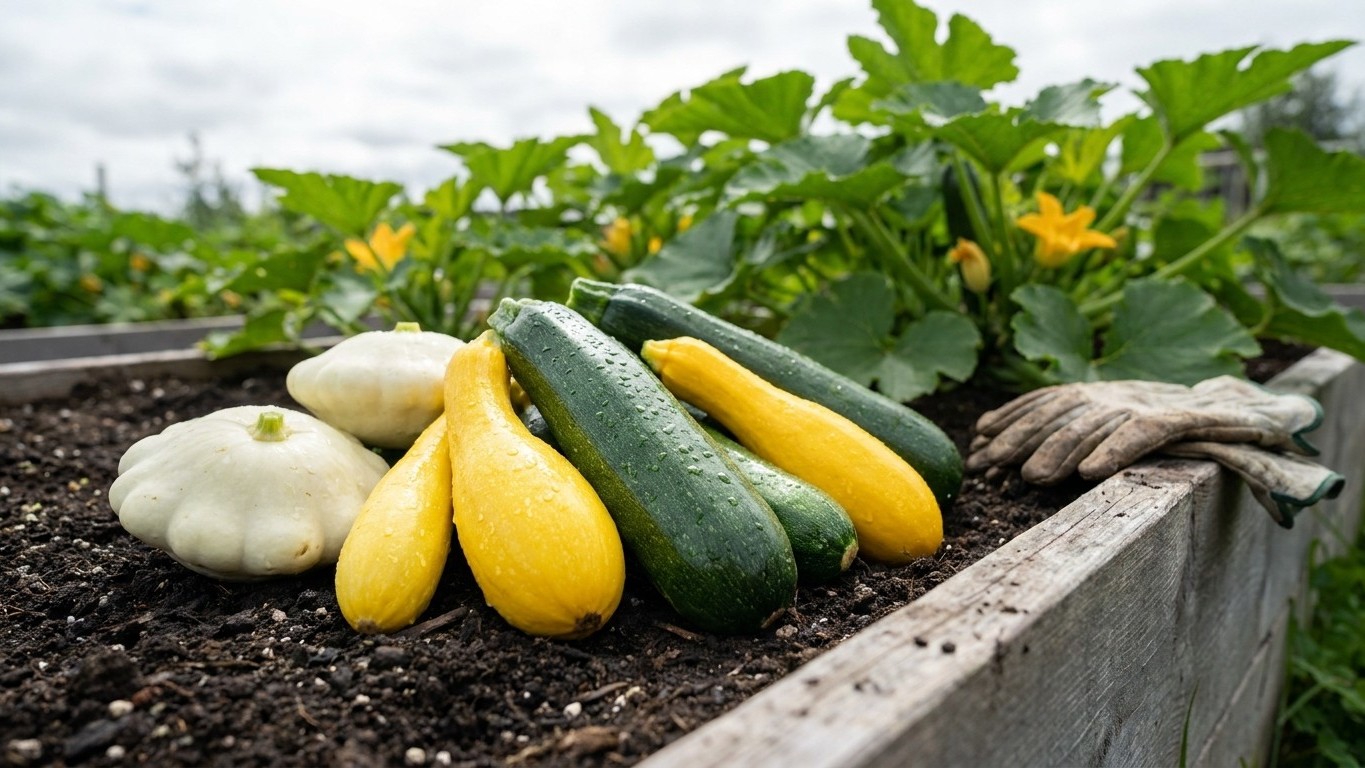

Bush zucchini and yellow straightneck squash bred for powdery mildew resistance are the safest bet for most of Connecticut. The state’s frost-free window runs long enough for nearly any summer squash type, so the real decision hinges on humidity tolerance and disease resistance rather than days to maturity.
The short answer for Connecticut
Start with the calendar. Connecticut’s last spring frost falls between April 2 and April 12, and the first fall frost arrives between October 28 and November 10, both measured at the Bridgeport reference station over the 1991-2020 period. That’s a frost-free stretch of roughly 200 to 220 days depending on where in that window a given year lands. Summer squash needs 45 to 65 days from seed to first harvest, so length of season is not the constraint here. It almost never is for this crop in this state.
What actually separates a good year from a disappointing one is moisture and disease pressure, not heat. Connecticut averages just 6.2 days a year at or above 90F, which is a mild heat load compared to much of the country growing the same vegetable. That means varieties selected for scorching, arid climates gain nothing here and sometimes underperform, because they were never optimized for the cooler, damper conditions this state actually delivers.
Given that combination, the decision by type looks like this: bush-habit zucchini and yellow crookneck or straightneck varieties bred with powdery mildew tolerance are the strongest general-purpose choice for a Connecticut backyard plot. Pattypan and scallop types perform just as well season-length-wise and hold up reasonably against the same fungal pressure if chosen for resistance. Vining types are not a poor choice biologically, but they demand more square footage than most suburban Connecticut lots offer, and they don’t gain any advantage from the state’s climate that a bush type doesn’t already capture.
The summer rainfall total, about 11.1 inches spread across June, July and August, with July the driest month at 3.32 inches, matters more than any heat statistic when picking a variety. Squash that need very even, ample moisture to avoid blossom-end problems or fruit deformities are working against a state where the rain comes in bursts and July regularly runs short. A resilient, disease-resistant bush variety tolerates that unevenness better than a finicky heirloom does.
What will not work here
Sowing squash outdoors in late March or the first days of April is the single most common mistake in this state. The last frost doesn’t clear until somewhere between April 2 and April 12, and squash seedlings have zero frost tolerance. A cold snap that arrives even a few days inside that window kills young plants outright, and gardeners who jump the gun because a warm stretch showed up in mid-March lose their first planting almost every year. Soil temperature matters as much as air temperature here: squash seed sits and rots in cold, wet spring soil rather than germinating, so early sowing doesn’t just risk frost, it risks the seed never coming up at all.
Heirloom or specialty varieties bred for hot, dry western or southern growing regions consistently underperform in Connecticut, and the reason is humidity, not temperature. With summer rainfall running around 11.1 inches and humidity lingering after nearly every rain event, powdery mildew and downy mildew find ideal conditions on foliage that stays damp longer than it would in a drier climate. Varieties without built-in resistance to these fungal diseases often decline sharply by mid-August, well before the first fall frost would otherwise end the season.
Assuming a weekly watering schedule is enough is another failure point specific to this state’s rainfall pattern. July, the driest summer month at just 3.32 inches, frequently produces stretches of a week or more with no meaningful rain, and on sandy or well-drained soil that moisture disappears within a day or two. A gardener watering once a week on that soil type is effectively letting the plant go dry for several days at a stretch during peak fruit set, which shows up as small, bitter, or misshapen squash.
Spacing too tight in humid pockets
Planting bush varieties at the tight end of their spacing range compounds the mildew risk described above. Reduced airflow between plants keeps leaves wet longer after rain or morning dew, and in a state where summer humidity is already working against the gardener, cramped spacing removes one of the few free defenses available.
What changes across Connecticut
Connecticut spans USDA Hardiness Zone 6a to 7b, according to the USDA Plant Hardiness Zone Map built on 1991-2020 normals. That’s a real spread within one small state, not a rounding difference, and it means there is no single frost date or season length that applies everywhere. The coastal reference station used for the frost dates above sits in the warmest part of that range, close to Long Island Sound, which moderates temperature swings in both directions. Inland valleys, the higher elevations of Litchfield County, and the northwest hills run colder in both directions: frost arrives earlier in fall and lingers later in spring than the coastal numbers suggest.
For a gardener in one of those colder inland or upland pockets, the practical shift is to treat the coastal frost dates as an optimistic guide rather than a firm schedule. Pushing transplant or direct-sow dates a week or two later in spring, and treating the fall frost date as arriving a week or two earlier, is a reasonable adjustment until a gardener has a season or two of local observation to calibrate against. The zone spread from 6a to 7b is exactly the kind of variation that makes a single statewide date range imprecise for anyone away from the coast.
This doesn’t change which squash types work, since the season is long enough across nearly the whole range for any summer squash variety to mature and produce. What it changes is the margin for error. A gardener in the milder 7b coastal zone has more slack to recover from a late spring cold snap or an early fall chill. A gardener in the colder 6a interior has less room, which makes choosing a fast-maturing, disease-resistant bush variety even more worthwhile, since it gets a harvest established before either end of the season narrows.
Where to check this for your own county
The state-level numbers on this page describe Connecticut broadly, anchored to a single coastal reference station. A county-level recommendation will always beat that, because it accounts for the elevation, frost pattern, and soil conditions specific to a smaller area, and this page simply cannot do that job. The place to get that finer detail is the University of Connecticut Cooperative Extension.
Two things are worth looking for once there. The first is a local or regional planting calendar, if one is published for the reader’s part of the state, since it will reflect the actual frost pattern of that county rather than the coastal normals cited on this page. The second is any list of squash varieties that have been trialled or specifically recommended by UConn Extension for Connecticut growing conditions. Land-grant extension services run variety trials precisely because a statewide guide can’t account for every local combination of soil, elevation, and microclimate, and those trial results are the closest thing available to ground-truthing what actually performs.
Extension offices also field direct questions from local gardeners, often through a county office or a master gardener helpline, which is a reasonable next step for anyone whose plot sits well outside the coastal conditions described in the state normals above, particularly in the higher, colder parts of Litchfield County or other inland areas where the zone 6a end of the state’s range applies.
Checking this against your own garden
Every date and average on this page describes what the region can typically expect, not what’s happening in one particular yard. The most reliable information a gardener has is what the plants themselves are doing, and three simple observations outrank any calendar.
Soil warmth by feel is the first. Squash seed sown into soil that still feels cold to the hand, even after the calendar says frost has passed, tends to sit and rot rather than germinate. Waiting until the soil feels consistently warm, not just the air, is a better trigger than any single date.
The first flush of male flowers is the second signal worth tracking. Squash plants typically produce male flowers before female ones, and a strong early flush suggests the plant has settled in well and is building toward fruit production. A long delay in flowering, well past when neighboring gardens are seeing blooms, often points to a cooler or shadier microclimate than the general area suggests.
The appearance of the first true leaves, the second set that follows the initial rounded seed leaves, is the third. Their timing and vigor say a lot about how the plant is handling local soil and moisture conditions, and a gardener who tracks that timing from year to year on the same plot builds a far more precise sense of their own microclimate than any state or county average can offer.