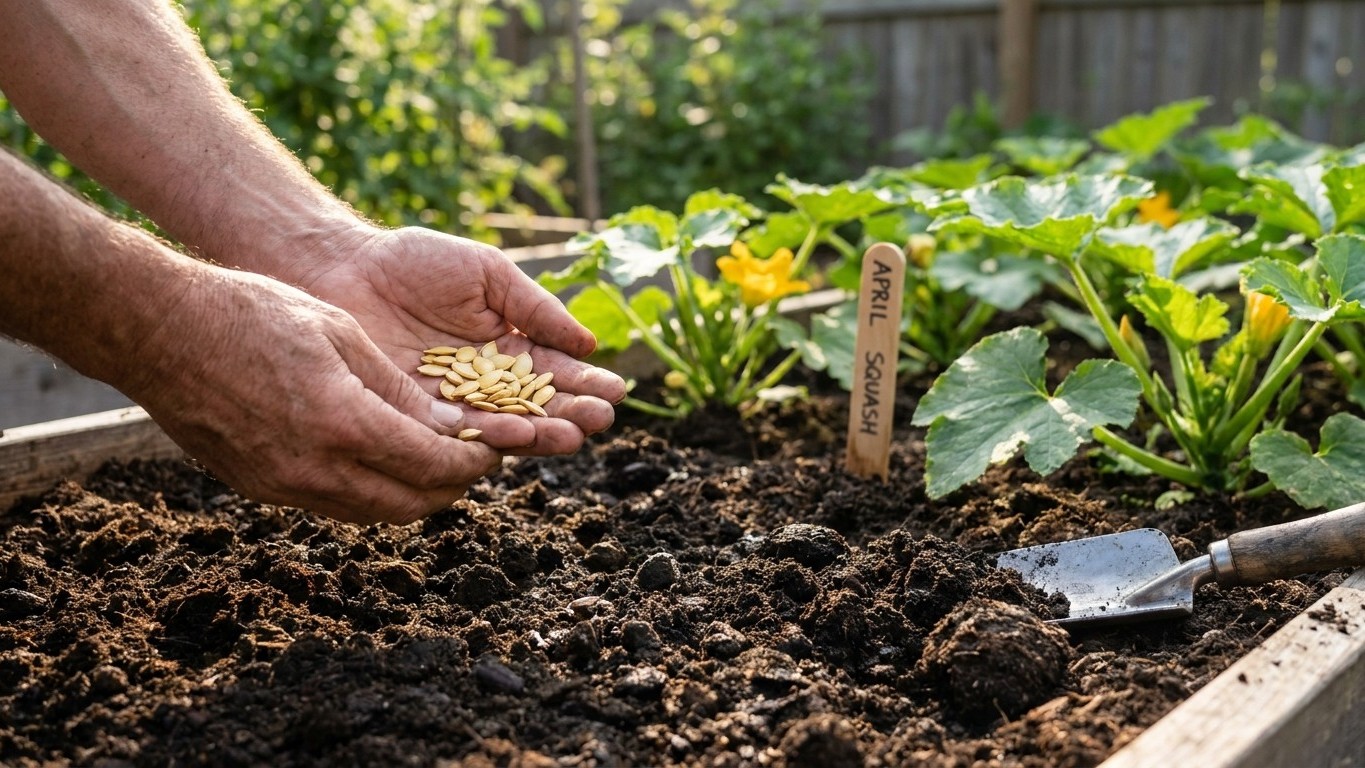

The safe window to direct-seed summer squash outdoors in Idaho’s Boise valley runs from roughly May 7 through early October, built around a last spring frost that falls between April 23 and May 7 and a first fall frost between October 7 and October 21. But that window is a probability, not a promise, and most of the state sits colder and shorter than the valley these dates come from.
The short answer for Idaho
Summer squash is a warm-season crop with no tolerance for frost, so the sowing decision hinges entirely on those spring and fall dates from NOAA’s 1991-2020 climate normals for station USW00024131, the Boise reference station. The last spring frost falls somewhere between April 23 and May 7, that’s the 30 to 70 percent probability band for a 32F freeze, meaning even by May 7 there’s still a real chance, just under a coin flip, of a damaging freeze in a given year. Direct-seeding before that band closes is a gamble with young seedlings that have zero frost tolerance.
The practical answer for a Boise-area gardener: hold direct seeding until the first week of May, and treat late April as transplant-only territory, ideally under row cover or a cold frame that buys a couple weeks of insurance. On the back end, the first fall frost arrives between October 7 and October 21, which sets the hard stop for harvest regardless of how many blossoms are still on the vine.
Stack those two windows against each other and the frost-free season in Boise runs somewhere between about 153 and 181 days, depending on where each year lands inside its band. Summer squash varieties typically need somewhere in the neighborhood of 45 to 65 days from seed to first harvest, which means even the shorter end of that Boise window leaves comfortable room, including for a second succession planting in June or early July if the first crop peters out.
One number that doesn’t answer this question, despite looking relevant: the USDA hardiness zone rating of 3b-7b that covers Idaho. That range is built entirely on winter’s average extreme minimum temperature, a measure of what perennial roots survive over winter. It says nothing about when your soil warms up in May or how long your frost-free stretch runs. Don’t use it to time a squash seed. What it does signal, and this matters later in this piece, is that Idaho contains wildly different growing conditions depending on elevation and latitude, and the Boise dates above apply to Boise, not the whole state.
What will not work here
The most common failure isn’t a bad variety choice, it’s timing driven by impatience. Squash seed sown into soil that hasn’t cleared the frost risk band germinates poorly or rots outright, since the seed sits in cool, often damp ground for a week or two before the plant can even push through. Waiting until the probability of a 32F freeze has genuinely dropped, not just until the calendar feels like spring, is the difference between a stand that emerges evenly and one that needs replanting.
The second failure shows up in July and August, and it’s a watering mistake, not a timing mistake. Boise’s reference station averages 47.5 days a year at or above 90F, a heat load that drives fast evaporation from both soil and leaf surface. Against that heat, summer rainfall during the growing season is thin: about 1.1 inches total across June, July and August combined, and it doesn’t fall evenly. June brings 0.75 inches, July drops to just 0.21 inches, and August, right when plants are setting and sizing fruit, is the driest month of the year at 0.17 inches. A gardener who waters once a week and expects rain to fill the gaps is going to watch blossoms drop and fruit turn bitter or misshapen, because the plant is under water stress exactly when it needs consistent moisture most.
That combination, low summer rainfall stacked against high heat load, means the failure mode here isn’t the crowded, humid conditions that cause mildew problems in wetter states. It’s drought stress. Mulching to hold soil moisture and watering deeply two or three times a week through July and August matters more in this climate than the plant spacing adjustments that a humid-summer gardener would prioritize.
The third failure is variety mismatch at altitude, which the Boise numbers above don’t cover at all and which the next section addresses directly. A slow-maturing or vining summer squash variety that works fine in a 175-day valley season can simply run out of time in a much shorter mountain season, arriving at first frost with fruit still small.
What changes across Idaho
Idaho’s hardiness zone range, 3b through 7b under the USDA system, is one of the widest spans of any state, and it exists because the state stacks a low, relatively mild valley floor against high mountain basins and northern latitudes that behave nothing alike. That range is built on winter’s extreme minimum temperature, but it’s a useful flag here for a different reason: it tells you the frost-free season length varies enormously across the state too, even though that’s not literally what the zone number measures.
The frost dates cited above, April 23 to May 7 for last spring frost and October 7 to October 21 for first fall frost, come from the Boise reference station specifically. Boise sits in a low valley, one of the warmer, longer-season pockets in the state. Higher elevations and northern valleys run considerably colder and shorter, sometimes by a matter of weeks on both ends of the season, which compresses the frost-free window that summer squash depends on.
There is no single planting date for Idaho as a whole, and this page can’t responsibly hand you one beyond the Boise-area window above. What a gardener at higher elevation or further north should do differently: lean on transplants rather than direct seed to buy two or three weeks of head start, use black plastic mulch to warm the soil early, keep row cover on hand for late cold snaps even after the “safe” date has technically passed, and pick the fastest-maturing summer squash varieties available rather than the slower, larger-fruited types that a longer valley season can accommodate.
None of that substitutes for knowing your own local frost dates. The zone map and the county-level data referenced in the next section are where that gets settled, not a statewide range.
Where to check this for your own county
University of Idaho Extension publishes county-level planting guidance that reflects actual local conditions rather than a single valley reference station. That’s the resource to check before finalizing a planting date, and it’s the resource this page can’t substitute for.
Two things specifically worth pulling up there: the local planting calendar for your county, which will reflect frost dates recorded closer to your actual garden than the Boise station cited throughout this page, and any variety trial results for summer squash that Extension has run in your area. Land-grant university extensions routinely trial vegetable varieties under local soil and climate conditions and report which ones perform reliably, which is far more useful than a generic variety list, since a squash that thrives in a long, hot valley season may underperform or simply run out of time in a shorter, cooler county.
Worth saying plainly: a county-level recommendation from Extension will beat anything on this page every time. This article works from one reference station’s climate normals, useful as a statewide starting point and for understanding the mechanics of frost probability and heat load, but it is not a substitute for the localized data your county office maintains. If your county’s Extension office publishes its own frost date table or squash variety trial, that number wins over the Boise-based band cited here.
Extension offices also field direct questions from home gardeners, often by phone or email, and can usually speak to conditions on a specific side of a valley or at a specific elevation in ways no published calendar can. That’s the level of detail worth chasing once the general window above has narrowed your planting decision to a specific week or two.
Checking this against your own garden
Every date on this page is a normal built from thirty years of averages at one weather station. Your own garden will run ahead of or behind that average depending on slope, soil type, sun exposure and a dozen other small factors, so three direct observations settle the question better than any calendar.
Soil warmth by feel is the first and most reliable check. Push a finger a couple inches into the planting bed in the morning; summer squash seed wants soil that feels genuinely warm, not just frost-free. Cold, clammy soil that feels only a little above chilly is still too early, regardless of what the calendar date suggests.
The first flush of male flowers on an already-growing plant is the second signal. Squash plants typically produce male blossoms before female ones, and a strong early flush tells you the plant has settled in and started active growth, a sign the local season has genuinely turned the corner into reliable warmth rather than a brief warm spell.
The appearance and vigor of the first true leaves, the second set that emerges after the rounded seed leaves, is the third. Leaves that unfold slowly, with a purplish or stunted look, usually mean the soil is still running cooler than the plant wants, even if air temperatures feel warm during the day. Vigorous, quickly expanding true leaves are the clearest sign that conditions in that specific bed, not the regional average, have caught up to what summer squash actually needs.