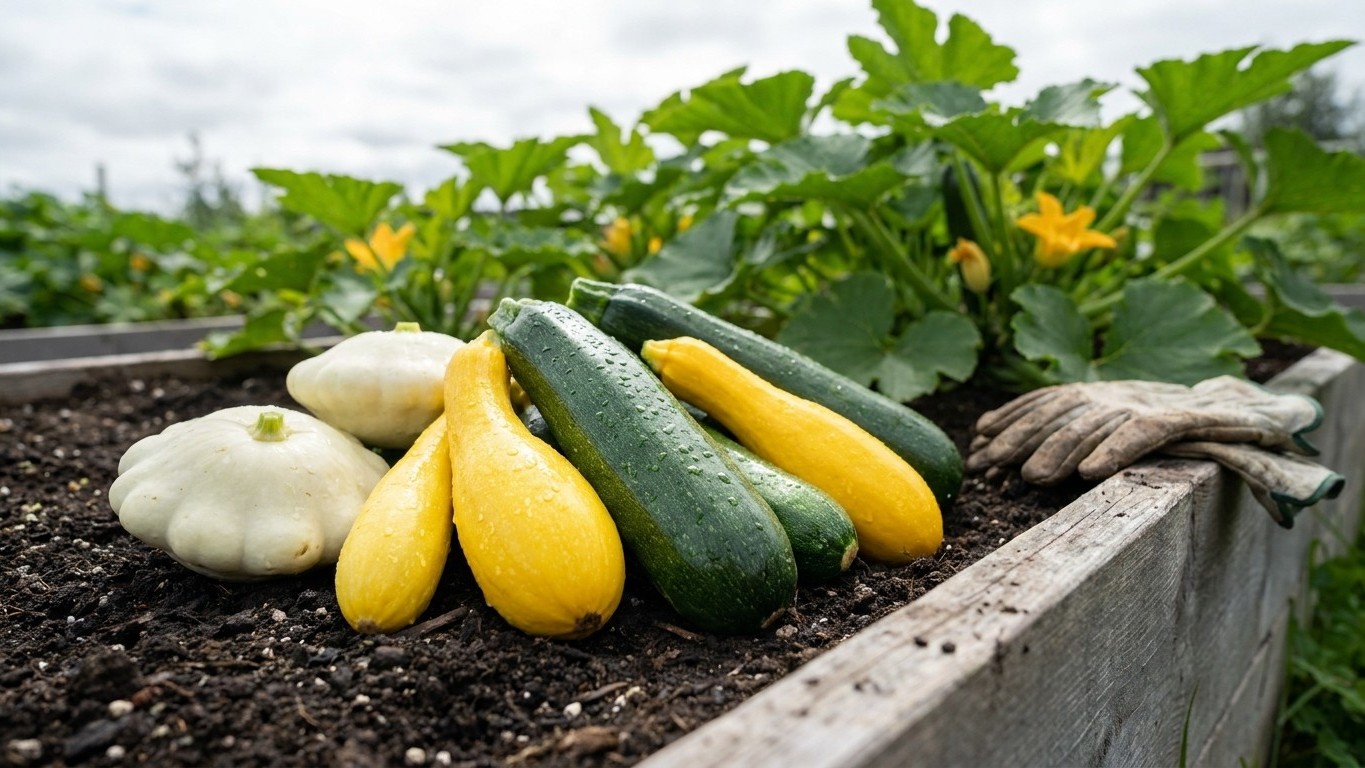

Choose heat-set, powdery-mildew-resistant bush types first, since Kansas summers push past 90°F on 57.6 days a year on average and squash blossoms often abort fruit above that mark. Season length isn’t the constraint here; heat and humidity are. Zucchini and yellow crookneck varieties bred for heat tolerance and disease resistance outperform the classic cool-summer picks most seed catalogs default to.
The short answer for Kansas
At the reference station used for these normals, the frost-free window runs from a last spring frost of April 4 to April 18 to a first fall frost of October 23 to November 2. Do the math and that’s somewhere near 198 to 212 days of growing season, depending on where in that probability band your year lands. That’s a long window by squash standards, long enough that a slow vining variety has time to sprawl and ripen without racing the calendar. So the decision in Kansas isn’t “can I finish this variety before frost” the way it might be in Minnesota or Montana. It’s “can this variety keep setting fruit through the hottest stretch of July and August without shutting down.”
That reframes the whole choice. Bush-type summer squash, the compact zucchini and yellow crookneck forms bred for continuous production, handle the heat load better than sprawling heirloom types that were selected in cooler, shorter-summer regions. Look for varieties explicitly marketed as heat-tolerant or bred for southern and Great Plains conditions. Pair that with powdery mildew resistance, because the summer rain pattern here, about 13.2 inches spread across June (4.93 inches), July (3.98 inches) and August (4.3 inches), keeps enough humidity around leaf surfaces in a wet June to set up mildew pressure even when July itself turns dry.
Vining varieties aren’t ruled out. With close to seven months of frost-free time available, a vigorous vining zucchini or a scalloped pattypan has room to run. The tradeoff is space and airflow: a sprawling plant packed too close to its neighbors traps humidity at the leaf level, and that’s exactly the condition that turns a wet June into a mildew outbreak by mid-July. If space is tight, bush types win on both counts, faster to first harvest and easier to keep dry.
The bottom line for a Kansas garden: prioritize heat tolerance and disease resistance over days-to-maturity. A 50-day variety and a 65-day variety both have time to finish. Only one of them may still be setting fruit cleanly when the thermometer sits above 90°F for the better part of eight weeks.
What will not work here
Varieties selected for cool, short, foggy-summer regions, the kind of squash you see recommended for coastal Pacific Northwest gardens, tend to struggle once daytime highs push consistently into the 90s. Squash blossoms are sensitive to heat stress: pollen viability drops and fruit set becomes erratic when temperatures run high for extended stretches, and Kansas racks up 57.6 such days in an average year. A variety bred without any regard for heat tolerance will often keep producing male flowers while female flowers abort, leaving a gardener with plenty of blooms and disappointingly little squash on the vine through late July and August.
Watering on a once-a-week schedule is another mismatch. With 57.6 days a year at or above 90°F, evaporative demand runs high, and a single weekly soaking on sandy soil can leave roots dry well before the next watering. The summer rainfall total, roughly 13.2 inches across June through August, sounds reasonable on paper, but it doesn’t arrive evenly. July is the driest of the three months at 3.98 inches, meaning a squash plant can go through the hottest stretch of summer on the least rainfall of the season. Gardeners relying on rain alone to carry plants through July are the ones most likely to see stunted, bitter fruit.
Tight spacing is the third failure point, and it’s specific to the rainfall pattern here rather than a generic gardening rule. June brings the wettest month of the summer at 4.93 inches, often arriving as thunderstorms rather than gentle, soaking rain. That combination, wet foliage plus warm nights, is close to ideal for powdery mildew and downy mildew to take hold. Varieties without listed disease resistance, planted at the tight spacing recommended on a seed packet written for a drier climate, tend to show mildew on the lower leaves by midsummer and can lose significant productive leaf area before the season’s best harvest weeks even arrive.
Put together, the plants most likely to disappoint in Kansas are heat-sensitive heirlooms, planted close together, and watered on a fixed weekly schedule regardless of soil type or heat spikes. All three problems trace back to the same two numbers: 57.6 days above 90°F, and a summer rainfall total that’s front-loaded into June rather than spread evenly.
What changes across Kansas
Kansas spans USDA Hardiness Zones 5b to 7a, based on the USDA Plant Hardiness Zone Map’s 1991-2020 average annual extreme minimum temperature. That’s a meaningful spread within one state. Zone 5b sits at the colder end, typically found toward the north and at higher elevation in the state; zone 7a sits at the milder end, generally toward the south. There is no single answer for “when is it safe to plant Squash in Kansas” that applies equally at both ends of that range, and this page, built from a single reference station, can’t tell you which end applies to your yard.
What that spread means in practice: a gardener in the colder end of the state’s zone range is working with a shorter effective window before the first hard fall frost and later safety in spring than the frost dates cited above, which come from one specific weather station. A gardener toward the milder end likely gets a longer stretch on both ends of the season. Since the frost-date figures already come with the caution that suburban and rural gardens tend to see later spring frosts and earlier fall frosts than an airport-based reading, often by one to two weeks, that gap only widens the further you are from the reference station and the higher your elevation.
The practical shift for a reader toward the colder end of that zone range is to lean harder on faster-maturing bush varieties and to treat the spring planting date as a suggestion to verify locally, not a fixed calendar entry. A reader toward the milder end has more room for a slower vining variety and can push a second summer squash planting later into the season for a fall harvest. Neither adjustment comes from this page alone. The zone map itself, not a paragraph of state-level averages, is what tells you which end of that 5b-7a range your specific location falls into.
Where to check this for your own county
The frost dates and heat-day counts on this page come from one reference weather station, and Kansas is a big state with real differences in elevation, soil, and microclimate from the Missouri border to the Colorado line. The next step is K-State Research and Extension, the state’s land-grant extension service, and it’s a better source for your specific county than any statewide summary, including this one.
Two things are worth looking for once there. First, a local planting calendar for your county or region, which will reflect the actual frost pattern recorded near you rather than the single airport station used for these statewide normals. Second, variety trial results or recommended-variety lists specific to Kansas growing conditions. County extension offices and K-State’s horticulture program regularly test summer squash varieties under regional heat and disease pressure, and their recommendations reflect real performance in Kansas soil and Kansas summers rather than a national seed catalog’s general description.
A county-level recommendation will always outrank a state-level one, because it accounts for local soil type, local rainfall patterns that can differ from the statewide average cited here, and local pest and disease pressure that varies from the eastern part of the state to the drier west. This page is deliberately the state-level view, useful for understanding the broad pattern of heat load and rainfall that shapes variety choice across Kansas, but not a substitute for what your county extension agent has actually observed in trial plots near you. If the two disagree on a planting date or a variety recommendation, trust the county source.
Checking this against your own garden
None of the figures above, not the frost dates, not the heat-day count, not the rainfall averages, replace what your own garden tells you in real time. Three signs are worth tracking, and each one reveals something about your specific microclimate that a statewide normal can’t.
Soil warmth by feel is the first. Summer squash seed germinates poorly in cold soil, and a simple hand check, pushing a finger a couple of inches into the bed in the morning, tells you whether the soil has actually warmed enough regardless of what the calendar says. A raised bed or a south-facing slope often warms noticeably ahead of an open, low-lying garden, even within the same yard.
The first flush of male flowers is the second signal. Summer squash typically produces male blossoms before females, and their appearance is a rough marker that the plant has settled into active growth. If male flowers show up but female flowers lag well behind for an extended stretch during a hot spell, that’s a sign the heat is suppressing fruit set, echoing the heat-stress pattern that shows up statewide on the 57.6 days a year above 90°F.
The first true leaves, the ones that appear after the initial rounded seed leaves, are the third. Their size, color, and speed of appearance say a lot about whether your soil, sun exposure, and watering routine are actually matching what the plant needs on your specific plot, not just what a regional average predicts. Slow, pale true leaves point toward a watering or fertility gap worth addressing before the heat of midsummer arrives.