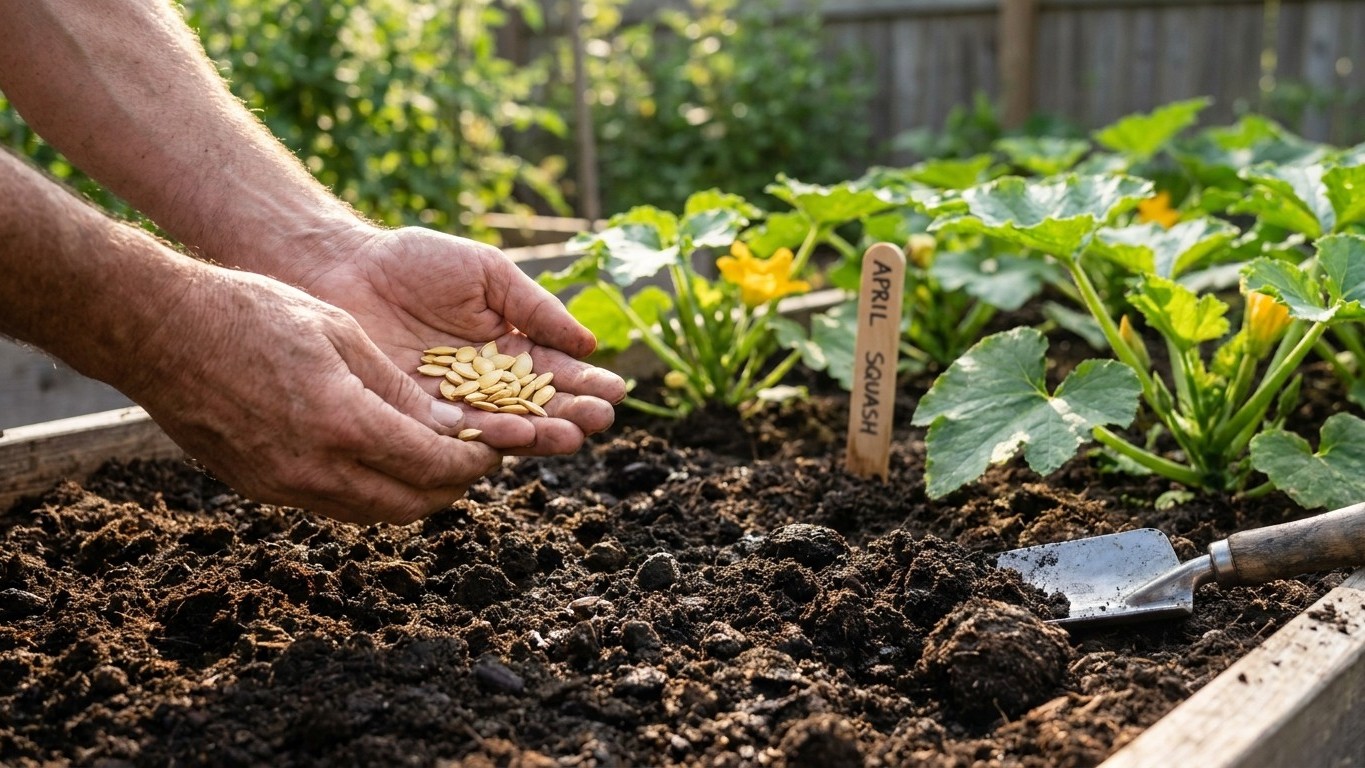

Summer squash goes into Kansas gardens once the frost risk drops below one in three, which for the Wichita reference station falls between April 4 and April 18. Because the plant can’t take even a light freeze, that window is the real starting line, and it opens differently depending on where in the state you’re standing.
The short answer for Kansas
Sow summer squash directly in the ground after the last spring frost window closes: April 4 to April 18 is the 30-70% probability band for a final 32°F freeze at the Wichita airport station (NOAA NCEI, 1991-2020 Climate Normals). That band is not a guarantee. It means that by April 4, roughly 70% of years are already frost-free, and by April 18, the odds of another freeze have dropped to about 30%. Waiting until the later end of that stretch buys you insurance; jumping in at the early end trades some risk for a longer harvest season.
What makes summer squash forgiving is its short life cycle. Most types run 45 to 55 days from seed to first harvest, and Kansas offers a long runway to work with: the first fall frost at the same reference station lands between October 23 and November 2. That’s roughly six and a half months of frost-free growing, more than enough room to sow a second or even third round through late May and June for continuous fresh fruit into September.
The USDA Plant Hardiness Zone Map lists Kansas as spanning zones 5b through 7a, but that number describes winter minimum temperatures, not summer planting timing. It’s useful for deciding whether a perennial will survive January, not for deciding when to drop squash seed in May. For summer squash, the frost dates and the days-to-maturity math are what set the calendar, not the hardiness zone.
So the working answer: aim for the last week of April into May for your first sowing, then follow with succession plantings every three to four weeks through late June or the first days of July, timed so the final round still has 45-plus days to mature before the earliest fall frost risk arrives in late October.
What will not work here
Planting ahead of that April 4-18 band is the most common misstep. Summer squash has zero frost tolerance, and seed or seedlings set out during the 70%-plus frost-risk period simply die back or stall in cold soil, forcing a costly resow. Unlike a leafy green that shrugs off a light freeze, squash offers no second chance once the tissue is hit.
On the other end of the season, waiting too long to start a final succession planting runs the plant out of time. If you sow after the first week of July, a 50-day variety is due to mature right around October 1 through mid-October, uncomfortably close to the October 23-November 2 fall frost window, and any given year could land on the early side of that range. A late-July sowing gambles the whole planting on a frost that arrives late.
Kansas summer heat is the other trap. The reference station averages 57.6 days a year at or above 90°F, a heavy heat load that drives fast evaporation and heavy water demand right through fruiting. Combine that with a July that’s typically the driest summer month at just 3.98 inches of rain, and a once-a-week watering routine leaves the shallow-rooted plant short on moisture exactly when it’s setting fruit. Blossom drop and stunted, misshapen squash are the usual result of that gap between heat load and rainfall.
Rainfall doesn’t arrive gently, either. Kansas summer moisture tends to come as thunderstorms rather than steady drizzle, meaning a good part of that June-through-August total of about 13.2 inches runs off rather than soaking into the root zone. Gardens on heavier clay hold that moisture longer; sandy soil lets it through in a day, which is exactly the kind of local variable no statewide rainfall number can settle for you.
What changes across Kansas
A hardiness range of 5b to 7a is a wide spread for one state, and it signals something worth taking seriously: there’s no single frost date that applies from the Colorado border to the Missouri line. The reference figures above come from one station, generally representative of south-central Kansas. Areas farther north, or at higher elevation in the western part of the state, run cooler and see their frost windows shift accordingly.
Elevation matters more in Kansas than most gardeners expect. The land rises steadily from around 700 feet in the southeast corner to well over 3,000 feet in the high plains near the Colorado line, and that climb cools the air enough to push both frost dates in opposite directions: a later last spring frost and an earlier first fall frost, which together shorten the safe planting season by a week or two compared with the reference station’s numbers.
The practical shift for a gardener in one of those cooler pockets: treat the April 4-18 band as an early estimate rather than a firm start date, and lean toward the later end, or even a few days past it, before direct-seeding. On the back end, stop starting new successions by mid-to-late June instead of stretching into July, since a shorter frost-free window leaves less cushion for a slow-maturing planting.
None of this replaces knowing your own location. The state spans enough hardiness zone variation that a single answer can’t cover it, which is exactly why the next step matters: checking a source built around your own county rather than one weather station.
Where to check this for your own county
K-State Research and Extension is the place to take this from a state-level estimate to a county-level plan. The frost dates and rainfall figures in this article come from one airport weather station; your local extension office works from data and field trials specific to your county’s soil and microclimate, which is a meaningfully different, more precise starting point.
Once there, look for two things specifically. First, a local or regional planting calendar for vegetables, which will translate the general frost-date math above into dates adjusted for your part of the state, whether that’s the humid southeast, the drier west, or somewhere along the elevation gradient in between. Second, look for variety trial results or recommended cultivar lists for your county or extension district. Summer squash varieties differ in disease resistance and days to maturity, and the ones performing best in a humid river-bottom county aren’t necessarily the same ones thriving in a dry, windy western county.
A county recommendation beats a state one every time, for the simple reason that it’s built on conditions closer to your actual garden. This page works from a single reference station’s normals, useful for understanding the mechanics of frost probability and heat load, but not a substitute for the localized data your extension office maintains. Treat this article as the framework, and your county extension page as the fine print that adjusts it to where you actually garden.
Checking this against your own garden
Every date on this page is a normal, an average built from thirty years of weather station records. Your own garden runs on its own conditions, and three simple observations will tell you more than any calendar.
Start with soil warmth by feel. Push a finger a few inches into the bed on a spring morning; if it feels cold and damp rather than cool and workable, the ground hasn’t caught up to the calendar yet, no matter what the frost-date band suggests. Summer squash seed sits and rots in cold soil rather than germinating, so this simple check often matters more than the date on a seed packet.
Watch for the first flush of male flowers once plants are established. Squash produces male blooms before the female flowers that actually set fruit, and their appearance signals the plant has shifted from vegetative growth into reproductive mode. An early, strong flush suggests your particular spot, with its sun exposure and soil, is running warm and vigorous for the season; a delayed or sparse flush suggests the opposite, and that your microclimate may run cooler or slower than the regional average.
Finally, note when the first true leaves appear after the seed leaves, or cotyledons. That transition marks the seedling settling into real growth, and its timing, faster or slower than a typical 45-to-55-day maturity clock would suggest, tells you how your specific bed compares to the regional normal this article is built on. Taken together, these three checks turn a statewide estimate into something calibrated to your own yard.