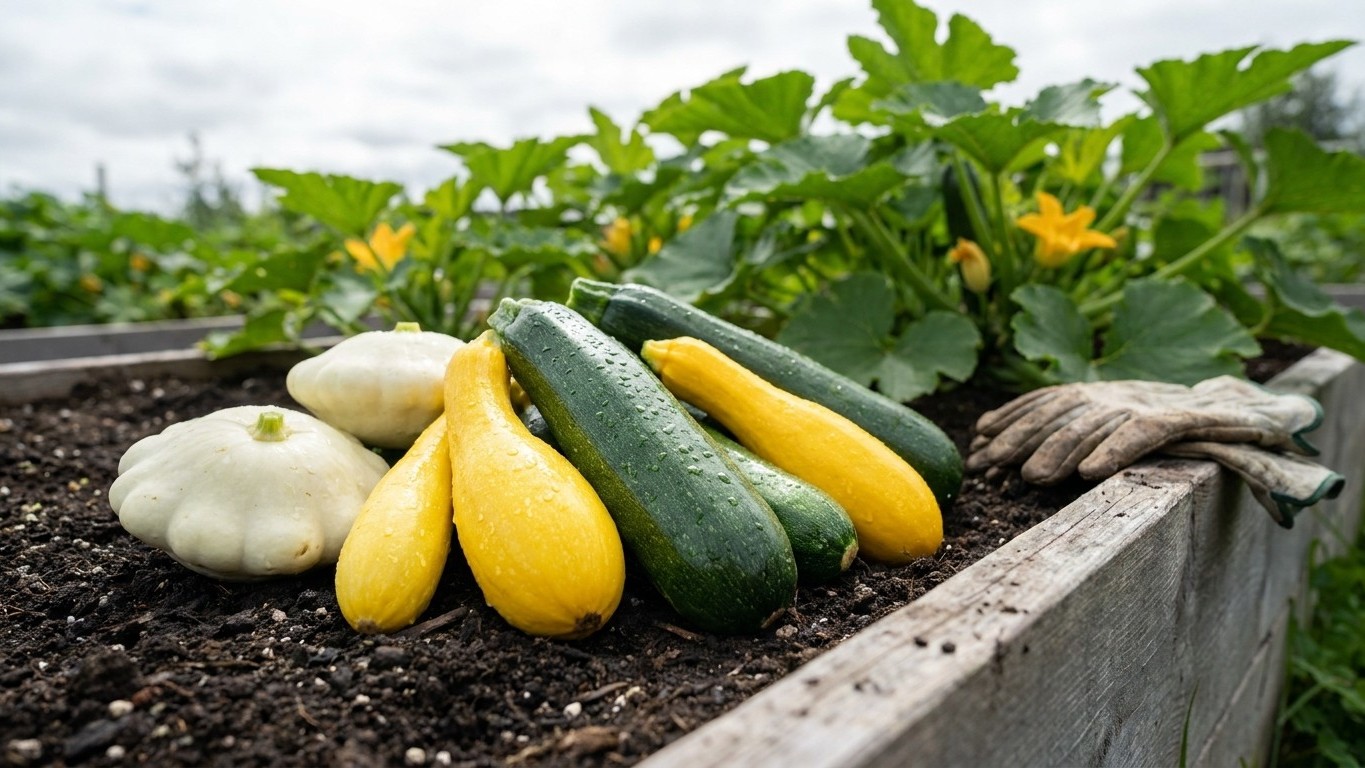

Zucchini and yellow summer squash both mature fast enough for Maine’s frost-to-frost window, but the varieties that do best here are the shorter-season types, not the ones bred for long, blistering summers further south. Maine’s cool nights and modest heat load favor squash that sets fruit without needing weeks of 90-degree days to do it.
The short answer for Maine
Start with the number that actually decides this: Maine averages just 3.8 days a year at 90°F or above, measured at the Portland reference station over 1991-2020. That’s not a typo and it’s not a bad summer, it’s the normal. Summer squash doesn’t need tropical heat to produce, but fruit set and growth rate both slow down without a steady run of warm days, and Maine simply doesn’t offer many of those. That single fact reshapes the variety decision more than anything else on this page.
For gardeners working with the frost-free window near Portland, roughly April 22 to May 1 for the last spring freeze and October 9 to October 21 for the first fall freeze, the growing season runs somewhere between about 161 and 182 days depending on where those dates fall in a given year. That’s generous by New England standards. It means days-to-maturity isn’t the limiting factor for most summer squash the way it is in, say, northern Vermont or coastal Alaska. The limiting factor here is heat accumulation, not calendar days.
That changes the type of squash worth choosing. Bush-type zucchini and yellow crookneck or straightneck varieties bred for standard 45- to 55-day maturity windows are the safe default, because they don’t demand extended heat to size up fruit. Compact bush habits also matter in a state where garden space is often carved out of a short, busy season rather than laid out on acreage. Pattypan and scallop types work too, and tend to be forgiving of the on-and-off warmth that’s typical of a Maine June.
What doesn’t fit as well are the specialty and heirloom types that were selected in hotter growing regions and rely on sustained heat units to push vigorous vine growth, things like some of the trailing Italian and Mediterranean summer squash varieties that want long, hot stretches to really take off. They’ll often still produce in Maine, but later, smaller, and less reliably than a straightforward bush zucchini or crookneck planted in the same bed. If the goal is a dependable harvest rather than a specific heirloom flavor, the shorter-season bush types are the better bet across nearly all of Maine.
What will not work here
The clearest failure mode in Maine isn’t a short season, it’s mismatched heat expectations. A variety bred to ripen under long stretches of 85-95°F weather is going to sulk here. With only 3.8 days a year reaching 90°F, fruit set on heat-hungry varieties can be spotty even when the plant itself looks healthy and green. Growers who’ve had strong luck with a particular squash in a hot southern garden and then bring that same variety north often end up disappointed, not because Maine’s season is too short, but because the heat units simply aren’t there.
Rainfall timing creates a second, less obvious problem. Maine gets about 11.2 inches of rain across June, July and August, but it isn’t spread evenly: June brings 4.15 inches, July drops to 3.43, the driest of the three, and August climbs back to 3.57. That mid-summer dip lands right when squash plants are flowering and setting fruit, the stage where they’re least tolerant of inconsistent moisture. A watering routine built around “once a week” can leave plants short right through the driest month of summer, especially on sandy soil where that rain moves through fast rather than sitting in the root zone.
Humidity compounds the problem for varieties planted at tight spacing. Dense summer air trapped between crowded plants after a June downpour is exactly the environment powdery mildew and other fungal issues thrive in. Varieties without at least some disease tolerance, planted shoulder to shoulder to save space, tend to decline by midsummer in a way that has nothing to do with the length of the season and everything to do with airflow and leaf moisture.
Put together, the varieties that struggle most in Maine share one of three traits: they need extended heat above what the region reliably delivers, they carry high water demand concentrated in July when rainfall is at its yearly low, or they’re bred for tight spacing without built-in mildew resistance. None of these are season-length failures. They’re mismatches between a variety’s native growing conditions and Maine’s actual weather pattern.
What changes across Maine
Maine is not one garden, and the state’s USDA Hardiness Zone range makes that plain: it spans zone 3b to zone 6a, based on the average annual extreme minimum winter temperature. That’s a wide spread for a single state, and it means there’s no single planting date, frost window, or heat expectation that applies evenly from the coast to the far north.
The frost dates and heat-day figures used above come from the Portland reference station, which sits at the mild end of that range. Coastal southern Maine, moderated by the Atlantic, tends to warm earlier in spring, hold heat longer into fall, and see a milder winter minimum than inland or northern parts of the state. Move north toward Aroostook County or up in elevation through the western mountains, and both the hardiness zone number and the practical growing season shift substantially, with a later spring frost, an earlier fall frost, and a shorter overall window for heat-loving crops.
This page doesn’t have county-level or zone-specific frost data for inland and northern Maine, and it would be a mistake to borrow Portland’s numbers and apply them further north. A gardener in zone 4a working land that sees frost well into May and again in early September is operating on a meaningfully shorter and cooler season than the one described here, and the short-season bush varieties recommended above become even more clearly the right call, not just the safer one.
Rather than guess which end of that 3b-6a range applies to any individual garden, the practical move is to check the USDA Plant Hardiness Zone Map directly for the specific location. Zone alone won’t set a planting date, but it’s the fastest way to see roughly where a given spot falls relative to the coastal figures used in this article, and how much adjustment might be needed.
Where to check this for your own county
Everything above describes Maine at the state level, built from a single reference station. That’s useful for a general sense of what works and what doesn’t, but it’s not a substitute for county-specific guidance, and Maine’s cooperative extension exists specifically to fill that gap.
The University of Maine Cooperative Extension is the state’s land-grant extension service and the right next stop for anyone gardening outside the immediate Portland area, or honestly, for anyone in it too. Two things are worth looking for there specifically. First, a county-level planting calendar, which will reflect the actual frost dates for a given area rather than the coastal figures used as a statewide baseline here. Second, records of which summer squash varieties have been trialled by extension agents or Master Gardener volunteers in that county, since local trial results carry more weight than a general recommendation built from regional climate normals.
A county recommendation will always beat a state-level one, because it accounts for local microclimate effects that a single reference station can’t capture: elevation, distance from the coast, soil type, even the way a valley or ridge shapes frost pooling on a particular piece of land. This article is deliberately the state-level layer of that picture, useful for understanding the broad pattern across Maine’s varied geography, but not a replacement for what a local extension office can offer about a specific county or town.
Reaching out directly is worth the effort too. Extension offices typically field exactly these kinds of questions from home gardeners, and a phone call or email describing a specific location often gets a more precise answer than searching through general publications alone.
Checking this against your own garden
Every date and average on this page describes a typical year at one reference point. A gardener’s own observations, made right on the plot in question, outrank all of it, and there are three signs worth watching that don’t require any special equipment.
Soil warmth, checked by hand, tells more than any calendar date. Summer squash seed wants soil that’s genuinely warm through, not just frost-free, and a gardener who digs a couple inches down and feels cool, damp soil in early May, even after the average last frost date has passed, is looking at a microclimate running cooler than the regional normal, whether from shade, poor drainage, or simply sitting in a low spot where cold air settles.
The first flush of male flowers is another useful marker. Squash plants typically produce male blooms before the female flowers that actually set fruit, and a strong early show of male flowers signals the plant has settled into active growth. If that first flush seems delayed compared to what a gardener remembers from a previous year, it’s often a sign the season is running cooler or slower than usual in that specific spot, worth factoring into expectations for harvest timing.
The appearance of the first true leaves, the ones that follow the initial rounded seed leaves and actually look like squash foliage, marks the point where the plant shifts from surviving on stored seed energy to growing on its own. A quick emergence of true leaves after germination suggests good soil warmth and light; a slow, stalled gap between seed leaves and true leaves usually points to conditions cooler or shadier than the plant would prefer, information no regional average can offer about one particular garden bed.