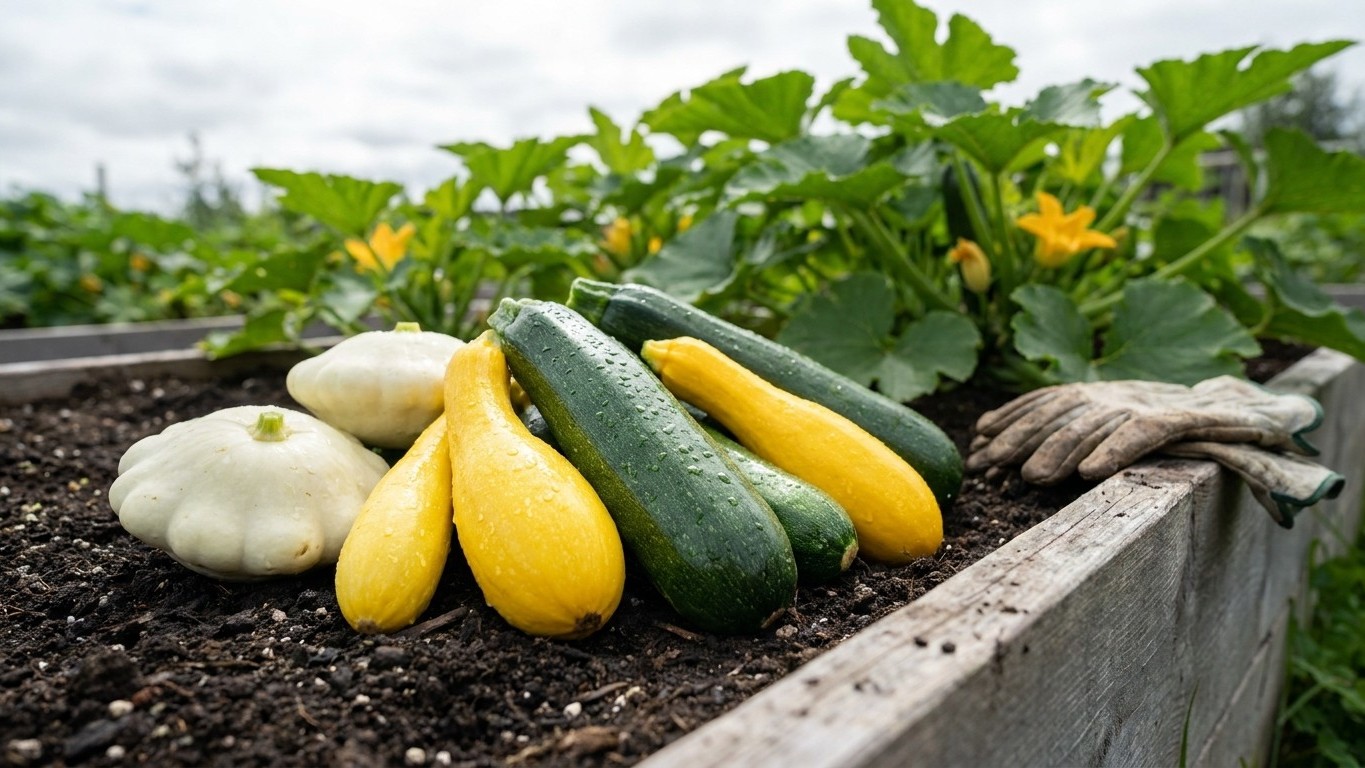

Nebraska’s growing season runs long enough that maturity days barely matter for summer squash. Between the frost dates on record, the state offers 175 to 197 days without a killing freeze. What actually separates a good harvest from a disappointing one here is heat load and water timing, not variety speed. Heat-tolerant, mildew-resistant types beat fast ones almost every time.
The short answer for Nebraska
Skip the “fastest to harvest” marketing and pick for heat tolerance and disease resistance instead. Nebraska’s frost-free window, April 12-23 on the early end to October 15-26 on the late end, gives every summer squash type enough calendar time to finish. A 45-day zucchini and a 65-day crookneck both fit comfortably inside that stretch. The variable that actually decides success is the region’s 28.1 average days per year at or above 90F, paired with a summer rainfall pattern that drops most of its 12.6 inches in scattered June and August storms while July, the hottest stretch, delivers only 3.55 inches.
That combination rewards heat-set, drought-tolerant bush varieties of yellow straightneck and crookneck squash, along with vigorous zucchini types bred for continued fruit set under stress. These plants keep producing female flowers through stretches of 90-plus-degree afternoons that would stall out a variety selected mainly for early yield in a cooler climate. Powdery mildew resistance matters almost as much: Nebraska’s summer rain tends to arrive as short, heavy thunderstorms rather than steady drizzle, which leaves foliage wet for hours at a time and creates exactly the conditions mildew needs to spread.
Pattypan and other scallop types can work, but they tend to slow production faster under sustained heat stress than crookneck or zucchini types do, so they’re a better fit for a partial-shade bed or a gardener willing to irrigate more consistently. Vining zucchini varieties bred for extended harvest windows tend to outperform compact bush types in the hottest weeks of July and August, simply because they carry more leaf area to shade their own root zone and fruit.
The practical takeaway: in Nebraska, buy for the plant’s behavior at 90F and its resistance to powdery mildew, not for a maturity-date number on the seed packet. The season length is not your constraint. The July heat and rainfall gap is.
What will not work here
Two Nebraska numbers eliminate certain choices outright. The first is 28.1 days a year at or above 90F, concentrated mostly in July and August. Any summer squash variety marketed as “cool-summer” or bred primarily for short-season, mild-climate regions will stall, drop blossoms, or shut down fruit production during the hottest two- to three-week stretch of a typical Nebraska summer. This isn’t a minor yield dip. It can mean a two- to three-week gap in harvest right when a home garden expects to be swimming in squash.
The second constraint is the rainfall pattern itself. Nebraska’s summer total, about 12.6 inches across June, July and August, sounds reasonable on paper. But July, the hottest month, only delivers 3.55 inches, and that rain typically arrives as isolated thunderstorms rather than gentle, even coverage. A single storm can dump an inch in twenty minutes and then leave the garden dry for ten days. Combine that with 90-degree heat driving evaporation, and a “water once a week” approach, which works fine in a cooler, wetter state, will leave Nebraska squash plants drought-stressed and prone to blossom drop by midsummer.
Tight spacing is the third failure point. Varieties or planting plans that call for closely packed rows, common in seed catalog advice written for humid Eastern states with more consistent light rain, trap moisture around the leaves after Nebraska’s heavier, less frequent storms. That still-wet foliage sitting under afternoon heat is a near-perfect setup for powdery mildew, which shows up as white patches on leaves and can defoliate a plant within two to three weeks if ignored. Wider spacing than the seed packet minimum, with room for airflow between plants, matters more here than in a state with gentler, steadier summer rain.
Finally, don’t count on the season length to bail out a poor variety choice. Because the frost-free window is genuinely generous, it’s tempting to assume any squash will “catch up” if it stalls in July heat. In practice, a plant that shuts down fruit set for three weeks during peak summer rarely produces a strong second flush before fall frost risk returns in mid-October. Choosing right at planting time beats trying to out-wait a bad match.
What changes across Nebraska
Nebraska spans USDA Hardiness Zone 4a to 5b, a real spread built on one measurement: the average annual extreme minimum temperature (USDA Plant Hardiness Zone Map, 2023, based on 1991-2020 normals). That’s a two-and-a-half zone difference within a single state’s borders, and it matters for summer squash timing even though the crop itself is a warm-season annual, not a perennial worried about winter survival. A colder zone rating generally tracks with a later last spring frost, an earlier first fall frost, and fewer total warm days to work with.
A gardener in the colder end of that range, generally the state’s western and northern reaches, should expect the frost-free window to run shorter than the reference-station dates cited above, and should lean toward the faster-finishing end of whatever heat-tolerant variety they’ve chosen, plus consider starting seedlings indoors two to three weeks before the average last frost rather than direct-seeding. A gardener in the warmer end of the range, generally the southeast, can direct-seed later-maturing vining zucchini types with more confidence that the season will carry them through a full harvest cycle plus a second succession planting.
Elevation compounds this inside each zone, not just across it. Higher ground tends to run cooler and see frost earlier in fall and later in spring than a low-lying river valley just a few miles away, even within the same official hardiness zone. That’s a separate effect from the zone rating itself, and it’s exactly the kind of local variation a statewide figure can’t capture.
There is no single Nebraska answer to “when do I plant” or “how long is my season,” because the state itself doesn’t have a single season length. The honest range is 4a to 5b, and where a specific reader’s own garden falls inside that range determines whether they should shift planting dates earlier or later, and by how much.
Where to check this for your own county
This page describes Nebraska at the state level, built from one reference weather station’s normals. That’s useful for understanding the general pattern, useless for pinning down a planting date for a specific backyard in a specific county. The University of Nebraska-Lincoln Extension service, at extension.unl.edu, publishes county-level guidance that accounts for local frost timing, soil conditions and variety trial results that this page simply doesn’t have access to.
Two things are worth pulling up there specifically. First, the local planting calendar for the reader’s own county, which will reflect frost dates that may run a week or two later in spring and earlier in fall than the airport-station figures cited on this page, particularly for gardens outside the immediate metro areas where the reference stations sit. Second, any variety trial results or recommended cultivar lists specific to the reader’s region of the state, since Extension offices often track which summer squash varieties have actually performed well against local disease pressure and heat patterns in real test plots, not just in a seed catalog description.
A county-level recommendation beats a state-level one every time, for the simple reason that it’s built from data closer to the actual garden in question. This page is the state-level view: a useful starting point for understanding why heat and rainfall timing matter more than maturity days in Nebraska generally, but not a substitute for checking what the local Extension office says about a specific county’s frost risk and variety performance before finalizing a planting plan.
Checking this against your own garden
None of the figures above, not the frost dates, not the heat days, not the rainfall averages, describe one particular backyard with certainty. They’re normals built from a weather station that may sit miles from a reader’s actual garden, on different soil, at a different elevation, with different sun exposure. The reader’s own observations settle what the averages can only suggest.
Soil warmth by feel is the first check. Summer squash seed germinates poorly in cold soil regardless of what the calendar says, so a gardener who reaches into the top few inches of bed and finds it still cool and damp in mid-April, even after a warm stretch of days, is looking at a soil that hasn’t caught up to the air temperature yet. Waiting another week often beats trusting the date alone.
The first flush of male flowers is the second signal. Summer squash typically produces a run of male blossoms before the female flowers, the ones with the small swollen base that will become fruit, show up in meaningful numbers. Watching for that shift tells a gardener the plant has moved from vegetative growth into fruiting mode, which is a more reliable heat-and-maturity marker for that specific plant than a generic days-to-maturity number.
The first true leaves, the ones that appear after the initial rounded seed leaves, are the third. Their size and color say something about how well that particular spot in the garden, with its own microclimate, sun exposure and soil, is actually supporting the plant, regardless of what the county average predicts. A gardener who tracks these three things season after season builds a more accurate planting guide for their own yard than any regional average can offer.