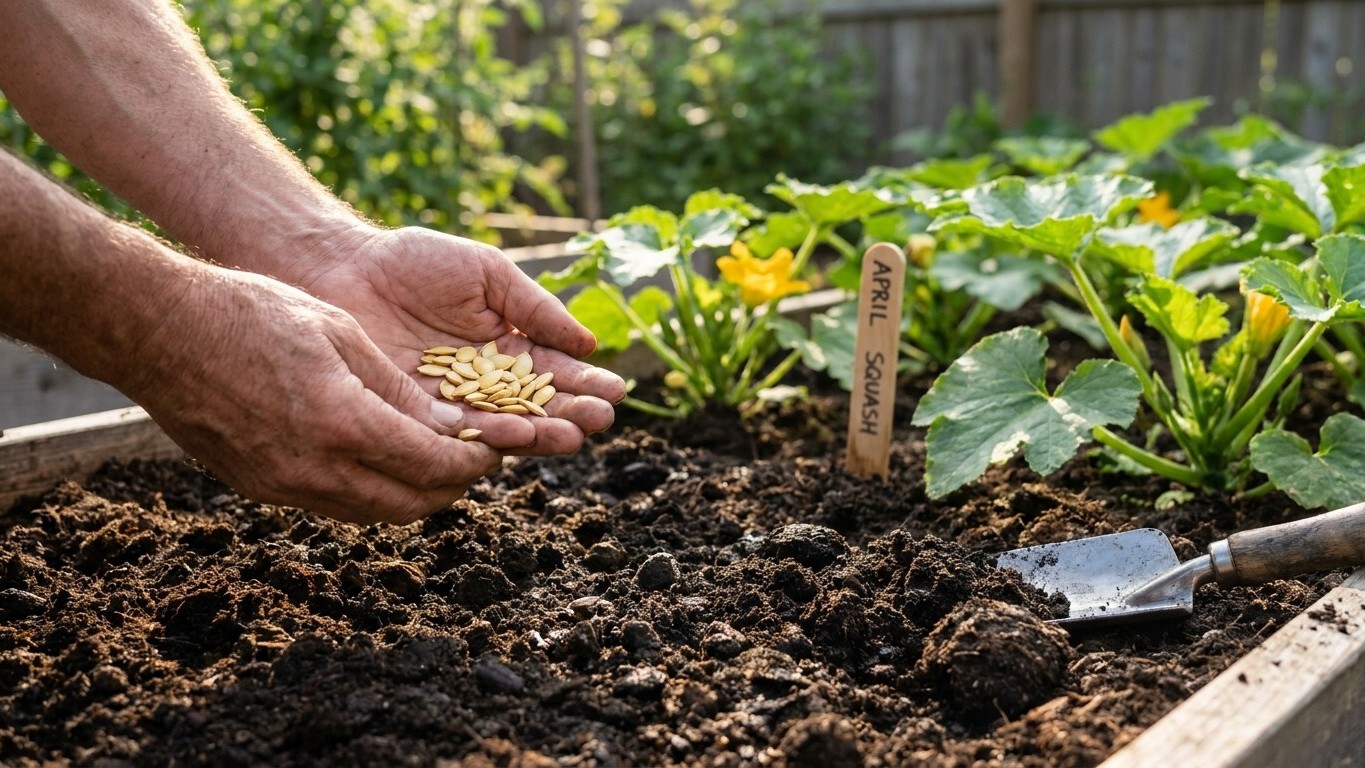

Direct-seed or transplant summer squash in Nebraska once soil has warmed past the frost-tender threshold, roughly late April through early May in the Omaha area, with succession sowings possible into early July. That window sits between a last spring frost of April 12–23 and a first fall frost of October 15–26 at the reference station, and it shifts by a week or two depending on where in the state you garden.
The short answer for Nebraska
Summer squash is frost-tender at every stage, seed, seedling, and mature vine. That single fact anchors the whole calendar. At the NOAA reference station used for these normals (Omaha, station USW00014942), the last spring freeze falls somewhere in the April 12 to April 23 window, and that date is a 30-70% probability band, not a guarantee. Half the time, frost can still show up after April 23. The other half, it’s already gone by April 12. Neither edge of that band is a promise.
Because squash won’t tolerate a stray 32°F night, the practical sowing window opens after that band closes, once the risk has dropped low enough that a gardener is comfortable trading a small chance of frost for a longer season. That puts direct seeding or transplanting into a range starting in the last week of April and running through mid-May for most of the area around this reference station, with soil temperature at 60°F or warmer as the real gatekeeper, not the calendar date itself.
On the back end, the first fall frost arrives in a October 15 to October 26 band, again a probability range rather than a fixed line. Summer squash matures fast, most varieties in the 45- to 55-day range from seed, which means there’s real room for succession planting. A second or third sowing in June, or even the first week of July, can still reach harvest before the fall frost window opens, provided the plants get consistent water through the hottest stretch of summer.
That gives a growing season of roughly five months between the two frost bands at this station, more than enough for two or three staggered sowings if a gardener wants a steady supply rather than one big flush. The tighter constraint isn’t the calendar length. It’s what happens in the middle of it, during the driest, hottest weeks, which the next section covers directly.
What will not work here
Planting too early is the most common failure, and it’s a frost problem, not a cold-tolerance problem. Squash seed sown into soil that’s still cool from an April cold snap, especially anything planted before the April 12 start of the frost-probability band, sits and rots more often than it germinates. Transplants set out in that same stretch face a real chance of a freeze event landing on the wrong night, since the band only describes when frost odds drop to 30%, not when they hit zero.
The bigger failure mode shows up in July, and it’s about water math, not frost. The reference station’s summer rainfall runs about 12.6 inches across June, July, and August, but July itself is the driest of the three at just 3.55 inches, compared with 4.44 in June and 4.6 in August. Layer that dip against the heat load: an average of 28.1 days a year hitting 90°F or higher at this station, most of them clustered in July and early August. A weekly watering habit that works fine in a wetter June starts to fail exactly when squash plants are flowering and setting fruit, because the heat drives evaporation faster than a once-a-week soak can replace it, especially on sandy soil that drains within a day rather than holding moisture like clay does.
That same July heat window causes a second, less obvious problem: pollination stress. Squash flowers that open during a run of 90°F-plus afternoons can abort before bees ever get a chance to work them, which shows up as blossoms dropping without setting fruit. It isn’t a disease or a pest. It’s the heat load doing exactly what the 28.1-day average predicts it will do most summers.
Late-summer humidity brings a third failure worth naming: powdery mildew on crowded plants. August’s 4.6 inches of rain, often arriving as thunderstorms rather than steady soaking rain, leaves leaves wet longer in tightly spaced rows where airflow can’t dry them out. Spacing that looked generous in May can turn into a mildew trap by August once the canopy fills in.
What changes across Nebraska
Nebraska spans USDA Plant Hardiness Zones 4a to 5b, and that two-zone spread is wide enough that no single planting date works for the whole state. The hardiness system is built on one number, the average annual extreme minimum winter temperature, so it doesn’t measure spring frost timing directly. But it’s a reliable proxy for how much colder a given part of the state runs overall, and colder generally means a later safe planting date and an earlier fall cutoff.
The reference station behind the frost dates in this article sits closer to the warmer end of that range, in the 5b territory around the Omaha area. Areas toward the colder end, 4a, tend to sit farther west and at higher elevation, in the Panhandle and parts of the western high plains. A gardener in one of those colder zones should expect the safe planting window to open later than the April 12–23 band suggests, and the fall cutoff to arrive sooner than the October 15–26 band implies, sometimes by a week or two on each end.
There’s no way to collapse that into one statewide date, and this page won’t pretend otherwise. The honest version is: use the Omaha-area frost bands as the reference point for the eastern part of the state, and shift both ends of the calendar inward, later start, earlier finish, the farther west and higher in elevation the garden sits. How much shift depends on the specific county, which is exactly the kind of detail a state-level page can’t resolve on its own.
Rather than guess at which zone applies to any individual reader, the right move is checking the USDA hardiness zone map directly for a specific address, then pairing that zone placement with a county-level extension resource for the actual planting date adjustment.
Where to check this for your own county
Nebraska Extension, part of the University of Nebraska-Lincoln, publishes county-level planting guidance that accounts for local frost patterns, soil types, and the specific summer squash varieties that have performed well in field trials around the state. That’s the resource worth checking before locking in a planting date.
Two things are worth looking for once there. First, a local planting calendar, since county offices often adjust the statewide frost-date guidance based on years of local observation that a single airport weather station can’t capture. A county in the Panhandle or at higher elevation may carry a noticeably different recommended window than what the Omaha-area frost bands suggest, and the extension office there will know that from direct experience, not estimation.
Second, look for variety trial results specific to the region. Nebraska Extension and university trial programs test summer squash cultivars for how they handle the state’s heat load and disease pressure, including powdery mildew resistance, which matters given the August humidity pattern described above. A variety that performs well in a humid eastern county might struggle differently than one bred for the drier, more exposed conditions further west.
This page works from statewide and reference-station data, useful for understanding the general shape of the season, but a county recommendation from Nebraska Extension will always be more precise than anything built from a single weather station’s 30-year averages. Treat the frost bands and rainfall figures here as the framework, and the county office as the fine-tuning. If county-specific squash guidance isn’t posted online, a call or email to the local extension office usually gets a direct answer, often from someone who has watched the same soil and same frost patterns for years.
Checking this against your own garden
No frost-date band replaces what a plant is actually doing in its own patch of soil, and three simple observations settle the question better than any calendar.
Soil warmth by feel is the first check. Squash seed wants soil that feels warm to bare hands at a couple of inches down, not just air temperature that feels comfortable. Cold soil that still feels cool or damp in the morning, even on a warm afternoon, is a sign the ground hasn’t caught up to the season yet, regardless of what the frost-date band suggests.
The first flush of male flowers is the second signal. Squash plants typically produce several male flowers before the first females appear, and a strong, early male flush usually means the plant is settled in and building energy well. A plant that’s slow to flower at all, weeks after germination, often points to either cooler-than-expected soil or stress from an early cold snap that set growth back.
The first true leaves, the ones that appear after the initial rounded seed leaves, tell a similar story. Vigorous, deep-green true leaves within a week or so of germination suggest good soil temperature and adequate moisture. Pale, slow-to-emerge true leaves are worth reading as a warning that conditions weren’t quite ready when that seed went in, useful information for timing the next succession planting a little later in the season.