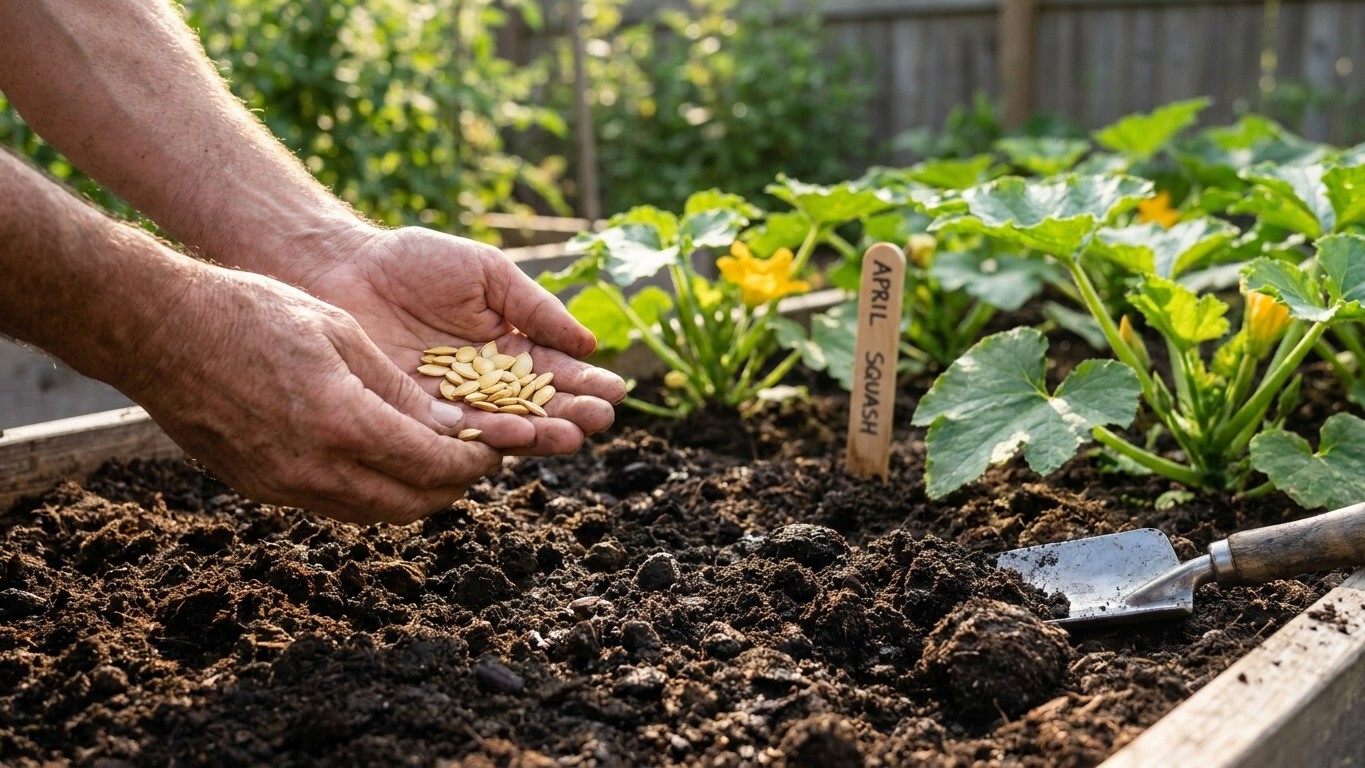

There’s no single sowing date for Summer Squash in Nevada. This state stretches from low desert floor to high mountain valley, and that spread changes everything about when soil warms enough to plant. Squash needs frost-free ground and soil in the 60s Fahrenheit before seed or transplant goes in, but where that lands on the calendar depends entirely on elevation, and Nevada has more of that variable than almost any other state.
The short answer for Nevada
NOAA’s 1991-2020 climate normals put the last spring frost at the Las Vegas reference station (USW00023169) somewhere between January 7 and February 1, and the first fall frost between December 8 and December 23. Those dates come from the 30-70% probability band for a 32°F freeze, meaning there’s a real chance of frost outside that window too, not a hard guarantee inside it.
Here’s the catch, and it matters more in Nevada than almost anywhere else: those figures come from an airport station sitting in a low desert valley with a strong urban heat island effect. They describe one of the mildest, warmest pockets in the entire state. Reno sits at roughly 4,500 feet. Carson City is close behind. Elko and much of the rural north climb higher still. Frost at those elevations arrives months earlier in fall and lingers months later in spring than anything the Las Vegas numbers suggest.
That’s why this page can’t hand you one sowing window and call it Nevada guidance. The honest answer is that the state doesn’t have a single planting date for summer squash, it has a range so wide that a date accurate for one corner of Nevada would actively mislead a gardener in another. This page doesn’t have county-level frost data for Reno, Carson City, or Elko, and rather than borrow a number that doesn’t belong to those places, the right move is to send you to a source that actually tracks them (more on that below).
What does hold true statewide: summer squash is a warm-season crop with no frost tolerance at all. Seedlings sown into cold or wet soil rot before they sprout. Transplants set out ahead of the true last frost get knocked flat by a single cold night. The safe rule, wherever in Nevada you garden, is to wait until night temperatures have stabilized above the mid-50s and soil has warmed past 60°F, then sow or transplant with roughly two weeks of buffer past your local last-frost date. In the Las Vegas valley, that buffer sits inside the window described above. Everywhere else, it shifts later, sometimes by two or three months.
What will not work here
Watering on a weekly schedule is the fastest way to lose a squash planting in most of Nevada. The reference station’s 1991-2020 normals show 131.3 days a year at or above 90°F — that’s not an average summer temperature, it’s a count of how many days the heat load is intense enough to pull moisture out of soil and leaves fast. Pair that with summer rainfall that barely exists: about 0.7 inches total across June, July, and August, with June averaging a nearly nonexistent 0.04 inches, July at 0.38, and August at 0.32. A garden that gets watered once a week in that combination of heat and near-zero rain is a garden with wilted, bolting, or dead squash plants by the second week.
Assuming Nevada’s dryness means disease isn’t a worry is another mistake, just aimed the wrong direction. In humid states, gardeners space squash wide to keep powdery mildew and fungal rot from spreading through damp foliage. Nevada’s problem is closer to the opposite: leaves scorch, blossoms drop, and fruit develops sunscald when daytime highs push past the mid-90s for weeks on end, which the 131.3-day figure says happens routinely. Tight spacing isn’t the enemy here, un-shaded soil and exposed fruit are. Skipping mulch, skipping afternoon shade cloth during the hottest stretch, or skipping a fruit-out planting schedule that avoids peak July heat setting flowers, all of that fails for reasons specific to a desert summer, not a generic “too hot” explanation that would apply anywhere.
Planting too early at elevation is the third trap, and it’s the mirror image of planting too late in the low desert. Cold, wet spring soil in the mountain valleys and high desert rots seed and stalls transplants for weeks, sometimes killing them outright, a slow start that a fast-maturing crop like summer squash usually shrugs off in warm climates but can’t recover from where the growing season itself is short.
What changes across Nevada
The USDA Plant Hardiness Zone Map puts Nevada across zones 4a through 10a — a six-zone spread built entirely on one measurement, the average annual extreme minimum winter temperature. That’s an unusually wide range for a single state, and it means there is genuinely no single answer to “when do I plant” here. A gardener in a 4a pocket and a gardener in a 10a pocket are effectively gardening in different climates that happen to share a state line.
In the colder zones toward the north and at higher elevation, the growing season compresses hard. Last frost can push well into late spring, first frost can arrive by early fall, and the workable window for a warm-season crop like squash narrows to a few months at most. Gardeners there generally need to lean on transplants started indoors rather than direct-seeding, and they benefit from choosing squash varieties bred for a shorter time to maturity.
Toward the warmer end of that zone range, near the desert floor, the challenge flips. Frost risk disappears early and returns late, so the growing season is long, but the summer heat load described above (131.3 days above 90°F at the reference station) becomes the limiting factor instead of cold. Gardeners there often plant twice: once in spring for an early crop, and again in late summer for a fall crop, skipping the worst of the peak-heat weeks in between.
This page won’t tell you which of those zones your own yard sits in, that’s not something a state-level page can responsibly guess. The USDA hardiness zone map is built for exactly that lookup, and it takes an address or zip code to return a specific zone rather than a six-zone range.
Where to check this for your own county
Nevada’s land-grant extension service is the University of Nevada, Reno Cooperative Extension, and its site is extension.unr.edu. That’s the source built to close the gap this page can’t close on its own: a state-wide article can describe the range of conditions across Nevada, but it can’t hand you a frost date for your specific county, and it shouldn’t try.
Two things are worth hunting for once there. First, a county-level or regional planting calendar, many extension offices publish these specifically because a date that works in Las Vegas doesn’t work in Washoe County, and a date that works in Reno doesn’t work in Clark County. Second, look for any variety trial results or recommended cultivar lists for your area. Extension offices frequently test squash and other vegetable varieties under local conditions and publish which ones held up to the local heat, the local season length, or the local water restrictions — information that a general “summer squash” guide simply can’t replicate because it’s specific to soil, elevation, and microclimate in a way a state-wide page never will be.
A county recommendation beats a state one every time, for the same reason a tailor beats an off-the-rack suit. This page is deliberately the off-the-rack version: useful for understanding the shape of the problem, not a substitute for a fitting. If your county extension office publishes a specific window for summer squash, plant by that window over anything written here.
Checking this against your own garden
Every date on this page is a normal built from thirty years of averages. Your actual yard this actual year can run warmer, colder, wetter, or drier than any of it, and three things you can check with your hands and eyes will tell you more than any calendar.
Soil warmth by feel is the first and most direct check. Push a finger a few inches into the planting bed in the morning. If it feels cool and slightly damp rather than warmed by the sun, the soil likely hasn’t crossed the 60°F threshold squash seed needs to germinate reliably, whatever the calendar says about the date.
The first flush of male flowers on an already-growing plant is the second signal. Squash produces male blossoms before female ones, and their appearance means the plant has settled into active growth rather than just surviving a cold or stressed start. If male flowers show up fast after transplanting, conditions in that spot are running favorable; a long delay suggests the plant is still recovering from cold shock or transplant stress.
The first true leaves, the ones that appear after the initial seed leaves and actually look like squash foliage, mark the point where a young plant has enough root and leaf structure to handle a bit of heat or dry stress without collapsing. Seeing them emerge quickly and stay a healthy deep green, rather than pale or curled, is a decent sign that the microclimate in that particular bed, shaded by a fence, warmed by a south-facing wall, exposed to wind, matches or beats the averages this page is built on.