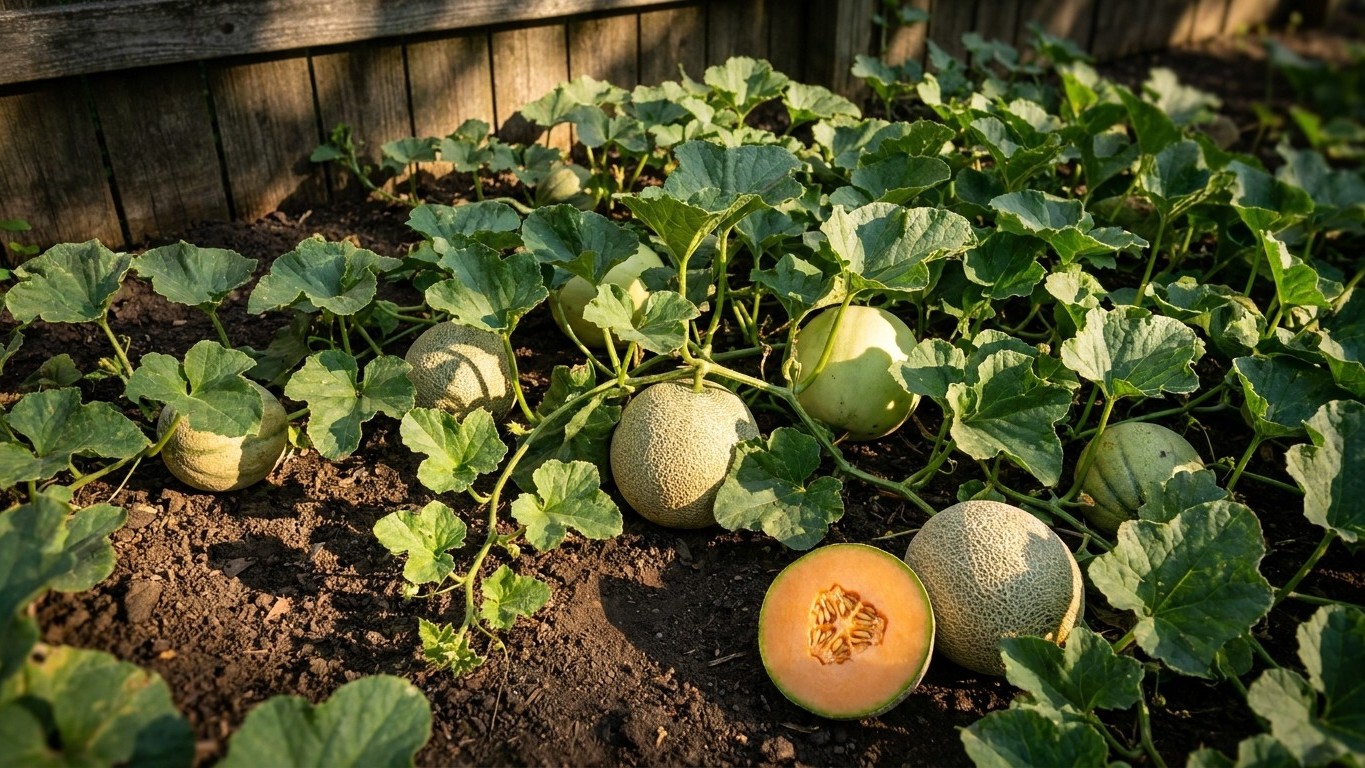

Melons taste bland for a handful of measurable reasons, not bad luck: not enough leaf area making sugar, too much water diluting what sugar exists, a harvest that happened before the plant finished its job, or heat and light patterns the variety wasn’t suited to in the first place. Fix the mechanism, not the fruit.
What is actually going on
A melon vine is a sugar factory with the fruit as the warehouse. Leaves convert sunlight into sugars through photosynthesis, and those sugars travel through the plant’s vascular tissue into the developing fruit, where they accumulate as the flesh matures. That’s the entire chemistry of a sweet melon: leaves make it, stems move it, fruit stores it. Anything that reduces leaf function or interrupts that transport chain shows up later as a watery, flat-tasting slice.
Shade is the most common leaf-function problem. A vine crowded by taller crops, planted too close to a fence line, or left to sprawl under its own tangled foliage produces less sugar simply because fewer leaves are catching direct sun for enough hours a day. Gardeners often blame the variety when the real issue is a planting spot that gets six hours of light instead of the eight or more melons need to build sugar reserves.
Water dilution is the second half of the equation, and it’s where timing matters more than quantity. Melon plants need consistent moisture through most of their growth, but sugar concentration in the fruit depends on the plant pulling back on water in the final stretch before harvest. Heavy irrigation or a soaking rain right before picking swells the fruit with water the plant hasn’t had time to convert into sugar, and the flesh tastes diluted even though the melon looks perfect on the outside.
Ripeness is not the same as sweetness arriving late
This is the point where most home gardeners get confused, so it’s worth stating without hedging: a melon does not sweeten after it’s picked. Sugar production stops the moment the stem separates from the vine. What continues after harvest is softening, the breakdown of cell walls that makes the flesh feel riper, along with some enzyme activity that can shift acidity and aroma slightly. But the sugar content in that melon on your counter is fixed at the level it had in the field. A melon picked too early will never catch up on the windowsill, no matter how long it sits. This is different from fruits like bananas or avocados, which do continue converting starches to sugars post-harvest, and the confusion between the two is probably the single biggest reason gardeners end up disappointed with a melon that looked ready.
In the garden
Four separate failures cost sweetness, and they rarely announce themselves individually. A melon can look flawless while carrying two or three of these problems at once, which is why the harvest disappointment often feels mysterious until you trace it back.
| Factor | What goes wrong | What to do instead |
|---|---|---|
| Light exposure | Vines shaded by neighboring plants, structures, or their own overgrown canopy produce fewer sugars per leaf | Give melon plants an open, south-facing spot with minimal shade for most of the day; thin excess foliage that blocks inner leaves from light |
| Watering schedule | Heavy or late-season irrigation swells fruit with water faster than the plant can build sugar | Keep watering steady during fruit set, then taper off noticeably in the final one to two weeks before expected harvest |
| Fruit load per vine | Too many melons developing at once forces the plant to split its sugar production across more fruit, so each one gets less | Remove some developing fruit early so the vine concentrates its output on fewer, sweeter melons |
| Root and soil stress | Compacted soil, root damage, or nutrient imbalance limits the plant’s overall capacity to move sugars efficiently | Keep soil loose and well-drained, avoid disturbing roots once vines are established, and follow a soil test rather than guessing at fertilizer |
The fifth failure, and the one gardeners cause entirely on their own, happens in the final two weeks before harvest. It’s an act of impatience, not neglect. After weeks of careful watering and pest watching, the temptation to pick “just in case” or to give the plant one more deep soak to plump up the fruit undoes all that earlier work. A melon pulled a few days early, before the plant has finished loading it with sugar, will never reach the sweetness it was capable of. And a melon given a heavy drink right before the anticipated harvest date dilutes flesh that was nearly at its peak.
The practical fix is patience paired with observation rather than a calendar date. Depending on the melon type, ripeness signs include a change in background color, a fragrant smell at the stem end, or the fruit slipping cleanly from the vine with gentle pressure, sometimes called “full slip” in cantaloupe types. Watermelon types don’t slip and instead rely on signs like a dulling of the skin’s sheen and a deepening yellow spot where the fruit rests on the ground. None of these signs can be rushed by extra water, and none of them mean the fruit will keep improving after it’s off the vine. For guidance on reading these signs for a specific melon type, the harvest-timing guide elsewhere in this collection walks through each signal in detail.
What it depends on where you are
Everything above about mechanism, photosynthesis, dilution, sugar transport, applies no matter where a melon is grown. What changes by region is how much margin a gardener has to work with, and that margin comes down to three regional variables: how long the growing season runs, how much heat accumulates during the day and night, and how much rain falls during the ripening window.
A longer, hotter growing season gives melon plants more total sunlight hours to bank sugar and more buffer if a planting is delayed by a wet spring. Shorter seasons mean less room for error, and gardeners in those areas often need to lean harder on variety choice, since some melon types were bred to mature faster and still build sweetness within a compressed window. Nighttime temperatures matter too. Melons that ripen during stretches of cool nights tend to hold onto more of the sugar produced during the day, because respiration, the process that burns through sugars, slows down when it’s cool. Regions with hot nights during the ripening period can see less sweetness even with plenty of daytime sun.
Rainfall timing is the other regional wildcard, and it cuts both ways. A region with reliable dry spells late in summer gives gardeners natural control over that final taper in watering. A region where late-summer thunderstorms are the norm has to work against the weather, sometimes with raised beds or mulching that sheds excess water, to keep the last two weeks before harvest from getting oversaturated.
None of this can be pinned to a specific date or hardiness zone in a general guide like this one, because the same melon type behaves differently across a few hundred miles. The most useful next step is checking the region-specific pages in this collection, along with the local Cooperative Extension office, which tracks which melon types have performed well in trials for that particular climate and can name varieties this page has no way of confirming for every reader.
The mistake that costs the most
If there’s one error that undoes more melon harvests than any other, it’s picking based on the calendar instead of the plant. Gardeners count days from planting, watch the date creep toward what a seed packet or a general guide suggested, and pull the fruit because “it’s been long enough.” That number was always an estimate built on average conditions, and this season’s weather almost never matches the average.
The fix is straightforward and it costs nothing: check the physical signs specific to the melon type instead of the calendar. For fruits that slip, wait for that clean separation rather than tugging or twisting one that resists. For watermelon types, learn the dulling skin and the ground-spot color change rather than thumping and guessing. These signs exist because they reflect what’s actually happening inside the fruit, not what a generic timeline predicted for a garden this page has never seen.
The second half of this mistake, and the part that makes it worse, is what happens after an early pick. A gardener who picks too soon and finds a bland melon often assumes a few more days on the counter will fix it. It won’t. Sugar production ended at the stem. What follows is only softening, and a soft, underripe melon is a worse eating experience than a firm one, since the texture suggests ripeness that the flavor doesn’t deliver. The only real remedy for an early pick is prevention: check the fruit itself before the knife comes out, not the days on a calendar, and treat the plant’s own signals as the final word every single time.