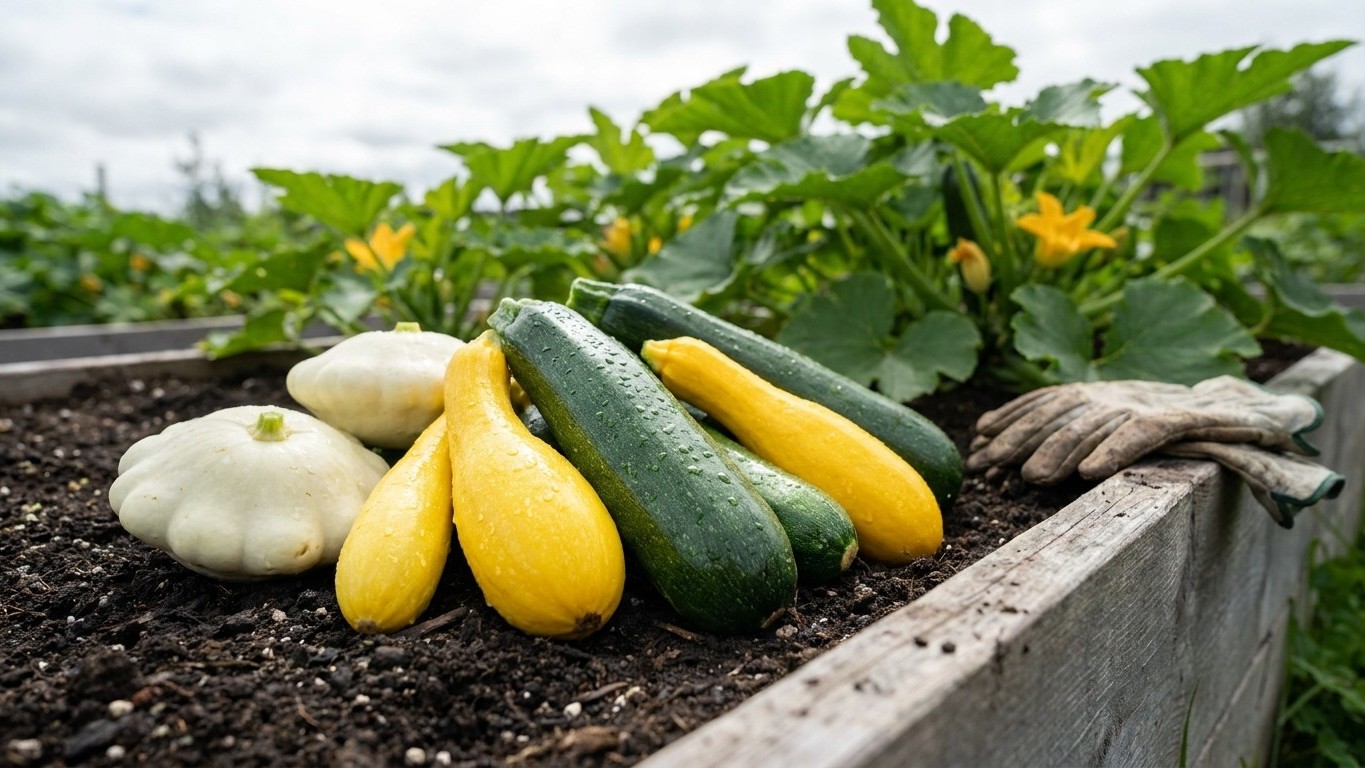

Growing Summer Squash in Nunavut means working against a season that averages 86 days between frost dates, with a mean summer that never once reaches 90°F. The only realistic option is the fastest-maturing bush varieties, started indoors and moved outside under protection. Even then, a harvest is never guaranteed here, this is a territory where squash is the exception, not the rule.
The short answer for Nunavut
Start with the numbers this page actually has. At Rankin Inlet, the reference station for these figures, the mean last spring frost falls on June 19 and the mean first fall frost on September 13. That’s a window of roughly 86 days, and it comes with a hard caveat: these are mean dates, not safe dates. In one year out of two, frost arrives later than June 19 or earlier than September 13. Treat 86 days as the best-case midpoint, not a promise, and plan for something shorter.
Add the heat figure and the picture narrows further. Rankin Inlet averages zero days a year at or above 90°F. Summer squash is a warm-season crop that wants heat to push flowering and fruit set along; without it, the same 45-day variety that races through a Midwest garden can take considerably longer to size up here. A nominal “days to maturity” listed on a seed packet assumes warmth this territory doesn’t reliably deliver.
Given both numbers together, the decision by type is straightforward. Bush-type summer squash, the compact zucchini and yellow crookneck varieties bred for a short window and tight space, are the only category worth the effort. They mature faster than vining types, take up less of a protected growing area, and don’t need a long tail of warm weeks to finish. Even among bush types, the fastest-listed maturity dates matter more here than anywhere further south, because the margin between the mean frost dates leaves little room to spare.
None of this works started from seed sown directly outdoors. Every realistic path to a Nunavut squash harvest runs through starting seedlings indoors four to six weeks ahead of the mean last frost, then transplanting into some form of protected structure, a cold frame, a hoop house, or a greenhouse, once soil and air have warmed. The seed packet’s maturity clock only starts counting once the plant is actually growing in reasonable warmth, and that point comes later here than the calendar date suggests.
What will not work here
Vining summer squash varieties are the first to rule out. They’re bred for gardens with room to sprawl and a season long enough to reward the extra growth before fruiting. Neither condition applies at 86 mean days and zero days of real heat. The plant spends critical early weeks building vine instead of flowers, and by the time it might start producing, the mean fall frost is already close.
Anything with a stated maturity above roughly 55 days is a poor bet for the same reason. Run the math against the mean dates: June 19 to September 13 leaves 86 days on paper, but half of all years run shorter than that, and the plant still needs a week or two of warm soil after transplant before it’s really growing. A 55-day squash pushed into cool ground with no heat units to speed it along can easily miss the window entirely.
Direct-seeding outdoors fails here for a different reason than the season length. It’s a soil-temperature problem. Squash seed wants warm soil to germinate reliably, and a reference climate with zero days above 90°F rarely delivers that warmth at the surface, let alone at seed depth, without some kind of cover. Seed sown straight into open ground in early summer tends to sit, rot, or germinate weeks late, burning through days the plant doesn’t have to spare.
Succession sowing, the trick gardeners further south use to spread out a harvest with two or three plantings, doesn’t apply here either. There simply isn’t a second window; the whole season is one narrow shot. And traditional wide spacing meant for open, wind-sheltered gardens ignores a real hazard in this territory: exposed, unprotected plantings face wind and cold-air drainage that a hoop house or cold frame is specifically built to blunt. A garden plan borrowed from a temperate-zone seed catalog, spacing included, is not a plan built for Nunavut conditions.
What changes across Nunavut
The hardiness zone figure available for this page, 0a in the Canadian system, describes Rankin Inlet specifically, not the territory as a whole. That distinction matters more here than almost anywhere else in this content set. Nunavut stretches from Hudson Bay communities in the south to High Arctic islands well north of the Arctic Circle, and a single reference station can’t stand in for that range. This page simply does not have frost, heat, or rainfall figures for those other locations, and it won’t invent them.
What can be said with confidence is that conditions almost certainly run colder, not warmer, the further north and the higher in latitude a community sits relative to Rankin Inlet. A shorter frost-free window, fewer heat units, and a harsher wind exposure are the likely direction of change, even without a specific number to cite for any other town. Note also that the Canadian zone system, built from seven climate variables rather than the single minimum-temperature figure the USDA uses, doesn’t translate into a USDA-style zone number at all; NRCan is explicit that a single Canadian zone can overlap nine different USDA zones. Comparing Nunavut’s zone to a American state’s zone on this site is not a meaningful comparison.
None of this tells an individual reader which zone covers their own community. That answer sits on one map, not in this article: Natural Resources Canada’s Plant Hardiness Site lets a reader look up their own municipality directly. Anyone gardening outside Rankin Inlet itself should treat every figure on this page as a starting reference point, then confirm their own zone on that map before trusting a planting plan built around these numbers.
Where to check this for your own county
Nunavut doesn’t organize agricultural information at the county level the way many U.S. states do, so the equivalent step here is checking with the federal agriculture department directly. The working link for this territory is Agriculture and Agri-Food Canada. It’s given here specifically because the territorial department’s own site currently blocks automated verification, so a resource confirmed to load is more useful than one that only might.
Once there, the value isn’t a squash-specific planting calendar, because none exists at the national level for a territory this far north. What’s worth looking for instead is any regional guidance tied to community greenhouse programs, local food security initiatives, or Arctic and northern agriculture research, since these programs work with growers dealing with exactly the frost and heat limits described on this page. Community greenhouses in places like Iqaluit and other Nunavut settlements have accumulated practical, season-specific experience that a national-level page can’t replace.
The general rule holds even where the usual U.S. structure of state-then-county doesn’t map cleanly onto Canada: a recommendation grounded in local, hands-on experience with a specific community’s soil and shelter conditions will always outperform a page built from a single reference station’s climate normals. This article is the territorial-level starting point. Local greenhouse coordinators, community garden groups, and anyone who has actually grown squash in a Nunavut hoop house hold the next, more specific layer of information, and that layer is worth tracking down before committing seed to a protected bed.
Checking this against your own garden
Every date and figure on this page is a regional average pulled from one weather station. A reader’s own garden, plot, or greenhouse corner will always tell them more, and three simple checks reveal it without needing any instrument beyond a hand and a pair of eyes.
Soil warmth by feel comes first. Squash seed and transplants stall in cold soil regardless of the calendar date; pressing a hand a few inches into the bed and feeling real warmth, not just an absence of frost, is a better transplant signal here than any mean frost date, because the mean is only a probability, not a measurement of the actual soil in front of the reader.
The first flush of male flowers is the second signal. Summer squash reliably produces male blooms before female ones, and their timing shows how much heat the plant has actually accumulated in that specific spot. An early flush suggests a warmer-than-average microclimate, sheltered by a wall or a hoop house doing its job; a late or thin flush suggests the plant is running behind the numbers on this page, and expectations for harvest timing should shift accordingly.
The appearance of the first true leaves, the leaves that emerge after the initial seed leaves and actually look like squash foliage, marks the point where growth genuinely begins. Comparing that date against a transplant date started using the mean frost figures gives a direct read on whether a particular garden is running ahead of or behind Rankin Inlet’s averages, and that comparison, repeated year to year, becomes far more useful than any single figure this page can offer.