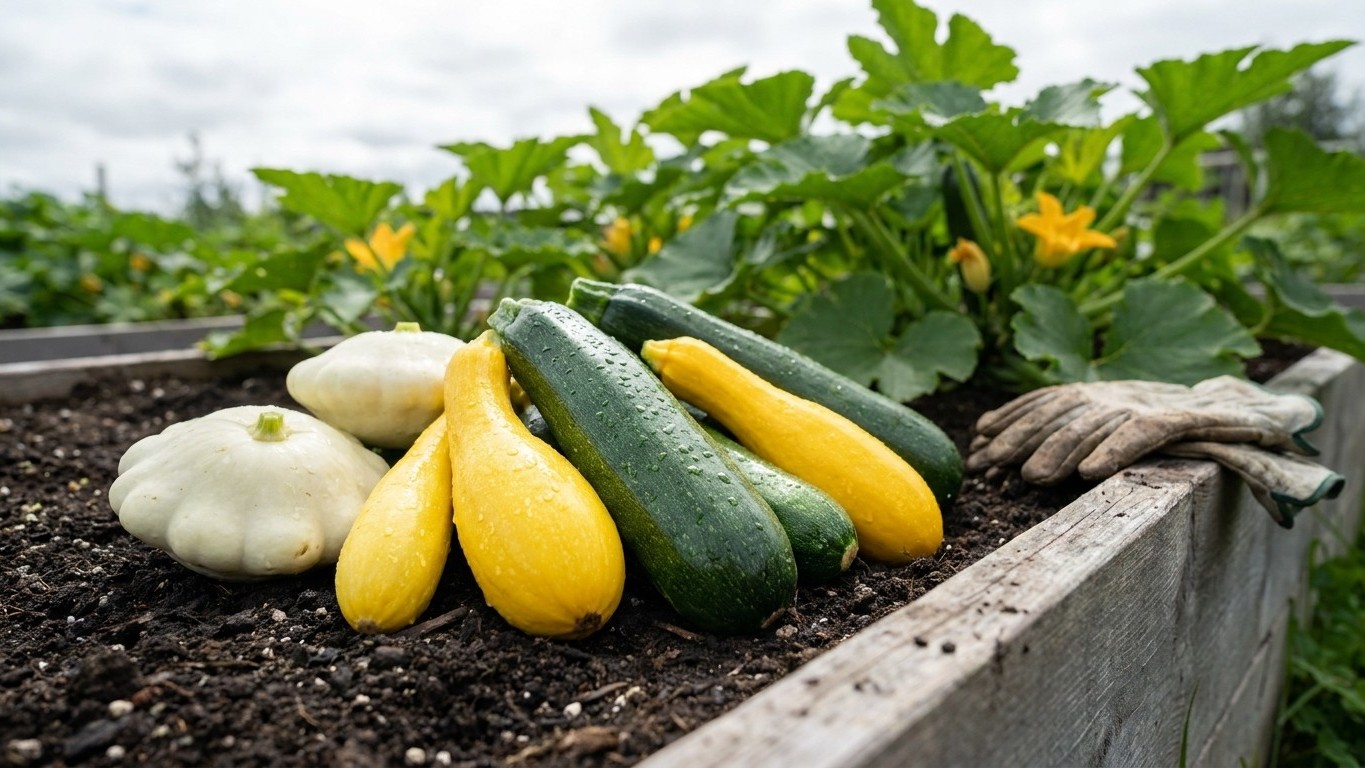

For Utah gardens, fast bush types like zucchini, yellow crookneck and straightneck squash are the safest bet, since they mature in 45 to 55 days and tolerate the state’s dry, hot summers. Vining types such as tromboncino do well only where the frost-free season runs long and the site holds water. Pattypan sits in between.
The short answer for Utah
Start with the number that actually drives this decision: the reference station used for these normals (Salt Lake City) records a frost-free window that can run from as short as roughly 140 days to as long as 200 days, depending on where the actual spring and fall frost dates fall within their probability bands (April 12 to April 29 for the last spring freeze, October 18 to October 29 for the first fall freeze). That’s a wide spread even in the mildest part of the state, and it means the type of summer squash worth planting is decided by how much of that window a reader actually has, not by which variety looks appealing on a seed rack.
Add the heat load: 52.1 days a year reach 90F or hotter at that same reference station. That’s a lot of stress days for a crop that stalls its fruit set once daytime temperatures push much past the low 90s for stretches, and it argues for types bred to keep flowering through heat rather than types that shut down and wait for cooler weather.
Then there’s water. Summer rainfall averages only about 2.0 inches across June, July and August combined, with July, the hottest stretch, delivering just 0.49 inches. A squash that needs steady soil moisture to size up fruit properly is fighting the climate from day one unless the gardener is prepared to irrigate on a fixed schedule rather than rely on the sky.
Put those three facts together and the type-level answer looks like this:
- Bush zucchini, straightneck and crookneck types are the default choice statewide. At 45 to 55 days to first harvest, they fit comfortably inside even a shortened frost-free window, and their compact habit makes hand-watering or drip irrigation practical during the hottest weeks.
- Pattypan and scallop types run a similar maturity window and handle the dry heat well once established, though their flatter fruit shows sunscald faster if the foliage thins out in a heat wave.
- Vining types like tromboncino need closer to 60 to 100 days and a lot more root run and water. They belong only on sites with the longer end of the frost-free spread and a reliable irrigation source, not on a dry slope or in a shortened high-valley season.
None of this is a statement about which zone a given reader gardens in. It’s a statement about what this state’s climate normals reward: quick, compact, heat-tolerant types over slow, sprawling, moisture-hungry ones.
What will not work here
The clearest failure mode in Utah is planting a long-season vining squash on a site that only has the short end of the frost-free window. If the local frost-free season lands closer to 140 days rather than 200, a tromboncino or another 90-to-100-day vining type is cutting it close before an early fall freeze ends the season, especially at elevation, where the caution attached to these normals matters most: Salt Lake sits in a mild valley, and most of Utah is higher and colder. A gardener at 5,500 or 6,000 feet is very likely working with a shorter window than the reference station shows, which turns a marginal variety into a losing bet.
The second failure is watering on a weekly schedule and assuming that’s enough. With 52.1 days a year above 90F, and only 0.49 inches of rain falling in the average July, a squash bed that gets watered once a week is running on a deficit for days at a time. Summer squash roots sit shallow, and the plant responds to that gap by aborting female flowers or producing misshapen fruit long before it wilts visibly. A once-a-week habit that works fine in a wetter, cooler state does not translate here.
The third failure is skipping mulch and bare-soil planting in full sun. Given how little of the summer’s already thin rainfall arrives as a soaking rain rather than a short thunderstorm, exposed soil between plants bakes and sheds whatever moisture does fall. That raises soil temperature around the root zone during the hottest stretch of the season, right when 90-degree-plus days are most frequent, and it’s a common reason zucchini plants that started strong in June stop setting fruit by late July.
Finally, treating all of Utah as one climate is itself a mistake worth naming here, because it leads directly to the two failures above. A planting plan copied from a lower, warmer part of the state and applied at altitude, or vice versa, mismatches both the frost dates and the heat load this section relies on.
What changes across Utah
Utah’s official hardiness range, under the USDA Plant Hardiness Zone Map, spans zone 4a to zone 9a. That is one of the widest spreads found in any single state, and it means there is no single answer to “when does my growing season start” or “how hot will my summer get” that applies from one county to the next. The USDA system itself is built on a single variable, the average annual extreme minimum winter temperature, so it doesn’t describe summer heat or rainfall directly, but the gap between 4a and 9a is still a useful signal for how differently the rest of this page’s numbers will play out on the ground.
A zone 8a or 9a reader in the state’s warmer, lower-elevation valleys is very likely working with a frost-free season longer than the 140-to-200-day figure attached to the Salt Lake reference station, along with more days above 90F than the 52.1 average cited here. That favors even the slower vining squash types, and it may argue for extra mulch and more frequent irrigation rather than less.
A zone 4a or 5a reader at higher elevation is working with the opposite situation: a shorter frost-free window than the reference station shows, cooler summer nights, and fewer days that reach 90F. That reader should lean harder toward the fastest bush types, watch the calendar for an earlier possible fall freeze, and treat any 90-day vining variety as a risk rather than a safe default.
This page can’t tell an individual reader which of those zones applies to their own yard. What it can say is that the spread is real and wide enough that a recommendation built for one end of it will misfire at the other. The USDA’s interactive map, searchable by zip code, is the tool for placing a specific address inside that 4a-to-9a range before making a variety decision based on it.
Where to check this for your own county
Everything above is a state-level picture, built from one reference station’s climate normals and one statewide hardiness range. Utah State University Extension is the land-grant service for the state, and its site is where a county-level answer actually lives.
Two things are worth looking for there specifically. First, a local planting calendar for the reader’s own county, which will translate the statewide frost-date range into a working planting window for that specific elevation and microclimate, rather than the broad April-to-October spread cited from the Salt Lake reference station on this page. Second, any variety trial results or recommended-variety lists that Utah State’s horticulture specialists have published for summer squash, since those trials are run against local pest pressure, local heat and local soil, not against a single reference station’s normals.
A county extension office recommendation will always outrank a state-level page like this one, for a simple reason: this page is built from statewide climate normals and one reference station, while a county office is working from what actually happens in gardens near the reader. If a county’s guidance conflicts with anything above, follow the county.
It’s also worth calling the local county extension office directly, if one exists in the reader’s county, since staff there often have unpublished field notes on which squash types have struggled or thrived in local demonstration gardens over recent seasons, information that rarely makes it onto a general website.
Checking this against your own garden
Every date and average on this page describes a reference station and a statewide range. A reader’s own garden will confirm or contradict those numbers faster than any calendar can, and three simple observations do most of that work.
Soil warmth by feel is the first. Summer squash seed germinates poorly in cold soil regardless of what the calendar says about the last frost date. Pushing bare fingers a couple of inches into the planting bed in mid-morning, several days in a row, gives a rough sense of whether the soil has actually warmed past the point where squash seed will sprout rather than rot. A bed that still feels cold to the touch in early May, even in a valley where the reference station’s frost dates suggest planting is safe, is telling the gardener something the state average can’t.
The first flush of male flowers is the second. Summer squash plants typically produce a run of male blossoms before the female flowers, the ones with a tiny swollen bulge behind the petals, appear. A long delay between the two, or male flowers that keep dropping without any females showing up, often points to heat or moisture stress rather than a variety problem, which loops back directly to the watering habits discussed above.
The appearance of the first true leaves, the ones that look like scalloped squash foliage rather than the rounded seed leaves, is the third. Their timing after germination gives a rough read on how favorable that particular week’s temperatures have been, and a much slower emergence than expected is a sign the site runs cooler than the general area, which matters for anyone deciding between a fast bush type and a slower vining one.
None of these three requires anything beyond a finger, an eye and a few minutes of attention over the course of a week, and together they outrank every date printed on this page for the one garden that actually matters: the reader’s own.