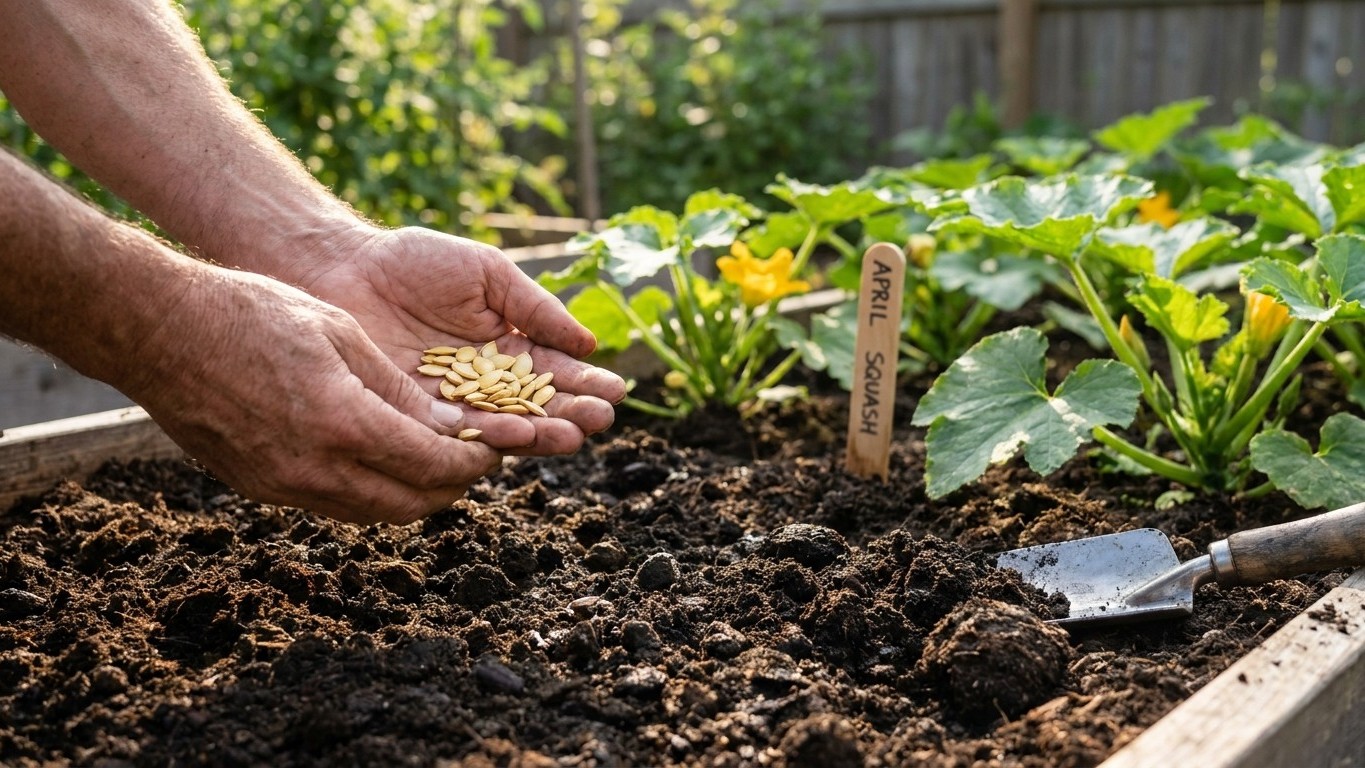

Summer squash goes into Utah soil once nighttime frost risk has passed and the ground has warmed, typically from late April through late May at the reference Salt Lake City station, with earlier windows in the low desert and later ones at altitude. That window comes from NOAA’s freeze-probability data, not a guarantee. The real answer for any single garden depends on elevation, aspect and soil, all of which shift the frost date this page uses as a baseline.
The short answer for Utah
NOAA’s 1991-2020 Climate Normals for station USW00024127 put the last spring frost somewhere between April 12 and April 29, and the first fall frost between October 18 and October 29. Those two ranges are not a guess with fuzzy edges. They mark the band where the probability of a 32F freeze runs from 30% to 70% in either direction, which means a frost on April 20 is a real possibility even in a normal year, not a fluke. Summer squash is a warm-season plant with zero frost tolerance, so the safe move is to treat the later end of that spring band, April 29, as the point where risk has dropped enough to direct-sow with confidence, and to treat October 18 as the point where the season is effectively closing.
Between those two dates sits a growing season of roughly 170 to 200 days, depending on which end of each band actually plays out in a given year. Summer squash needs about 45 to 55 days from seed to first harvest. That leaves enormous slack: a single planting in early May has time to produce for months, and a second sowing in late June or early July, timed to mature before the fall frost band opens, is a realistic way to keep zucchini and yellow squash coming through Labor Day and beyond.
Heat load matters just as much as the calendar. The reference station averages 52.1 days a year at or above 90F, concentrated in July and August, which is exactly when squash plants are trying to set fruit. That heat, combined with a summer that delivers only about 2.0 inches of rain across June, July and August (driest in July, at 0.49 inches), means the sowing date is only half the plan. Watering has to be built in from day one, because the sky will not do it.
What will not work here
Sowing on a fixed calendar date without checking that year’s actual frost timing is the first way this goes wrong. Because the spring frost band spans April 12 to April 29, a gardener who plants on April 15 every year regardless of conditions is gambling inside a two-and-a-half-week window where freeze odds are still meaningfully above zero. Seedlings set out too early into cold soil don’t die outright as often as they simply stall, sitting stunted for weeks while later, properly timed plantings catch up and pass them.
Watering on a fixed weekly schedule is the second failure mode, and it’s the bigger one given Utah’s summer numbers. With only 0.49 inches of rain typical in July and 52.1 days a year above 90F, a “water it Sunday and forget it” approach starves the plant during the exact stretch when it’s under the most heat stress and trying to size fruit. Squash roots are shallow and the leaves are large, so evapotranspiration on a 95-degree afternoon can outpace what a once-a-week soak ever delivered. The practical fix is watering deeply two to three times a week during the hottest stretch rather than once, and increasing frequency further if the plants are in a raised bed or sandy soil that drains fast.
Relying on a slow-maturing variety bred for a long, mild coastal season is the third mismatch, though it plays out differently depending on where in Utah someone gardens. At the Salt Lake City reference point the season is long enough that maturity time isn’t the limiting factor. But Utah’s elevation range is wide enough that a variety that performs fine in one part of the state can run out of season entirely in another, which is exactly what the next section gets into.
Blossom drop from heat is a fourth issue worth naming plainly: when daytime highs run into the mid-90s repeatedly, squash plants often abort flowers or produce fruit that stalls and rots at the blossom end. That’s a heat response, not a disease or a watering failure, and pushing more water at it doesn’t fix it. Timing the crop so peak fruiting lands before the worst of the 90F-plus stretch, rather than squarely inside it, avoids a chunk of this.
What changes across Utah
Utah’s official hardiness range runs from zone 4a to zone 9a on the USDA Plant Hardiness Zone Map, and that five-zone spread inside one state is enormous. The frost dates cited above come from the Salt Lake City reference station, which sits in a comparatively mild valley. Most of the state is higher and colder than that valley floor, and the state’s southern corner is warmer. There is no single answer for “Utah” here, only a spread.
A garden in a mountain valley or on a high plateau, closer to the zone 4a-5b end of that range, should expect a last spring frost noticeably later than April 29 and a first fall frost noticeably earlier than October 18. In practice that can compress the safe sowing window to a few weeks in June and push the reader toward faster-maturing squash varieties simply because the season doesn’t leave room for anything slower.
A garden in the southwestern low desert, closer to zone 8a-9a, is the opposite case: frost risk clears earlier in spring and returns later in fall, which opens the door to an earlier first planting and a realistic second planting well into what would be off-season further north. The heat load also runs higher there than the 52.1-day average cited for the Salt Lake reference point, which means the watering pressure described above is even more pronounced.
None of this tells an individual reader which zone applies to their own yard, and this page won’t guess. The USDA Plant Hardiness Zone Map is the tool built to answer that, using average annual extreme minimum temperature as its single variable. Checking a specific address against that map is the fastest way to know which end of Utah’s spread applies at home.
Where to check this for your own county
Utah State University Extension is the land-grant service for the state, and it publishes county-level guidance at extension.usu.edu. That’s the resource that turns this state-level page into something specific to one backyard.
Two things are worth looking for once there. The first is a county or regional planting calendar, since USU extension offices along the Wasatch Front, in the higher-elevation counties, and in the southern warm-desert counties each work with a different real-world frost window than the single Salt Lake City station cited on this page. The second is any list of squash varieties that county’s extension office has actually trialled locally, because a variety that performs well in a research plot near St. George won’t necessarily behave the same way in Cache County.
A county recommendation beats a state one every time, because it’s built on local frost data, local soil, and often local trial results rather than a single reference station standing in for an entire state that spans five USDA zones. This page is the state-level view: useful for understanding the mechanics of frost bands, heat load, and rainfall, but not a substitute for what a county office can say about a specific zip code. Treat this article as the framework and the county extension page as the number that actually applies.
Checking this against your own garden
Every date on this page describes an average built from thirty years of data at one station. A reader’s own garden will tell them something more current, and it outranks the calendar.
Soil warmth by feel is the first check. Summer squash seed wants soil that feels warm to bare skin, not just frost-free air. Pushing a finger a few inches into the planting bed on a sunny afternoon and finding it cool rather than warm is a sign the ground hasn’t caught up yet, even if the calendar says the frost band has passed.
The first flush of male flowers is the second signal. Squash plants typically produce male blossoms before female ones, and a burst of yellow flowers with no fruit forming behind them yet is completely normal early on. It’s a sign the plant has settled in and started reproductive growth, not a problem to fix.
The appearance of true leaves, the second set that emerges after the rounder seed leaves, is the third marker. True leaves mean the seedling has moved past its most fragile stage and started building the growth that will carry it through the heat of July and August. A garden where true leaves show up quickly after sowing is running warmer and faster than the state average, which is useful information for timing next year’s planting a little earlier.