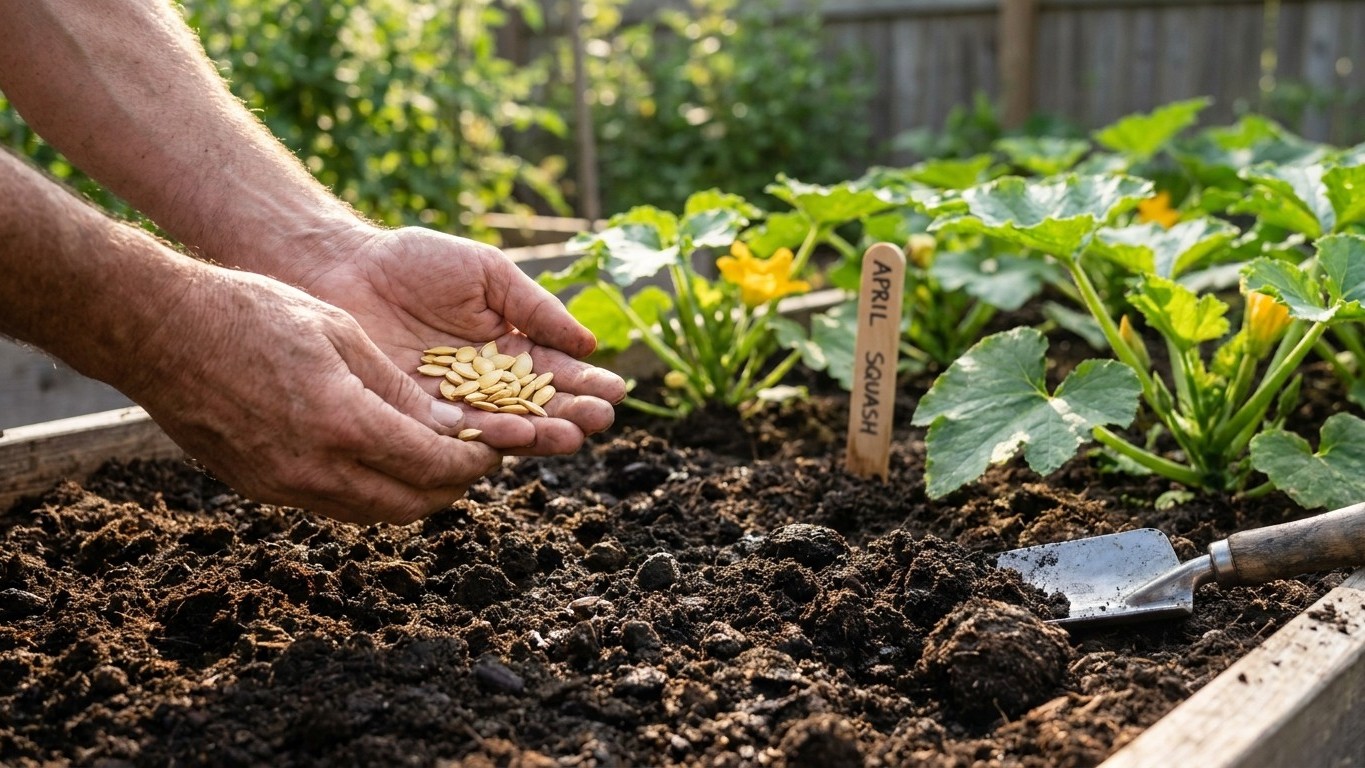

Summer squash goes in the ground in Wyoming only after the frost risk has genuinely passed, which the data puts between May 7 and May 18 depending on where you sit in the state. Wait for soil that’s warmed past cold-and-wet, and plan your harvest window to close before the first fall frost arrives, sometime between September 24 and October 5.
The short answer for Wyoming
Direct-sow or transplant summer squash outdoors between May 7 and May 18, the window NOAA’s 1991-2020 climate normals give for the last spring freeze at the reference station (USW00024018). That range isn’t a guarantee, it’s a probability band: it marks the stretch where a 32F freeze has a 30 to 70 percent chance of still happening. Squash planted on May 7 is playing the early end of that gamble. Squash planted on May 18 is playing it safe.
On the back end, the first fall frost normally lands between September 24 and October 5. That gives a working season of somewhere around 130 frost-free days at 6,000 feet of elevation, and the caution attached to these normals matters more here than almost anywhere else: frost is possible in any month once you climb into the higher parts of the state. A calendar date is a starting point, not a promise.
Inside that window, heat load stays modest. The reference station averages just 10.4 days a year at 90F or above, which is a mild number compared to squash country further south or at lower elevation. Summer squash doesn’t need blistering heat to produce, it needs consistent warmth without a late frost cutting the season short at either end, and Wyoming’s short middle stretch is really the whole story.
Rainfall during the growing months runs light: about 5.8 inches total across June, July, and August, with June wettest at 2.16 inches and August driest at 1.52 inches. That’s not enough to carry a squash bed on its own, especially with evaporation working against you on the hotter days. Plan on supplemental watering from the moment seedlings emerge, not as a backup plan but as the baseline.
Put together, the answer for most of Wyoming is: sow after May 18 if you want a safety margin, sow closer to May 7 only if you’re prepared to cover plants on a cold night, and harvest hard through August and into the first weeks of September before the fall frost window opens.
What will not work here
The single biggest way to lose a squash crop in Wyoming is trusting the calendar date over the ground. Direct-seeding on May 7 because “that’s when the window opens” ignores that May 7 sits at the early edge of a 30 to 70 percent freeze probability band, not the safe end. A grower who seeds that early in a cooler pocket of the state is betting against odds that aren’t in their favor yet.
Slow-maturing summer squash varieties are a poor match for this state’s season length. With roughly 130 frost-free days at 6,000 feet, and less at higher elevations, a variety that needs a long stretch from seed to first harvest is racing a clock that can close early. Choosing for shorter days-to-maturity isn’t a nice-to-have here, it’s the difference between a real harvest and a few small fruits cut short by a September freeze.
Watering on a weekly schedule
Summer rainfall of about 5.8 inches sounds workable until you spread it across three months and factor in evaporation. August alone averages just 1.52 inches, and that’s often delivered as a handful of thunderstorms rather than steady soaking rain, meaning much of it runs off instead of reaching root depth. A once-a-week watering habit, common in wetter states, tends to leave Wyoming squash beds chronically underwatered by midsummer, especially on the hotter days pushing toward that 90F mark.
Ignoring elevation swings
A planting plan built around the state’s average frost dates can fail badly for a garden sitting well above the reference station’s elevation. The caution attached to these normals is blunt about it: frost is possible in any month at higher elevations. A gardener at altitude who plants on the state-average date, without adjusting later, is exposed to a frost event the average simply doesn’t capture for their specific spot.
None of this means summer squash can’t succeed in Wyoming. It does mean the failure modes are specific: too early a sow date, too slow a variety, and a watering habit built for a wetter climate. Correct for those three, and the short, dry season stops being a liability.
What changes across Wyoming
Wyoming is not one garden, and the hardiness zone data makes that plain. The state spans USDA zones 3a to 6a, a genuinely wide range built on average annual extreme minimum temperature. That’s a three-zone spread inside one state’s borders, which means there is no single “Wyoming answer” to when the ground is safe to plant, only a range that shifts hard depending on elevation and latitude.
A gardener in a warmer, lower-elevation pocket sitting closer to zone 6a can expect an earlier practical planting date and a longer stretch of reliable summer warmth. A gardener in a colder, higher pocket closer to zone 3a is working with a shorter frost-free stretch than the state-wide averages suggest, and should lean toward the later end of the May 7 to May 18 window, if not push into early June for direct seeding.
The reference station behind these frost and heat figures represents one point in the state, not every point. Someone gardening at meaningfully higher elevation should treat the September 24 to October 5 fall frost window as optimistic and watch conditions closely once late August arrives. Someone in a lower, more sheltered valley may get a few extra weeks on both ends of the season that the state figures don’t show.
None of this tells you which zone your own yard sits in. What it tells you is that the spread is wide enough, three full zones, that guessing based on “I live in Wyoming” isn’t good enough. The next step is finding out where your specific location falls.
Where to check this for your own county
The state-wide numbers on this page are a starting point, not a finish line. For a recommendation tuned to your actual county, the right stop is the University of Wyoming Extension, the land-grant extension service for the state. County-level guidance accounts for local elevation, local frost patterns, and local soil in a way a state-wide average never can.
Once there, two things are worth hunting down specifically. First, a local or county-adjusted planting calendar, which will narrow the broad May 7 to May 18 window this page gives into something closer to your actual conditions, especially useful if you’re at meaningfully higher or lower elevation than the reference station used here. Second, look for summer squash varieties that extension agents have actually trialed in your county. Varietal performance data collected locally, over multiple seasons, tends to catch things a state-wide hardiness zone map can’t: which varieties handle a short season without sacrificing yield, and which struggle even within the same broad zone.
A county recommendation beats a state one every time, for a simple reason: it’s built on conditions closer to your own. This page works from state-wide climate normals, useful for understanding the pattern and the range, but not a substitute for what your county extension office has observed on the ground over years of local trials. Treat this as the map, and the county office as the terrain.
Checking this against your own garden
Every date on this page is an average built from decades of station data. Your own garden, this year, is a single data point, and it can disagree with the average in either direction. Three signs from the plants and soil themselves will tell you more than any calendar.
Start with soil warmth, checked by feel rather than instrument. Push a finger a couple inches into the bed where you plan to plant. Cold soil that feels damp and heavy, even weeks after the average last frost date has passed, is a sign your specific spot runs cooler than the state reference station, whether from elevation, shade, or drainage. Squash seed sown into soil that still feels cold tends to rot before it germinates rather than simply growing slowly.
Second, watch for the first flush of male flowers once plants are established. Male flowers typically appear before female ones, and an early, strong flush is a decent sign the plant considers conditions warm and stable enough to start reproducing. A long delay, or flowers that appear then stall, suggests the plant is still hedging against unstable weather, worth noting if you’re deciding whether to trust an early planting date next season.
Third, track how fast true leaves develop after the first seedling leaves appear. Quick, sturdy true-leaf growth signals conditions matching what the plant expects for this stage. Slow or pale true-leaf growth, even with adequate watering, often points to soil or air temperatures running cooler than the state averages this page is built on, information worth writing down for next year’s planting date.