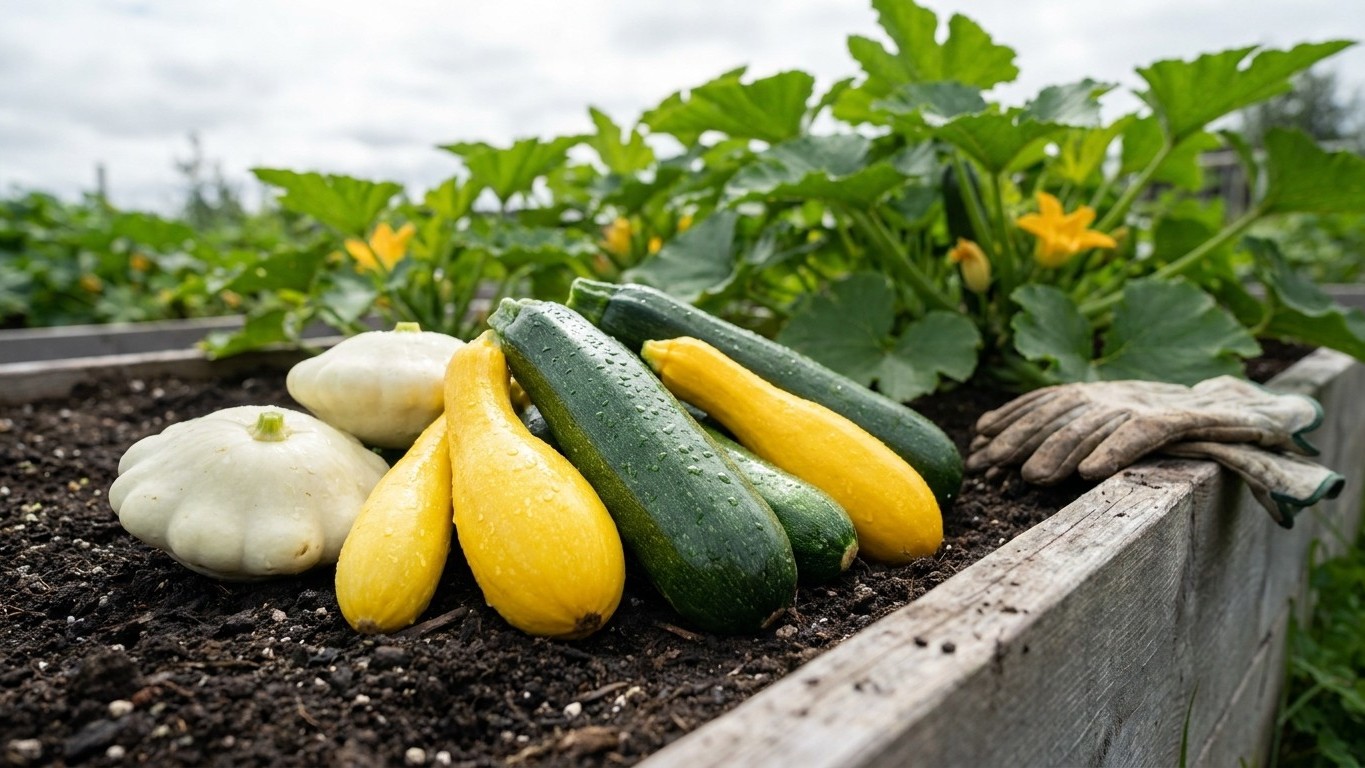

Summer squash needs about 45 to 65 warm days to bear fruit, and Yukon’s mean frost-free window runs roughly 81 days, from June 5 to August 25. That math leaves almost no slack, so the varieties that work here are the fastest bush-type zucchini, yellow crookneck or straightneck, and patty pan squash, started as transplants rather than direct-seeded, never the vining or long-season types bred for hotter regions.
The short answer for Yukon
Start with the two dates that frame everything: a mean last spring frost of June 5 and a mean first fall frost of August 25 at the Whitehorse reference station. Subtract one from the other and you get 81 days on paper. In practice it’s shorter, because those are averages, not guarantees. In one year out of two, the last spring frost lands after June 5, and by the same logic the first fall frost can arrive before August 25 just as often. A gardener who plants right on the mean date is gambling with both ends of the season at once.
That’s why the decision here is made by type, not by scanning a seed rack for something that looks nice. Vining or trailing summer squash, the kind that sprawl and typically need 65 to 80 days to size up, don’t fit inside a window this tight. Bush-type zucchini, bush yellow crookneck or straightneck, and scallop-shaped patty pan squash are the three categories that reliably finish faster, and within each of those categories, the fastest-maturing option available should win over one chosen for flavor or size alone.
Add in the heat side of the equation: Yukon averages zero days a year at or above 90F. Days-to-maturity numbers on seed packets are usually calculated under warmer regimes than that, meaning a squash rated 50 days in a hot state can easily run longer here. Starting seed indoors three to four weeks before the last frost and transplanting out as soon as the soil has warmed banks time that direct-seeding can’t recover.
| Type | Typical days to maturity | Fit for Yukon’s ~81-day window |
|---|---|---|
| Bush zucchini | 45-55 days | Best fit, especially the fastest cultivars within the group |
| Bush yellow crookneck/straightneck | 50-60 days | Workable if started as transplants |
| Patty pan/scallop | 45-55 days | Good fit, often among the quickest to fruit |
| Vining/trailing summer squash | 65-80 days | Poor fit, rarely finishes before frost |
What will not work here
The slowest summer squash lose first, and it isn’t close. Anything bred for a long, hot season, vining habits, storage-type flesh that needs extra weeks to develop flavor, simply runs out of days before the mean fall frost, let alone the early version of it that shows up in half the years on record. A variety that needs 70 days from direct seeding has no realistic path to maturity in a season this short.
Direct-seeding itself is a second failure point, separate from the variety question. Squash seed wants warm soil to germinate well, and with a mean last frost of June 5, Yukon soil in early June is often still cold at depth. Seed sown straight into ground that hasn’t caught up to the air temperature sits and rots rather than sprouting, which quietly eats another one to two weeks off an already short calendar. Transplants sidestep this by doing the slow part indoors, where soil temperature isn’t the bottleneck.
What doesn’t apply here is the failure mode that trips up gardeners further south: the hot, dry summer that punishes anyone watering only once a week. Yukon has zero days a year at or above 90F, and summer rainfall runs about 4.2 inches across June, July and August, with June, the driest month, at just 1.28 inches. There’s no heat wave to compensate for, and a watering schedule built for a scorching, arid climate is the wrong problem to solve. The more common mistake in cool, modest-rainfall conditions is overwatering, on the assumption that squash always wants more moisture; in cooler, damp soil that habit invites rot at the base of the plant instead of drought stress.
Frost risk is the last thing that trips people up, and it cuts both ways. Treating June 5 as a safe planting date ignores that it’s a mean, not a floor, and treating August 25 as a guaranteed harvest deadline ignores that the same statistic works in reverse. Squash left in the ground past the point when a light frost is plausible can lose a late flush of fruit overnight, and a grower who doesn’t watch the forecast in late August is trusting an average to behave like a promise.
What changes across Yukon
The 1b figure quoted for this territory is a Canadian hardiness zone, not a USDA one, and it describes the Whitehorse reference station specifically, not the territory as a whole. That distinction matters twice over. First, the Canadian system is built from seven climate variables rather than the single measure the USDA uses, so the two numbers can’t be placed on the same scale even where they share a digit. Second, Whitehorse sits in the milder part of a territory that stretches a long way north and climbs a long way in elevation, and neither of those directions is kind to a short-season crop.
A territory this size doesn’t have one growing season, it has several, layered by latitude and altitude. Communities further north than Whitehorse, and gardens sitting at meaningfully higher elevation even within the same region, run colder than the 1b figure suggests, with a shorter practical window than the 81 days worked out above. Southern valleys close to the reference station itself are the closest match to what these facts describe, but even there, a valley bottom that pools cold air overnight behaves differently from a slope a few hundred feet up.
None of this is something to guess at from a single provincial number. Natural Resources Canada’s Plant Hardiness Site maps zones down to the municipality, and that’s the tool for placing a specific garden rather than the territory-wide figure carried by this page.
Where to check this for your own county
This page describes Yukon as a whole, built from a single reference station in Whitehorse. That’s useful for understanding the mechanism, the frost dates, the heat load, the rainfall pattern, but it isn’t a substitute for a district-level recommendation, and a local one should always outrank a territory-wide one when the two disagree.
The provincial agriculture site doesn’t answer automated checks reliably, so the working link to use is the federal Agriculture and Agri-Food Canada site. From there, look specifically for two things: a planting calendar built for the Yukon or the nearest northern region covered, and any record of which summer squash varieties have actually been trialled in local conditions rather than just recommended in general terms. Trial results matter more than catalog descriptions, because a variety that performs well in a controlled trial plot near Whitehorse has already been tested against the frost dates and heat load this page can only describe on paper.
If the federal resources point toward a territorial office, a community garden association, or a local extension contact, that’s the source worth following up, since it will reflect actual local sowing dates and variety performance rather than a station-wide average. This page gives the mechanism and the numbers behind it; a county or district-level source gives the answer tuned to one specific piece of ground, and that’s always the more useful figure to plant by.
Checking this against your own garden
Every date on this page is an average pulled from decades of records at one station, and a reader’s own garden will outrank all of it. Three things are worth watching directly, none of which require anything beyond a hand in the dirt and a pair of eyes.
Soil warmth by feel is the first and most direct check. Squash seed and young transplants both stall in cold soil regardless of what the calendar says, so soil that still feels cold and damp several inches down, even after the mean frost date has passed, is telling a gardener to wait rather than trust the average.
The first flush of male flowers is the second signal. Summer squash typically produces male blooms before female ones, and a strong early flush is a sign the plant has settled in and started its reproductive clock, useful confirmation that the season is actually underway rather than just calendar-correct.
The appearance of the first true leaves, the second set that follows the initial seed leaves, marks the point where a young plant has moved past its most vulnerable stage. How quickly that set shows up compared to a typical season is a rough but honest measure of how warm this particular garden has actually been running, which is exactly the kind of local detail no territory-wide figure can supply.