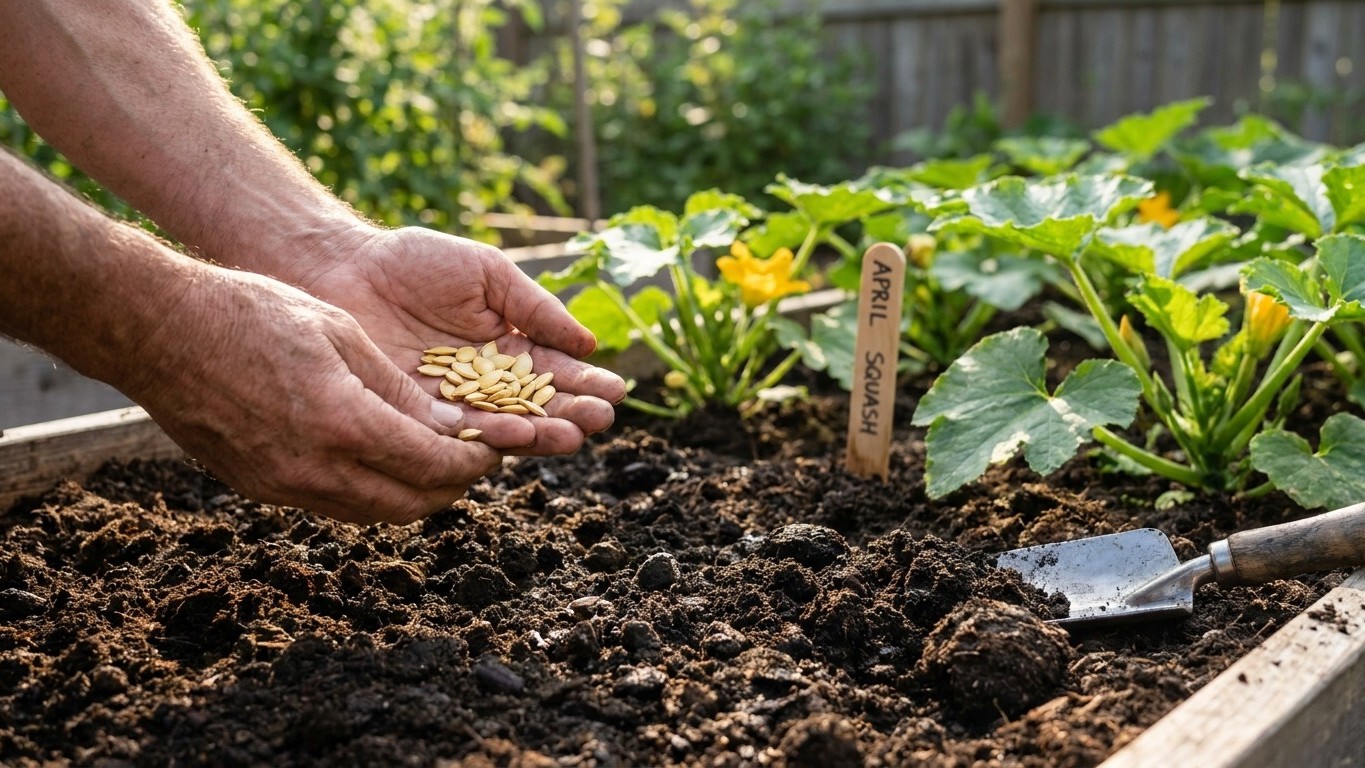

Set summer squash transplants or protected seedlings outside in Whitehorse and southern Yukon around the first days of June, right after the mean last spring frost. That date is only an average, not a guarantee, and the frost-free window it opens runs roughly 81 days before the mean first fall frost returns in late August.
The short answer for Yukon
Environment and Climate Change Canada puts the mean last spring frost at Whitehorse A on June 5, and the mean first fall frost on August 25. Both numbers come from the 1981-2010 Canadian Climate Normals for that one station, and both are averages, not thresholds. In roughly half of the years on record, frost has arrived later than June 5 in spring or earlier than August 25 in fall. Treat June 5 as the midpoint of a window that can slide either direction, never as a green light.
Do the math on that window and the picture gets tight fast. From June 5 to August 25 is about 81 days of frost-free growing, at least in the mean year. Summer squash is one of the faster vegetables in a garden, but it still needs weeks of warm soil to germinate, grow leaves, flower, and set fruit before the first cold night stops it. An 81-day mean window leaves little room for a late spring frost or an early fall one, which is exactly why gardeners across the north start squash indoors rather than direct-seeding it outside.
Starting transplants two to three weeks before the outdoor set-out date is the standard workaround for a short season like this one, and it buys back some of the days a direct-seeded plant would lose waiting for the soil to warm on its own. What this territory’s numbers do not demand is protection from heat. Whitehorse averages zero days a year above 90F, so there’s no need to shade squash or worry about heat-stressed blossoms the way a gardener further south would. The limiting factor here is cold, at both ends of the season, not heat in the middle of it.
The Canadian hardiness zone for the Whitehorse reference station is 1b, on the Canadian system, which is built from seven climate variables and does not convert to a USDA zone. That number alone tells you this is a short, cold-adjacent season where every week of frost-free growing counts, and where the sowing decision has to be built around the local frost dates rather than a generic zone chart.
What will not work here
Direct-seeding summer squash outdoors on the calendar date of June 5 and expecting a normal crop is the most common way this fails. Squash seed germinates poorly in cold soil, and even after the air stops freezing, the ground under it can still be too cool for a seed to sprout reliably. A seed sitting in cold, wet soil for an extra week or two doesn’t just delay germination, it often rots before it ever gets going. That’s the practical reason transplants, started indoors and moved out once both soil and air have caught up, beat a bare seed sown straight into ground that only just thawed out.
Counting on natural rainfall to water a squash crop through the season will also come up short. Summer rainfall across Whitehorse averages about 4.2 inches over June, July, and August combined, with June, the very month squash is getting established, the driest of the three at just 1.28 inches. That’s a thin margin for a plant that needs steady soil moisture to push out leaves and set fruit. A gardener who waters “when it rains” in a Yukon June is, most years, not watering enough, and a squash plant under that kind of stress produces fewer, smaller fruit, or simply stalls.
Planting a variety bred for a long, hot growing season and expecting it to finish here is another way to lose the crop before frost. With an 81-day mean gap between frost dates and zero days a year above 90F to speed things along, anything that needs a long run of warm days to reach harvest is racing a clock it’s likely to lose. The territory’s cold-driven limits, not humidity or disease pressure, are what decide success or failure in this particular garden.
What does not apply here, worth saying plainly, is the tight-spacing failure that shows up in humid states further south. Yukon’s low summer rainfall means fungal pressure from close planting is a smaller concern than the cold and the dry stretch in June. The two things actually working against a Yukon squash crop are frost risk at both ends of the season and a June that doesn’t hand out much water on its own.
What changes across Yukon
The 1b Canadian hardiness zone cited above belongs to the Whitehorse reference station, not to the whole territory. Yukon is a big stretch of land with river valleys, alpine terrain, and communities much farther north than Whitehorse, and a single zone number can’t stand in for all of it. A garden tucked into a sheltered valley bottom can run noticeably warmer through the season than one at higher elevation or further north, even within the same territory.
This matters directly for the sowing decision. The June 5 and August 25 frost dates used above are specific to the Whitehorse A station. A garden further north, at higher elevation, or in a low frost pocket is very likely working with a shorter frost-free window than the mean 81 days calculated here, and a spring frost date later than June 5. There’s no single number that covers a territory this size, and this page doesn’t have the station-level data to give one for every Yukon community.
The practical shift for a reader outside Whitehorse itself is to treat June 5 as a starting reference, not a local fact, and to lean more heavily on transplants started early indoors, since a shorter local season leaves even less margin for direct seeding. Anyone gardening north of Whitehorse or well above valley floor elevation should assume their own frost-free window runs shorter than the one calculated here, and plan the indoor head start accordingly.
For a reader’s own community, Natural Resources Canada’s Plant Hardiness Site maps zone by location across the country, and is the right place to look up the number for a specific town rather than assuming Whitehorse’s 1b applies. This page can name what the reference station shows; it can’t tell an individual reader which zone their own yard sits in.
Where to check this for your own county
This page gives the territory-wide picture, built from one reference station’s climate normals. A community-level planting calendar, built from local trial data, will always beat that. The right next step is Agriculture and Agri-Food Canada‘s site. The Yukon territorial department’s own site currently declines automated verification checks, which is why the federal address is the one given here: a link that’s confirmed to work beats one that only looks right.
Once there, look for two specific things rather than browsing generally. First, any locally published planting calendar or frost-date guidance for the specific Yukon community in question, since a station closer to home will track that garden’s actual conditions better than the Whitehorse A normals used throughout this page. Second, any list of vegetable varieties that have actually been trialled in Yukon conditions, since a variety proven to finish within a short northern season is a more reliable bet than one chosen off a seed packet written for a much longer growing region.
A county-level, or in Yukon’s case community-level, recommendation will always outrank a territory-wide one, because it’s built on conditions closer to the actual garden rather than averaged across a station many miles or many hundred feet of elevation away. This page is the territory-wide version: useful for understanding the pattern and the reasoning behind it, but not a substitute for whatever local data Agriculture and Agri-Food Canada or a Yukon garden club has published for a specific community.
Checking this against your own garden
Every date on this page is an average pulled from one weather station. A reader’s own garden will tell them more than any calendar can, and three simple checks are enough to read it.
- Soil warmth by feel: push a finger a couple of inches into the planting bed. If it feels cold and damp rather than just cool, the soil hasn’t caught up to the air yet, no matter what the calendar says about frost dates, and seed or transplants set out now are likely to sit and sulk rather than grow.
- The first flush of male flowers: summer squash typically opens several male flowers before the female flowers, the ones with a tiny swollen fruit behind the petals, show up. Seeing males appear tells a gardener the plant has settled in and is moving toward fruiting, a sign the local conditions are working in its favor.
- The first true leaves: the rounder seed leaves that appear first aren’t the plant’s real foliage. Once the jagged, more squash-shaped true leaves emerge, the plant has moved past its most fragile stage, and that timing, compared against when it was set out, says a lot about how warm this particular bed actually is.
None of these checks need a thermometer or any other tool, just a look and a touch every few days. Taken together, they tell a gardener whether their own patch of ground is running ahead of or behind the territory-wide averages this page is built on, which is the only way to know, season to season, whether June 5 was early, late, or right on time for that particular yard.