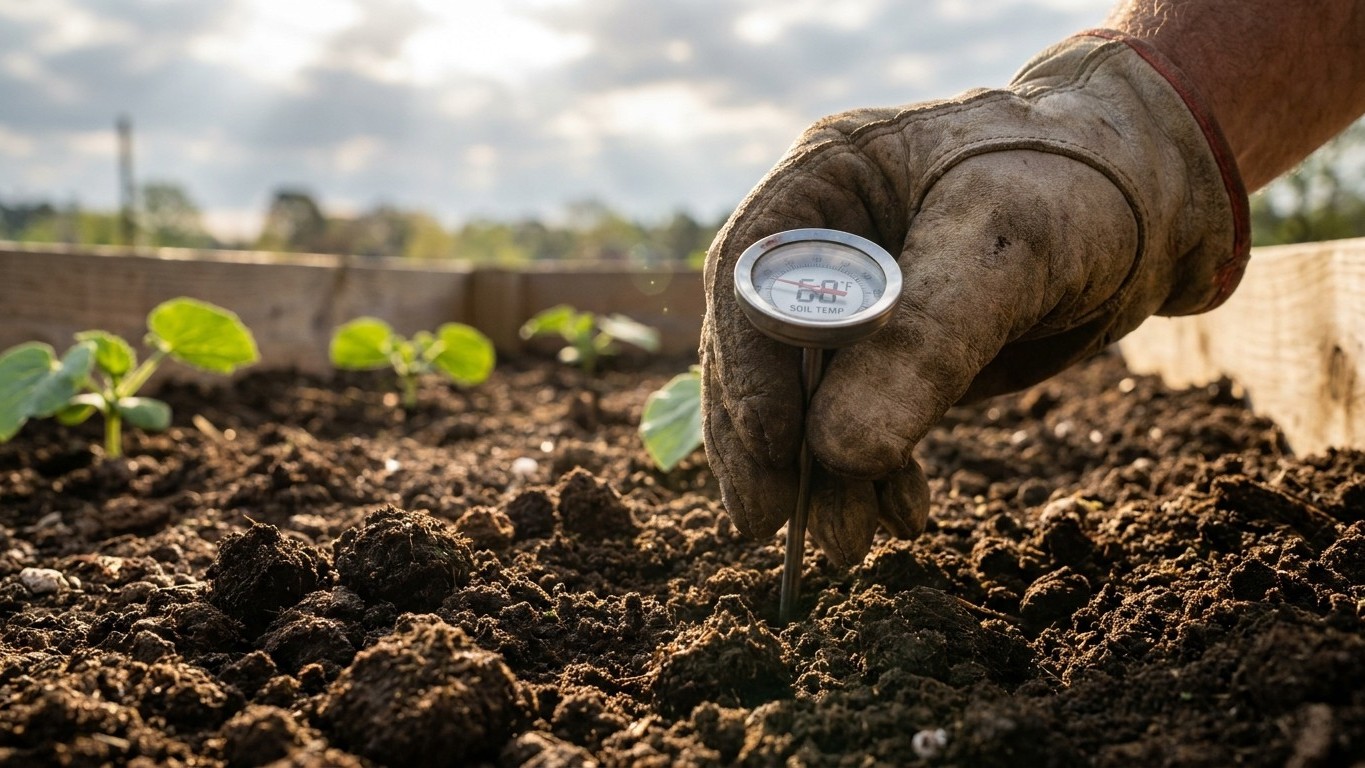

Melons go in the ground in South Carolina once soil temperatures climb into the mid-60s and above, which for most of the state falls somewhere between late March and mid-April. The exact week depends on where you garden: the Upstate lags the coastal plain by two to three weeks, and the frost risk itself is only the starting point, not the whole story.
When the soil is warm enough in South Carolina
The reflex is to count backward from the last frost and call it done. That instinct is only half right. NOAA’s 1991-2020 Climate Normals put the last spring frost in South Carolina, measured at station USW00013880, somewhere between February 28 and March 17 in a normal year, based on the 30-70% probability band for a 32°F freeze. That’s a wide window, and it’s a probability, not a promise, one worth stating clearly once and moving past.
Frost is a proxy. What melon seed actually responds to is soil temperature, and soil lags behind air temperature by days, sometimes weeks, especially where clay holds cold and moisture. A morning without frost risk doesn’t mean the top four inches of soil have crossed the threshold melons need to germinate without rotting. That’s the gap most first-time growers miss: they treat the last-frost date as a planting alarm, when it’s really just the point where the countdown to warm soil begins.
The caution baked into the NOAA data matters here too. Peninsular Charleston runs milder than the airport station the normals are drawn from, so gardeners close to the coast often see workable soil a week or so ahead of the inland reading. Upstate South Carolina runs the opposite direction: both the spring and fall windows tighten by several weeks compared to the reference station, which means a gardener in Greenville or Spartanburg is planting later and finishing earlier than the statewide range suggests.
What this means for direct sowing versus transplants
Because the state sits in USDA Hardiness Zone 7a to 9a, a range built on the average annual extreme minimum temperature rather than spring warmth, that zone number tells you almost nothing about when soil is ready for melon seed. It’s a winter-survival metric, not a planting calendar. The practical move is to warm the bed itself, whether through raised rows, dark mulch, or simply waiting an extra week past the local frost date before committing seed to open ground. None of this requires a product recommendation. It requires patience and, ideally, a soil thermometer pushed a few inches down before the first seed goes in.
How long the season lasts here
Bookend the frost dates and South Carolina’s frost-free stretch runs from as early as February 28 through as late as December 5 at the wide end, or as tight as March 17 to November 20 at the narrow end, both drawn from the same NOAA normals at station USW00013880. Even at the conservative end, that’s roughly eight months without frost risk, which puts South Carolina among the longer growing windows in the melon-growing part of the country.
That length changes the decisions a grower makes, and this is the part worth dwelling on rather than just the arithmetic. A short season, the kind found further north, forces a single planting and makes every week of delay costly. South Carolina’s window is generous enough that a second sowing, planted in early summer for a fall harvest, is a realistic option rather than a gamble. That’s not universal advice, it depends on which end of the state you’re gardening in, but the margin exists where it doesn’t in a six-month climate.
A long window also changes whether starting seed indoors is worth the trouble. Melons dislike root disturbance, and transplanting always carries some setback while roots recover. Where the season is short, that setback can cost you the harvest entirely, so growers accept the risk anyway to gain a few weeks. Where the season runs eight months, as it does across most of South Carolina, direct sowing after the soil has warmed is often the simpler and equally reliable path, since there’s enough calendar left to absorb a slower start.
The second sowing question deserves its own detail, since timing it wrong wastes a planting rather than gaining one. For the mechanics of spacing two melon plantings so the second one still has time to finish before fall frost, the site’s succession sowing guide walks through the counting backward from your local fall frost date rather than forward from spring.
Heat and water in South Carolina
South Carolina averages 55.1 days a year at or above 90°F, measured at the Charleston reference station in the same 1991-2020 NOAA Climate Normals. That’s not a description of every backyard in the state, since inland and upstate locations run their own local counts, but it’s a solid indicator: this is a territory with real, sustained summer heat load, not a marginal one where melons merely survive.
That much heat matters more for melons in terms of accumulated warmth than in terms of calendar days. A vine can sit in cool soil for two extra weeks and lose nothing if the following stretch delivers enough warm days to catch up. In a territory logging 55 days above 90°F, that catch-up capacity is rarely the limiting factor. What decides outcomes here is water, and specifically, how it arrives.
Summer rainfall across June, July and August totals about 19.8 inches at the same reference station (52.5 inches over the full year), split fairly evenly: 6.21 inches in June, 6.6 in July, 6.97 in August. On paper that looks generous. In practice, heat above 90°F drives evaporation hard, and summer rain in the Southeast tends to arrive as thunderstorms rather than steady soaking rain, which means a good share of it runs off rather than reaching root depth. A sandy bed can be dry again within a day of a downpour; a clay bed holds that same rain for a week. Neither reading substitutes for a rain gauge on the actual plot, but the pattern is consistent enough to plan around.
The practical consequence: irrigation, not rainfall totals, is what decides fruit size in a South Carolina summer, and the final two to three weeks before harvest are where consistency in that irrigation decides sugar content. Erratic watering late in the season, heavy one week and dry the next, is a common way to end a season with plenty of vine and disappointing fruit.
Which melons suit South Carolina
This page won’t name a variety, and that refusal is itself the useful answer. The types that perform well in a hot, humid, long-season state like South Carolina are rarely the same specific cultivars that top a seed catalog written for the whole country, and a name printed here without a local trial behind it is worse than no recommendation at all.
Reasoning by type instead of by name still gets a gardener most of the way there. Given a season that stretches eight months in most of the state, the earliest-maturing types aren’t the constraint they’d be further north, though they remain useful for that second, succession planting discussed above. Given 55.1 days a year above 90°F, types and rootstock choices that tolerate sustained heat, and that are given airflow through spacing and pruning rather than crowded onto a trellis or dense bed, hold up better through the hottest stretch of July and August.
Why disease resistance comes first here
Given nearly 20 inches of summer rain arriving as humid, thunderstorm-driven bursts rather than gentle soaking, disease resistance, particularly to the fungal and mildew pressures that thrive in warm, wet air, deserves to be the first filter a South Carolina gardener applies, ahead of flavor or size. A vine that succumbs to mildew in August never gets to the sugar-building final fortnight at all.
The trialled varieties that answer all three conditions at once, heat tolerance, disease resistance, and a maturity window that fits either a single planting or a succession pair, change from county to county and from year to year as new cultivars are tested. Clemson’s Cooperative Extension Service runs those regional trials and publishes the results for South Carolina specifically, which makes it the one source worth checking before buying seed, rather than a generic national list.