
In most of Vermont, growing melons means picking short-season types, warming the soil before you plant, and accepting one harvest window rather than two. The state’s cool nights and modest heat load favor smaller, earlier-maturing types over the big, slow cantaloupes and watermelons grown further south, and the University of Vermont Extension is the right place to confirm what actually ripens in your county.
When the soil is warm enough in Vermont
Gardeners always want a single date. Vermont doesn’t offer one. At the Burlington reference station (USW00014742), NOAA’s 1991-2020 Climate Normals put the last spring frost somewhere between April 30 and May 10, a 30 to 70 percent freeze probability band, not a hard line. That range itself is a warning: even at the mildest station in the state, frost risk tapers off rather than stopping on cue.
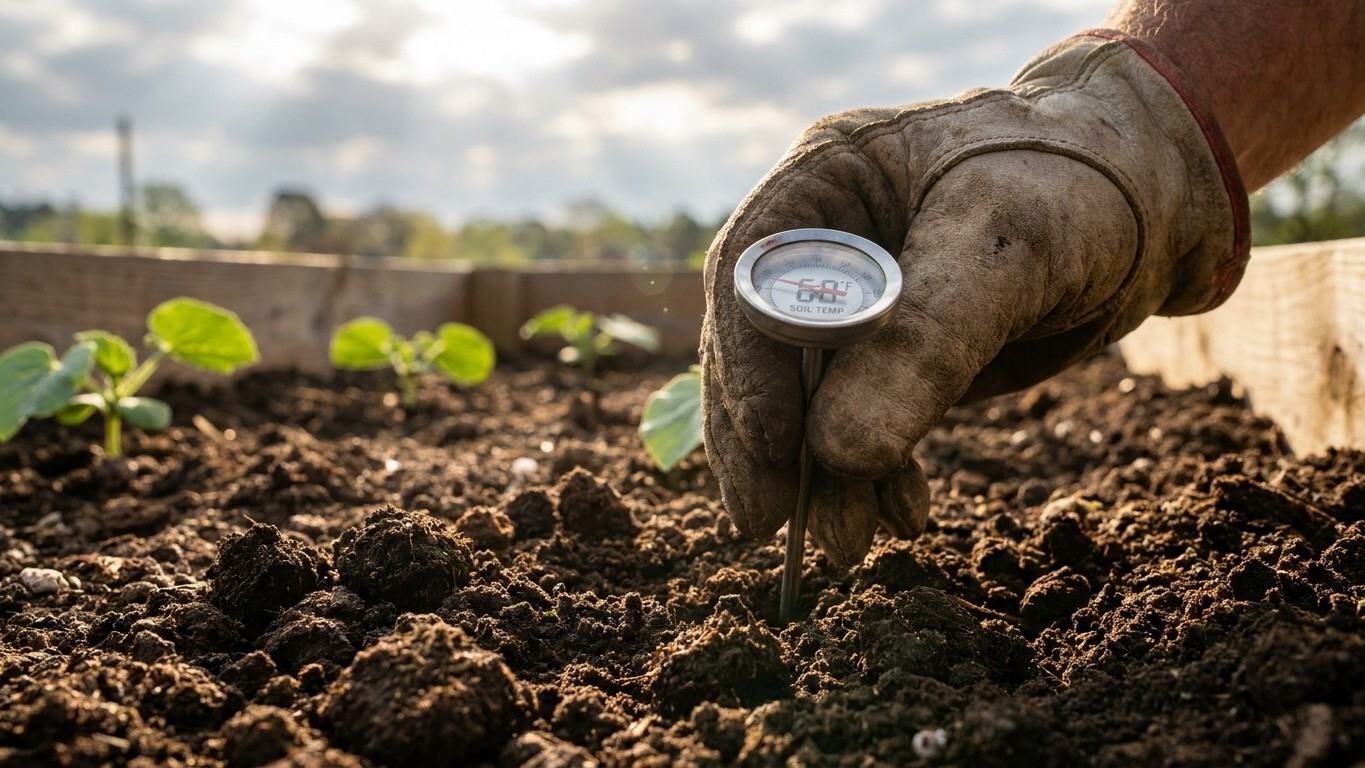
And that date is only a proxy anyway. Melon seed doesn’t care about frost. It cares about soil temperature, and soil warms on its own schedule, usually a couple of weeks behind the last frost, especially in a state where snowmelt and spring rain keep the ground cold and wet well into May. A garden bed can be frost-free and still too cold underneath for melon roots to do anything but sit and rot. Direct-seeded melons dropped into cold soil don’t die outright most years, they just stall, and a stalled melon in a short Vermont season rarely catches up.
The practical fix is to warm the bed before the seed or transplant goes in, not to chase the calendar. Raised beds drain and warm faster than flat ground. Dark mulch laid a week or two ahead absorbs sun and pushes soil temperature up several degrees. Row cover over young plants traps heat at ground level on the cool nights that are still common well into June at higher elevations. None of this changes the frost date; it changes how much of the season the plant actually gets to use.
One more caution matters more here than in most states. Burlington sits on Lake Champlain, the mildest corner of Vermont, where the lake moderates temperature swings in both directions. The Green Mountains and the Northeast Kingdom run substantially shorter and colder, a grower an hour east of Burlington should treat these dates as optimistic, not local. If you’re not gardening within a few miles of the lake, push your own working estimate later, and confirm it against your own soil thermometer rather than a station reading from across the state.
How long the season lasts here
Do the subtraction and Vermont’s frost-free window runs roughly 146 to 166 days, depending on where within each frost range your particular spring and fall land, from a late May 10 spring frost to an early October 3 fall frost on the short end, to an April 30 spring frost stretching to an October 13 fall frost on the long end. Call it about five months, give or take ten days either way.
That’s not a generous number for melons, which are among the slower vegetable-garden crops to reach harvest. In a state with a 200-day window, a grower can sow a first melon crop, harvest it, and still have time to start a second planting behind it, or stagger sowings a few weeks apart to spread the harvest out. Vermont doesn’t offer that luxury. With 146 to 166 days total, and melons needing most of a season to mature and then ripen properly, one sowing is usually the whole plan. There’s no real margin for a second attempt if the first one fails, and no window left over for a follow-up planting once the first vines come out.
That changes how much a failed transplant or a slow direct-sowing actually costs. In a long-season state, losing three weeks to transplant shock or a poor germination is an inconvenience. In Vermont, three weeks lost from a 150-day window can be the difference between a ripe melon and a green one still on the vine when the first fall frost arrives. That’s the real argument for starting melons indoors under cover and transplanting carefully, minimizing root disturbance, rather than counting on a direct-sown seed to catch up on its own. It’s also the reason succession sowing works differently here than it does with quicker crops, for guidance on which vegetables can still be staggered through a short Vermont season, see the succession sowing guide on this site.
Heat and water in Vermont
Melons ripen on accumulated warmth, not on the calendar, and Vermont doesn’t accumulate much of it. The Burlington reference station averages just 5.4 days a year at or above 90°F. That’s a modest heat load by any national standard, and it means the plant is rarely under real heat stress here. The flip side is less welcome: without those hot stretches, sugar development and the final ripening push that melons depend on late in the season simply take longer, or in a cool year, don’t fully arrive at all.
This is the point where a Vermont garden differs from a melon guide written for a hotter state. Where days above 90°F run high, the conversation is about irrigation and the final two weeks before harvest deciding sugar content. Vermont isn’t that territory. With heat this modest, the type of melon chosen and the soil-warming technique used at planting matter more than fine-tuning the sowing date, because the limiting factor isn’t a late start, it’s whether the plant ever gets enough cumulative warmth to finish what it started.
Rainfall complicates the picture rather than simplifying it. Summer rainfall at the same station averages about 11.9 inches across June, July and August : 4.26 inches in June, 4.06 in July, and 3.54 in the driest month, August. That’s a reasonable amount of moisture, enough that most Vermont gardens won’t need constant supplemental watering the way a dry Western state would. But melons don’t just need water; they need it to arrive predictably, and a summer thunderstorm that dumps an inch in twenty minutes mostly runs off rather than soaking into the root zone, especially on clay, which is common across much of the state.
The bigger risk from that rainfall pattern isn’t drought. It’s the combination of moderate rain and modest heat sitting on top of a plant that’s already growing slowly: humidity lingers, foliage stays wet longer between drying spells, and powdery and downy mildew find exactly the conditions they like. A cool, damp Vermont summer is far more likely to cost a melon crop through disease and slow ripening than through lack of water. Spacing plants for airflow and watering at the soil line rather than overhead does more for a Vermont melon patch than any amount of extra irrigation.
Which melons suit Vermont
Given all of that, the choice comes down to type, not variety name. A short frost-free window of 146 to 166 days favors the earliest-maturing types available in a given melon category, since anything bred for a long, hot season simply won’t finish in time here. A climate with few days above 90°F favors types and techniques that don’t depend on sustained heat to ripen, paired with soil-warming practices like raised beds, dark mulch, and row cover at planting. And a summer with regular rain and modest heat makes disease resistance the first thing to check on a seed packet or plant tag, ahead of size or flavor claims, because mildew pressure is the more realistic threat to a Vermont crop than drought or heat stress ever will be.
None of that adds up to a specific variety recommendation, and that’s deliberate. Seed catalogs list dozens of melon types under names that get bred, renamed, and replaced constantly, and what performs in a trial in one county can underperform thirty miles away in the Green Mountains or the Northeast Kingdom. The only recommendation worth trusting is the one built on local trial data, updated for the actual conditions where the seed will go into the ground.
That data exists, and it’s free. The University of Vermont Extension tracks which melon types and cultivars have actually performed in the state’s trial gardens, sorted by region and season length, and updates that guidance as new types come to market. A gardener near Burlington and one in the Northeast Kingdom are, in practical terms, gardening in different climates under the same state hardiness range of 3b-5b, and the extension office is set up to tell each of them something different, which is exactly what a general guide like this one can’t do.