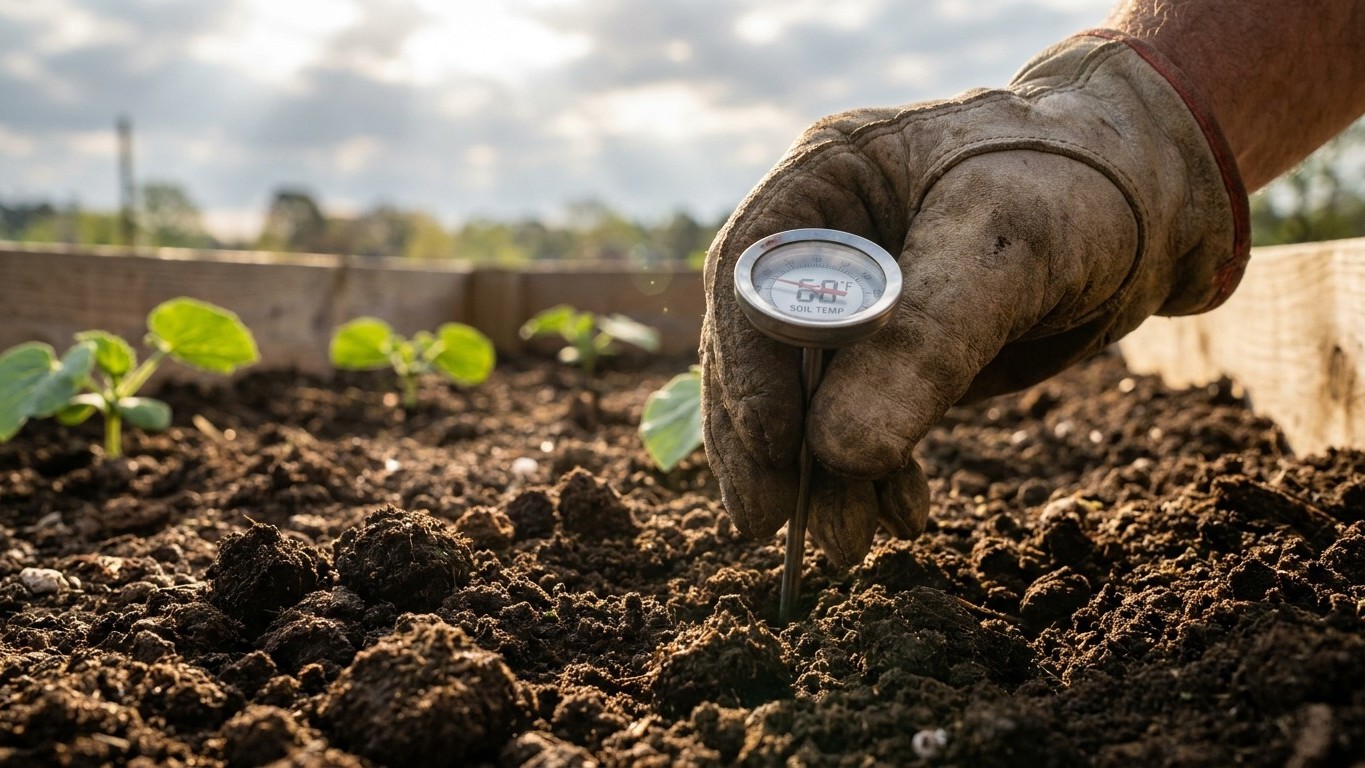

Yukon’s growing season is short and cool enough that melons need real help to ripen outdoors: with zero days above 90F most summers and frost possible into early June, the plan has to lean on soil-warming tricks and the earliest-maturing types rather than on variety alone or on a long stretch of hot weather that simply doesn’t happen here.
When the soil is warm enough in Yukon
The average last spring frost at Whitehorse A sits on June 5, according to Environment and Climate Change Canada’s Canadian Climate Normals 1981-2010. That date is a mean, not a guarantee: in roughly one year out of two, frost shows up later than June 5, so treat it as the middle of a window rather than a safe line to plant on.
Frost itself is only a stand-in for the number that actually matters to a melon seed: soil temperature. Melon seed sits and rots in cold ground even after the air has stopped freezing, because soil warms on its own schedule, several weeks behind the last frost, as the sun climbs higher and days lengthen. In a territory like this one, where the frost-free window opens late and closes early, waiting for the calendar date alone wastes precious growing days.
What closes that gap is warming the soil directly instead of waiting on it. Black plastic mulch laid over the bed for a week or two before sowing pulls heat down into the root zone faster than bare soil ever will. Raised beds warm quicker than ground-level rows because they drain and heat from more angles. Cold frames or simple cloches placed over young plants trap daytime heat and buffer the cool nights that are still common here well into June. None of these techniques change the frost date; they change how much use a gardener gets out of the season that date defines.
Variety choice matters too, but not in the way seed catalogs sometimes suggest. This page won’t name a specific cultivar, because the varieties actually trialled and proven for a short northern season change from one growing program to the next, and the only recommendation worth trusting is the one tested locally. For that, the right stop is Yukon’s own agricultural resource through Agriculture and Agri-Food Canada, which points to the trial data and extension guidance that applies to this specific climate. What’s worth knowing in general terms: look for the earliest-maturing types within whichever melon category interests you, since a short season punishes anything bred for a longer, hotter stretch.
How long the season lasts here
Subtracting the two ECCC normals for Whitehorse A, the June 5 last spring frost and the August 25 first fall frost, gives a frost-free window of about 81 days. That’s the entire span a melon plant gets between the average date the ground clears of frost risk and the average date the next one arrives.
Eighty-one days is short for a crop that typically wants a long, unbroken stretch of warmth to go from seed to ripe fruit. It’s short enough that a second sowing, the kind of succession planting that makes sense in warmer territories with a four- or five-month window, isn’t really on the table here. Whatever gets sown at the start of the window is, in practice, the only shot at a crop for the year. That single-sowing reality changes the calculus around a decision gardeners elsewhere take for granted: whether to start seed indoors and transplant, or sow direct.
Melons dislike root disturbance, which is why direct sowing is often preferred where the season allows it. But in a window this tight, transplanting becomes worth the risk because it buys back two to four weeks that direct-sown seed would otherwise spend germinating in still-cool soil. The trade-off is real: transplants need careful hardening and a gentle hand at planting time to avoid the root check that stalls growth right when the plant can least afford to lose momentum. Anyone weighing that decision, or wondering how a longer window elsewhere changes the math, can compare approaches in the site’s succession sowing guide, which lays out when a second or third sowing actually pays off and when it doesn’t.
The practical upshot for this territory: treat the single sowing as the whole season’s bet, start it with transplants raised indoors under warmth, and get plants into warmed soil the moment the frost risk genuinely eases, not on the calendar date alone.
Heat and water in Yukon
The Whitehorse reference station records an average of 0.0 days a year above 90F, per the ECCC 1981-2010 normals. That number says plainly that this is not a territory where heat accumulation happens on its own. Melons ripen on accumulated warmth over the whole season, not on hitting some peak temperature a handful of times, and a summer that never touches 90F means every bit of that accumulated warmth has to come from somewhere else: warmed soil, sheltered planting sites, structures that trap heat, and the earliest types available.
This is the point where a page written for a hot southern territory would pivot to irrigation and the final two weeks before harvest, because in a hot dry climate, water decides fruit size and the last fortnight decides sugar content. That paragraph doesn’t belong here. Yukon’s summer rainfall runs about 4.2 inches total across June, July and August (June the driest at 1.28 inches, July 1.5 inches, August 1.41 inches, per ECCC’s Whitehorse A normals), which is a modest but steady supply, not a drought and not a deluge.
What a cool summer with this rainfall pattern actually brings is a different set of risks than heat-driven ones. Cool air holds moisture on leaf surfaces longer than warm air does, so even modest rainfall combined with lower temperatures slows the drying-out that keeps foliar disease in check. Powdery mildew and other fungal problems find an easier foothold in cool, often overcast northern summers than in hot dry ones, even when the rain total itself looks unremarkable on paper. Ripening also slows: without the heat load that pushes sugars along in the final weeks, fruit can sit at the vine longer without finishing, which is exactly why the earliest-maturing types and every soil-warming technique available matter more here than they would in a hotter territory where the plant simply has heat to spare.
Practically, that means spacing plants and training vines for airflow rather than for shade, since shade is not the scarce resource here, and watering to keep soil moisture even rather than to fight evaporation, since evaporation from 0 days above 90F is a minor factor compared with disease pressure from lingering dampness.
| Factor | Whitehorse A normal | What it means for melons |
|---|---|---|
| Last spring frost | June 5 | Mean date; soil still needs weeks to warm past it |
| First fall frost | August 25 | Closes the harvest window |
| Frost-free window | ~81 days | One sowing only, no succession planting |
| Days above 90F | 0.0 | No natural heat accumulation; rely on technique |
| Summer rainfall (Jun-Aug) | ~4.2 in | Steady but modest; disease risk from cool damp air, not drought |
Which melons suit Yukon
Every fact above points to the same set of priorities, and none of them is a brand name. A short, 81-day frost-free window favors the earliest-maturing types within whatever melon category a gardener wants to grow, because anything bred for a longer season simply won’t finish before the first fall frost arrives. A summer with zero days above 90F favors types and techniques that don’t depend on strong ambient heat, meaning raised beds, black plastic, and cold frames matter as much as the seed packet itself. And a cool, often damp northern summer makes disease resistance the first thing to check for, ahead of size or flavor claims, since a plant that succumbs to mildew in a short season never gets a second chance to recover the way it might in a longer one.
This page deliberately stops short of naming a specific variety, and that’s the honest answer rather than a gap. The types actually proven to mature and resist disease in a subarctic short season are a matter of local trial data, updated as breeders release new early types, and that information lives with the people running trials in this climate, not on a general content page. The right next step is Yukon’s own extension contact through Agriculture and Agri-Food Canada, which can point toward whatever early-season, disease-resistant types have actually performed in trials for this territory’s zone.
One more number worth carrying into that conversation: the reference city here sits in Canadian hardiness zone 1b, under Natural Resources Canada’s Plant Hardiness Zone system. That’s a seven-variable Canadian rating, not a USDA zone, and the two systems don’t convert directly, so it’s not a number to cross-reference against American zone charts elsewhere on this site. It’s simply a reminder, alongside the frost dates and the heat and rainfall figures above, of just how much technique has to substitute for climate when melons are grown this far north.