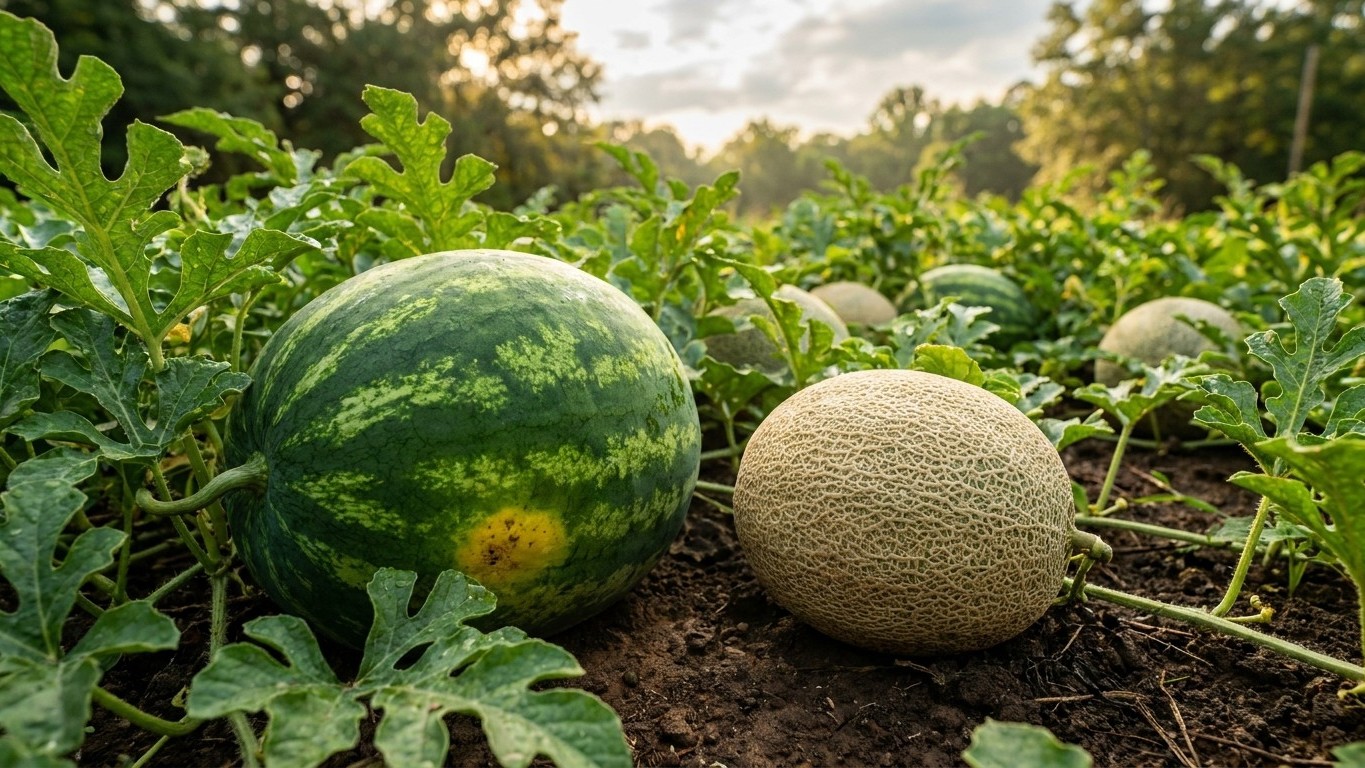

Michigan’s growing season runs long enough for fast melons, not long enough for slow ones. Between a last frost near the end of April in the Detroit area and a first fall frost as early as October 6 in zone 6a, the window favors watermelon and muskmelon types bred to finish in 75 to 85 days over honeydew, Crenshaw, or canary melons that need 90 to 100 days of warmth to ripen.
The short answer for Michigan
Start with the frost dates themselves, because they set the ceiling on everything else. Last spring frost lands around April 30 in the Detroit area, later across the rest of the Lower Peninsula into early or mid-May. First fall frost arrives between October 6 and October 21 in zone 6a. Stack those together in the best case, a Detroit-area garden starting at the earlier end and finishing at the later end, and the frost-free window tops out near 160 days. That’s a generous number for a Midwest state, but it’s a ceiling, not a guarantee, and it assumes the earliest possible start and the latest possible finish landing in the same year.
Against that ceiling, the type of melon matters more than the specific variety name on the seed packet. Days-to-maturity is the number that decides whether a melon fits inside the window with room to spare, or whether it’s racing the calendar every single season.
| Melon type | Typical days to maturity | Fit for Michigan’s window |
|---|---|---|
| Icebox watermelon (Sugar Baby, Blacktail Mountain) | 70-80 days | Comfortable fit, even in shorter local seasons |
| Standard muskmelon/cantaloupe (Hannah’s Choice, Halona) | 75-85 days | Comfortable fit in most of the Lower Peninsula |
| Small-fruited melon (Minnesota Midget) | 60-70 days | Wide margin, good insurance in a cool spring |
| Honeydew | 85-100 days | Tight fit, only in the longest local seasons |
| Crenshaw, canary, Piel de Sapo | 90-100+ days | Poor fit statewide, routinely caught by frost |
The heat load backs this up. Detroit averages 10.3 days a year at 90°F or above, a moderate number, not a Deep South number. Melons that depend on long stretches of intense heat to sweeten up don’t get the conditions they need here even when the calendar days are technically available. The practical read for Michigan: build the garden around one or two fast watermelon types and one fast muskmelon type, and treat anything advertised as a 90-day-plus melon as a specialty gamble rather than a main crop.
What will not work here
The clearest failure mode is a long-season melon planted on the assumption that “160 frost-free days” means every variety fits. It doesn’t. A honeydew rated at 95 days, started at a typical local frost-free date rather than the earliest possible one, is often still ripening when the first fall frost hits in a zone 6a county on the early side of that October 6 to October 21 range. Canary melons and Crenshaw types run the same risk, and they run it every year, not just in a cool one. These aren’t marginal cases; they’re varieties working against the state’s numbers from the start.
Watering habits fail almost as often as variety choice. Summer rainfall across June, July, and August adds up to about 10 inches, with August, the month melons are sizing and sweetening, the driest at 3.26 inches. A gardener watering once a week on the assumption that “10 inches of summer rain” means the soil is staying moist is misreading the number. Combine that August dry stretch with 10.3 days a year of 90-degree heat, and a sandy garden bed can go from moist to bone-dry inside a couple of days, right when melon fruit needs steady moisture to size up. Weekly watering on sand is a common way to lose a melon crop to blossom-end rot or stalled fruit, even in a state that isn’t considered dry.
Spacing failures run the other direction. Michigan’s summer rainfall, spread across three wetter-than-desert months, plus the humidity that comes with it, creates real pressure for powdery mildew and other foliar disease on melon vines. Planting cantaloupe or watermelon at the tight spacing that might work in an arid state invites exactly that problem: leaves stay wet longer, air doesn’t move through the row, and mildew moves fast once it starts. Wider spacing and good airflow aren’t optional extras here; they’re the difference between a vine that produces through August and one that collapses in mid-July.
What changes across Michigan
Michigan’s USDA hardiness zone range, 4a to 6b under the USDA Plant Hardiness Zone Map, is wide enough that “Michigan advice” without a location attached is close to useless. That’s a five-zone spread inside one state, built on average annual extreme minimum winter temperature, which is itself a proxy for how much growing season the rest of the year is likely to offer. A zone 6b garden and a zone 4a garden are not running the same melon season, even though both are technically in Michigan.
The frost dates already hint at the shape of that gap. The April 30 last-frost date and the Detroit-area heat numbers describe a southern, lower-peninsula reality. Counties further north, and anywhere at higher elevation, are working with a later spring frost, an earlier fall frost, or both, which shrinks the usable window well below that roughly 160-day ceiling. In practice, that means a gardener in the northern part of the state, or in a colder pocket anywhere, should shift toward the fastest-maturing end of the melon list, the 60-to-75-day types, and lean harder on season-extension tools like black plastic mulch or row cover to bank extra warmth in spring.
None of the facts available here say which zone any individual reader’s county falls into, and this page won’t guess. What can be said plainly is that a single “Michigan planting date” or “Michigan variety list” is doing real damage if it’s applied the same way from the Ohio border to the Upper Peninsula. Checking the USDA Plant Hardiness Zone Map for a specific address is the only way to know which end of that 4a-to-6b spread actually applies.
Where to check this for your own county
This page describes Michigan at the state level, using reference-station numbers from the Detroit area and a zone 6a fall-frost figure. That’s useful for understanding the shape of the season, but it isn’t a county-level recommendation, and county-level is where melon growing actually succeeds or fails. MSU Extension runs that level of detail, and the place to start is the outreach directory, which connects to local extension offices across the state.
Two things are worth asking for once there. First, the local planting calendar for the specific county, which will reflect that county’s own frost dates rather than the Detroit-area figure used above, and can differ by a meaningful stretch of weeks from one end of the state to the other. Second, any list of melon varieties actually trialled in that county or region, since Michigan State’s horticulture program and county extension educators do run variety trials, and a cultivar that performed well in a controlled trial nearby is a stronger bet than one pulled from a national seed catalog with no Michigan data behind it.
A county recommendation beats a state one every time, because it’s built on that county’s actual frost pattern, soil, and disease pressure rather than a statewide average. This page is the state one: a useful starting frame, not the last word for any specific garden.
Checking this against your own garden
Every date and average on this page describes a normal, not a promise, and a reader’s own observation in their own garden outranks all of it. Three things are worth watching before trusting any calendar.
Soil warmth by feel is the first. Melon seed germinates poorly in cold soil regardless of what the last-frost date says, so cupping a handful of bed soil a few inches down and feeling for real warmth, not just “not freezing,” is a better signal than the calendar for when to actually put seed in the ground.
The first flush of male flowers is the second. Melon vines put out male flowers before female ones, and a garden that’s throwing plenty of male blooms but no female flowers yet is still a couple of weeks from fruit set, regardless of how far along the calendar suggests it should be.
The first true leaves are the third. The initial leaves that emerge after the seedling leaves are the ones that tell whether a plant is actually growing on schedule or stalling in cool soil, and a slow move from seedling leaves to true leaves is often the first sign that a bed is running colder or wetter than the state numbers assume.