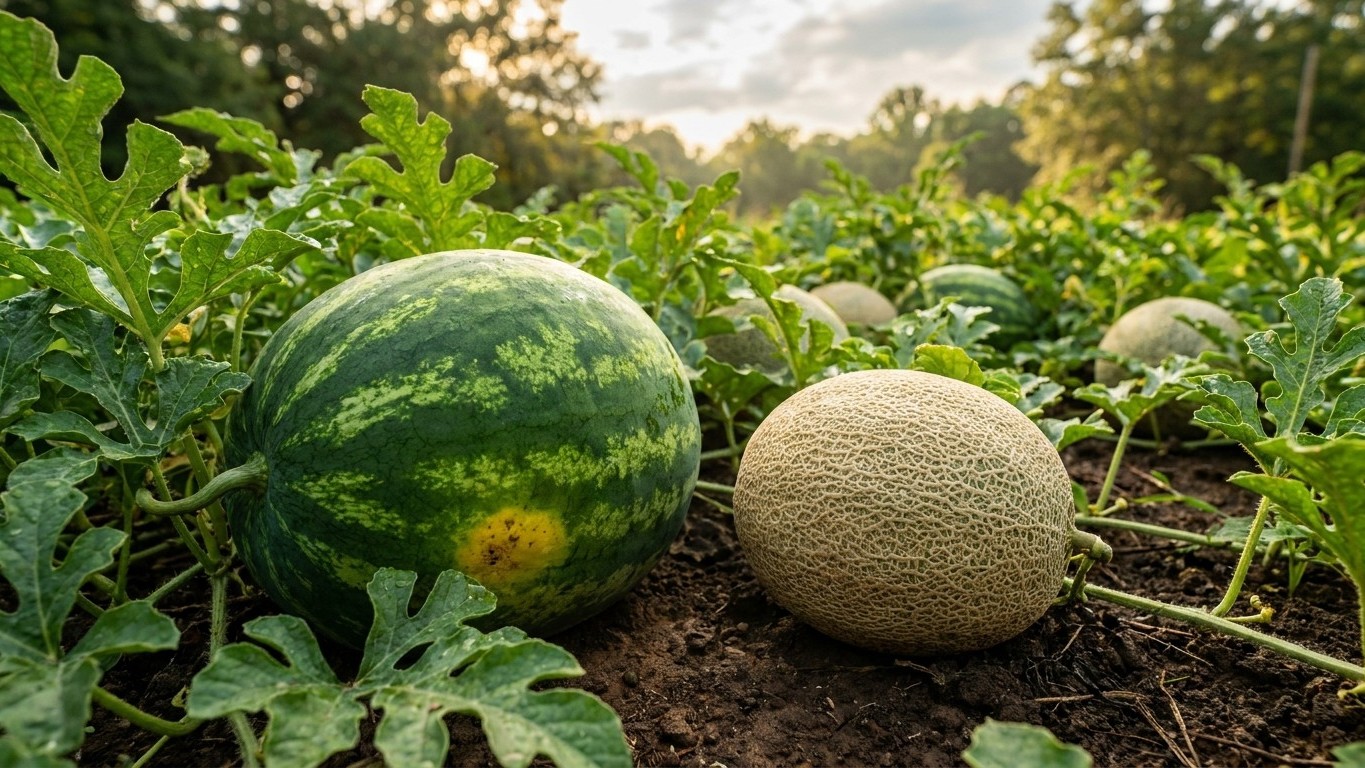

New Hampshire’s short growing season and modest summer heat make fast-maturing melons the safest bet: short-season muskmelons (cantaloupe-type) and small icebox watermelons that ripen in roughly 70 to 85 days. Big slicing watermelons and long-season honeydew types struggle to finish before the first fall frost, especially north of the Lakes Region. The details below explain why, and what to check before you commit to a variety.
The short answer for New Hampshire
Start with the numbers that actually run the calendar. At the reference station used for New Hampshire’s climate normals, the last spring frost falls between April 16 and April 27, and the first fall frost arrives between October 13 and October 26. Stretch those dates to their widest, and you get a frost-free window of somewhere between 169 and 193 days. That sounds generous for a melon, which typically wants 70 to 95 days from transplant to fruit. The catch is that melon seed does not germinate in cold soil, and transplants sulk until the ground warms well past the frost line, often two to three weeks after that last freeze date. Subtract that lag and the real melon-growing window shrinks toward 140 to 160 days in a good year, less in a cool one.
Heat matters as much as length. The reference station averages just 10.9 days a year at or above 90F. That is a modest heat load compared to the mid-Atlantic or the Midwest corn belt, and melons are a crop that converts heat units into sugar and ripening speed. A variety bred for a long, hot growing region will sit in a New Hampshire garden looking green and stubborn well into September, because it never banked the degree-days it needed.
Put those two facts together, short-season muskmelons and small watermelons are the types that fit. Muskmelon (cantaloupe-type) selections bred for a 70 to 80 day maturity window are built for exactly this situation: they set fruit early and finish before the heat runs out. Icebox watermelons, the personal-sized types rather than the 20-pound picnic slicers, follow the same logic at 75 to 85 days. Both groups tolerate the cooler nights that come with New Hampshire summers better than melons selected in the Southeast or the Southwest.
None of this replaces a look at your own thermometer and your own soil. The frost dates above come from one airport weather station, and gardens away from that station, especially inland, at elevation, or away from any paved heat sink, typically see a later last frost and an earlier first frost than the station records, sometimes by one to two weeks. That shifts the safe window from both ends at once.
What will not work here
The clearest failure mode is a melon that needs more season than New Hampshire reliably gives it. Standard slicing watermelons in the 85 to 95 day range, the kind bred for Georgia or Texas summers, are working against both limits at once here: a frost-free window that may be closer to 150 usable growing days once soil-warming lag is factored in, and a heat load of under 11 days a year above 90F to push sugar development. Honeydew and casaba types are worse. Those melons were selected for long, dry, hot growing regions, often need 90 to 110 days, and depend on sustained late-season heat to convert their characteristic pale flesh to something sweet rather than watery. Planted in a typical New Hampshire backyard, they are the melon most likely to still be hard and flavorless when the first fall frost date arrives.
The state’s summer rainfall pattern creates a second, quieter failure mode. The reference station averages about 10.7 inches of rain across June, July and August, with July, the peak melon-growing month, the driest at 3.3 inches. That is enough moisture, arriving as scattered summer rain rather than a dry season, to keep humidity around the plant canopy higher than melons like. Varieties bred for arid growing regions, and any planting laid out at the tight spacing those dry-climate growers use, are more exposed to powdery mildew and downy mildew here, because the leaves simply do not dry out between rain events the way they would in a low-humidity climate. Wide spacing and full sun exposure matter more in New Hampshire than the seed packet’s minimum distance suggests.
A third, less obvious failure: treating a warm week in May as the all-clear. Because the last frost date spans an eleven-day range even at the single reference station, and because outlying gardens often run later than that station by a week or two, a melon set out on the first mild weekend risks a frost that a slower gardener two weeks behind never sees. Melon seedlings do not recover from a hard chill the way squash sometimes does; a single cold night near the soil surface can stunt the plant for the rest of the season even if it survives.
What changes across New Hampshire
New Hampshire is not one climate wearing one name. The USDA Plant Hardiness Zone Map, built on average annual extreme minimum winter temperature, places the state across a 3b to 6a range. That is a wide spread for a state its size, and it means there is no single melon answer that applies from the Great North Woods to the Seacoast.
Zone 3b conditions, the coldest end of that range, show up at higher elevation and in the far north, where winters bottom out hard and, by extension, the growing season on either side of winter tends to run shorter and cooler than the state’s southern river valleys. A gardener working in that kind of location should lean toward the fastest-maturing muskmelon and icebox watermelon selections available, plan on black plastic mulch or row cover to bank extra soil heat early, and treat any melon needing more than 80 days as a gamble rather than a plan.
Zone 6a conditions, the mildest end, cluster in the warmer valleys and closer to the coast, where both the frost-free window and the accumulated summer heat run longer than the reference station’s own numbers might suggest for the state as a whole. Gardeners there have more room to try a mid-season muskmelon or a watermelon pushing toward 85 days, though the same humidity and rainfall pattern described above still applies statewide.
This page cannot tell you which of those zones your own garden sits in, and elevation alone can shift a property by a full zone within a few miles. What it can say is that the gap between 3b and 6a is large enough that a variety confidently recommended for one end of the state can be a poor fit at the other. Check the current USDA Plant Hardiness Zone Map for your own address before treating any zone-based advice here as settled.
Where to check this for your own county
Everything above is a state-level answer, built from one reference weather station and one statewide hardiness range. A county recommendation beats a state one every time, because it accounts for the local frost pattern, the local soil, and years of trial results that a statewide page cannot capture.
The University of New Hampshire Cooperative Extension is the place to get that county-level detail. Two things are worth looking for specifically once there. First, a local or regional planting calendar, which will reflect frost timing closer to your own county than the single airport station cited throughout this page. Second, any list of melon varieties the extension has actually trialled or recommended for New Hampshire conditions, since those recommendations come from real seasons of local growing rather than a generalized fit to statewide climate normals.
Extension offices also field walk-in and phone questions from home gardeners, and county-level staff often know which varieties have done well, or badly, in dooryard gardens near you in recent years, information that never makes it into a state climate summary. If your county has a master gardener program, that is frequently the fastest route to a variety list built from local trial beds rather than statewide averages.
Treat this page as the broad strokes: the type of melon that fits New Hampshire’s season and heat, and the types that fight against it. Treat the extension service as the fine print for your specific ZIP code, and the source that should override anything general written here if the two ever disagree.
Checking this against your own garden
No frost date on this page knows your particular yard. Three direct observations, none requiring any equipment, will tell you more about your own microclimate than any calendar.
Soil warmth by feel comes first. Push a bare hand two to four inches into the bed where melons will go. Cold and clammy to the touch means the soil is still well below the roughly 60F melon seed wants for reliable germination, regardless of what the calendar says the frost date should be by now. Warm and dry to the same depth is the signal that the ground, not just the air, has caught up with spring.
The first flush of male flowers is the second marker. Melon plants typically produce male blooms in a burst before the first female flowers, the ones with the small swelling at the base that will become fruit, appear. A garden throwing male flowers early and steadily is running ahead of a typical season in that spot; a plant sitting green with no blooms well into its expected flowering window is behind, and may be signaling either a cool microclimate or a nitrogen-heavy soil pushing leaf growth over flowering.
The first true leaves, the ones that follow the rounder seed leaves and actually look like the plant’s mature foliage, mark real establishment rather than just germination. Slow, pale true leaves after a normal-looking germination often point to a site colder or shadier than it looks on paper, information worth banking for next year’s bed placement even if this season’s crop still comes in fine.