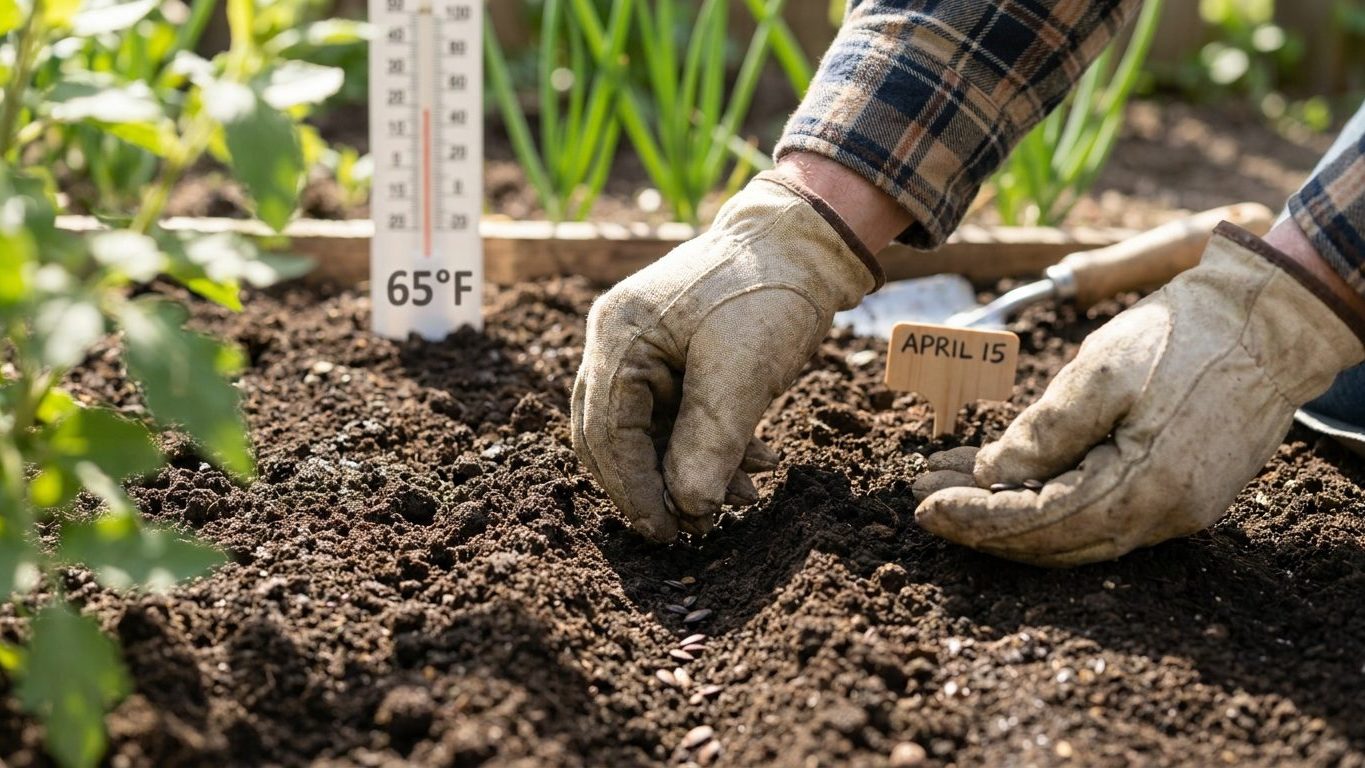

Start melon seeds indoors around three to four weeks before your last frost date, then move transplants outside only once nighttime lows are reliably clear of frost and the soil has warmed. For most of New Hampshire, that means an indoor start in early-to-mid March through early April, with transplanting outdoors between mid-May and early June, depending on how close your garden sits to the Manchester reference station used for the state’s frost data.
The short answer for New Hampshire
The frost dates that anchor this calendar come from NOAA’s 1991-2020 Climate Normals for the Manchester airport station: a last spring frost falling between April 16 and April 27, and a first fall frost between October 13 and October 26. Those dates aren’t fixed calendar markers, they describe a 30-70% probability band, meaning there’s still a real chance of frost on either side of that window. A grower who transplants melons on April 20 because “that’s the last frost date” is gambling on the safer half of that probability, not a guarantee.
Working backward from those numbers gives the practical sowing calendar. Melons need warmth to germinate at all, ideally soil in the 70F range, so indoor seed starting typically begins three to four weeks before the last frost window opens, putting most trays going in early-to-mid March. Transplants then wait until the frost risk has genuinely passed and the soil has caught up, which in practice runs from mid-May into early June for most of the state, later at higher elevations or in valley cold pockets that trail well behind the airport station.
Direct-seeding outdoors is a riskier path in New Hampshire than starting transplants, simply because the frost-free window between April 27 and October 13, on the conservative end of the probability bands, is already tight for a fruit that wants a long, warm run. Counting from the latest safe frost date to the earliest fall frost gives roughly 168 days at best; count from the more cautious end and it shrinks further. That’s the ceiling the whole calendar has to fit inside, transplants included, because every week spent germinating indoors is a week added back onto the effective growing season outdoors.
None of this replaces a local check. The Manchester station is one point on the map, and the caution attached to these normals is explicit: outlying gardens, especially rural or elevated ones, tend to see frost arrive later in spring and earlier in fall than the station shows, sometimes by a week or two. Treat the April 16-27 and October 13-26 windows as the reference case for the state, then adjust toward the more conservative end if your garden sits somewhere that historically lags behind town.
What will not work here

The single biggest failure mode in New Hampshire melon growing is choosing a variety bred for a longer, hotter season than the state reliably offers. With roughly 168 days between the latest safe spring frost and the earliest fall frost, a melon needing 90 to 100 days to maturity leaves almost no margin for a cool spring, a slow transplant recovery, or an early fall frost creeping in from the conservative end of the October 13-26 band. Add the time lost to indoor starting and hardening off, and a slow-maturing variety can simply run out of season before it ripens.
Heat load is the second constraint, and it’s a quieter one because it doesn’t show up as an obvious failure the way frost does. The Manchester station averages just 10.9 days a year at or above 90F. Melons are heat-loving fruit that size and sweeten fastest during stretches of sustained warmth, and New Hampshire simply doesn’t hand out many of those days. A variety selected for a hot, dry climate elsewhere may set fruit reluctantly here, or ripen with less sugar concentration than the seed catalog description implies, because the heat units it was bred around never arrive.
Watering on a weekly schedule is a habit that travels badly to this region, for the opposite reason gardeners in drier states might expect. Summer rainfall here averages about 10.7 inches across June, July, and August, with July, the driest month, still delivering 3.3 inches. That’s meaningful moisture, but it tends to arrive as thunderstorms rather than steady soaking rain, and combined with the humidity those storms bring, tight plant spacing becomes a real liability. Melon vines packed close together in a humid New Hampshire July hold moisture on their leaves longer after a storm, and that’s exactly the setup powdery and downy mildew need. A spacing plan copied from a drier, sunnier region’s growing guide will underperform here specifically because the air doesn’t dry the foliage out fast enough between rain events.
The fix isn’t more water on a fixed schedule, it’s better airflow and a soil check before watering at all, since a rain gauge and a finger in the dirt will tell you more than any weekly routine.
What changes across New Hampshire
New Hampshire’s USDA hardiness zone range, 3b to 6a, spans a genuinely wide gap for a state its size, and that spread is exactly why there’s no single melon planting date that fits the whole state. Zone 3b describes average annual extreme minimum winter temperatures far colder than zone 6a, and while that zone number is built on winter cold rather than spring warm-up speed directly, the two track closely enough in practice: colder zones mean a later, slower spring, a shorter frost-free window, and less accumulated heat by midsummer.
The Manchester reference station sits toward the milder end of that range, which is part of why its frost dates, April 16-27 for the last spring frost and October 13-26 for the first fall frost, read as relatively generous compared to what a garden in the White Mountains or the far North Country can expect. A grower in a colder zone within the state should shift the whole calendar later in spring and earlier in fall than the reference dates suggest, effectively shrinking the already tight frost-free window this calendar is built around.
Elevation compounds the zone effect independent of latitude. Two gardens at the same hardiness zone number can still behave differently if one sits in a valley that pools cold air overnight and the other sits on a south-facing slope that sheds it. Melons, sensitive to both frost and soil temperature at planting time, are unusually exposed to this kind of microclimate variation.
None of this is a cue to guess which zone your own garden falls into from this page. The right move is to look up your specific location on the USDA Plant Hardiness Zone Map directly, then treat the Manchester dates as a starting reference to adjust colder or warmer, later or earlier, based on where your actual zone number falls inside that 3b-6a range.
Where to check this for your own county
This page describes New Hampshire as a whole, built around one reference station’s frost data. A county-level recommendation will always beat that, because it accounts for the local soil, elevation, and microclimate patterns that a statewide airport reading can’t capture. The University of New Hampshire Cooperative Extension is the source built to close that gap.
Once there, the two things worth searching for specifically are a local planting calendar for vegetable crops, which will translate the generalized frost-date logic on this page into dates calibrated for your county’s actual growing conditions, and any variety trial results or recommendations for melons and other cucurbits that have been tested under New Hampshire conditions rather than in a seed catalog’s home region. Extension trial data matters here because it reflects how a variety actually performed against the state’s real heat load and humidity, not just its theoretical days-to-maturity number.
Extension offices also tend to hold practical, season-specific guidance that a general planting calendar can’t include: which years saw an unusually late frost, which counties are seeing more disease pressure from the wetter summers, or which local nurseries carry transplants of a variety that’s already been shown to perform in-state. That kind of on-the-ground detail is exactly what separates a county recommendation from a statewide one.
Treat this page as the broad framework, the reasoning behind why the calendar looks the way it does, and treat your local extension office as the authority on the specific dates and varieties for your own soil and slope. The two aren’t redundant; the state page explains the mechanism, the county contact gives you the number to actually use.
Checking this against your own garden
Every date on this page is a regional average built from decades of station data, and your own garden will always override it, because your soil warms and cools on its own schedule, not the airport’s. Three simple observations tell you more than any calendar once the season is underway.
The first is soil warmth, checked by hand rather than instrument. Push a finger a few inches into the planting bed in the morning before the sun has heated the surface. If the soil still feels distinctly cool or damp-cold rather than merely cool, it hasn’t caught up to the air temperature yet, and melon roots set into ground that cold will sit and sulk rather than grow, regardless of what the calendar says about frost being past.
The second is the first flush of male flowers on the vine. Melons produce male flowers before female ones, and a healthy early flush signals the plant has settled into active growth and is building toward fruit set. A vine that’s slow to flower at all, well past when neighboring plants have started, is telling you something about a stress it’s under, often cold soil, uneven watering, or too little sun reaching that spot.
The third is the appearance and vigor of the first true leaves after the seedling stage, the ones that look like the mature plant’s foliage rather than the rounder seed leaves. Slow, pale, or stunted true leaves in a transplant that seemed fine indoors usually point to transplant shock from a cold snap or wind exposure the seedling wasn’t hardened off for. Watching for that response in your own bed, rather than trusting the calendar date alone, is what actually tells you whether this year’s window opened on schedule or later than the averages suggest.