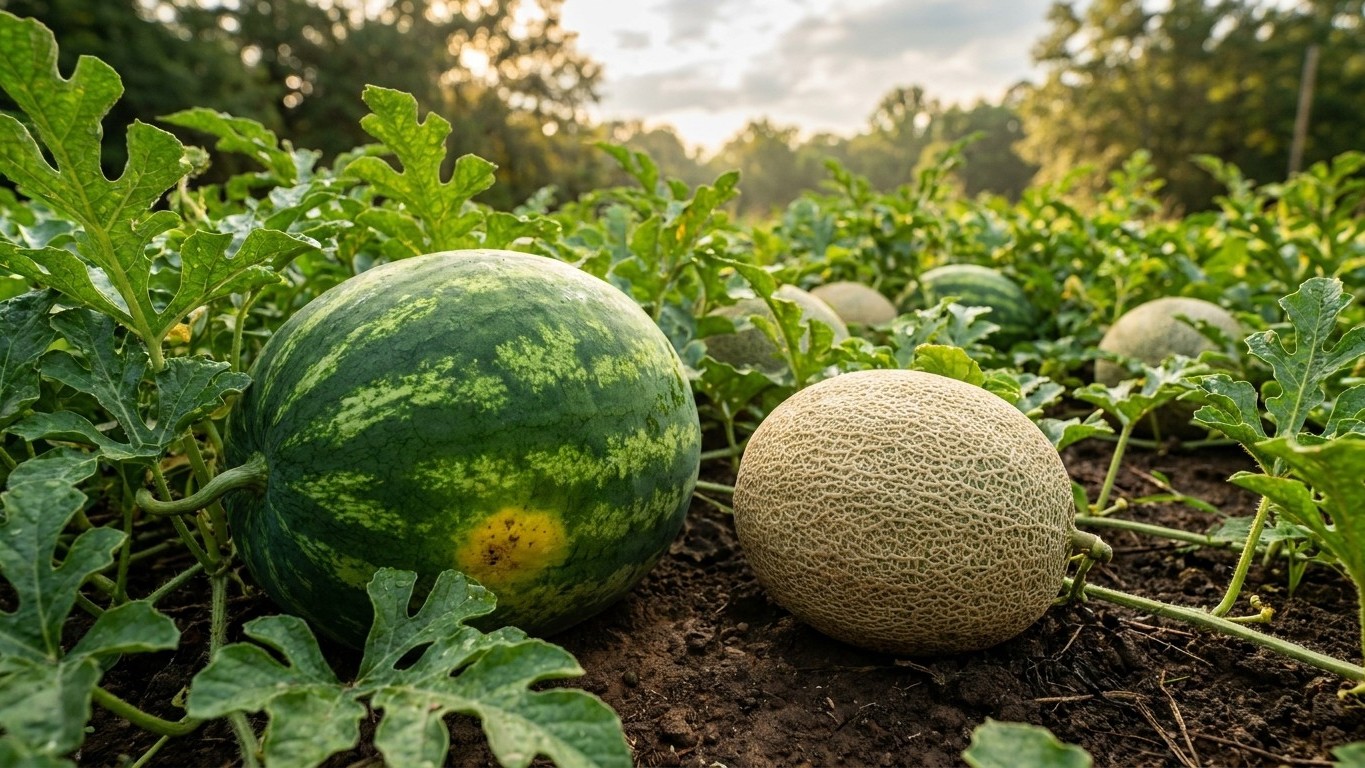

Yukon’s growing season is too short and too cool for standard melons grown outdoors without help. The best bet is the fastest-maturing, smallest-fruited melon types, started as transplants and grown under plastic mulch, row cover, or a greenhouse, never watermelon or honeydew types that need sustained heat this territory doesn’t have.
The short answer for Yukon
Start with the numbers, because they decide everything else. The mean last spring frost at the Whitehorse A reference station falls around June 5, and the mean first fall frost lands around August 25. That’s a mean frost-free window of roughly 81 days. Melons are heat-lovers that typically want 65 to 100+ frost-free days depending on type, plus real warmth to push growth along, not just an absence of frost. Yukon’s reference station recorded 0.0 days a year at or above 90°F. Zero. That single figure is the real obstacle, more than the frost dates themselves: melons don’t just need to avoid cold, they need heat units to swell fruit and convert sugars, and this territory’s summer doesn’t supply them outdoors.
By melon type
Sorting melons by category makes the decision clearer than sorting by variety name.
| Melon type | Typical days to maturity | Heat need | Realistic fit for Yukon |
|---|---|---|---|
| Watermelon | 80-100+ days | High, sustained warm days | Not viable outdoors here |
| Honeydew | 80-90 days | High, steady warmth to finish | Not viable outdoors here |
| Fast cantaloupe / muskmelon types | 65-75 days | Moderate, but still needs heat | Possible only with season extension |
That last row is where a Yukon grower has any real chance: the quickest-maturing muskmelon types, started indoors as transplants weeks before the last frost, then moved out under black plastic mulch and a row cover or into a high tunnel or greenhouse where daytime heat can actually build. Without that extra layer of protection, the mean 81-day window and the flat zero on days above 90°F leave very little margin for a fruit that needs both time and warmth to ripen.
What will not work here
Long-season melons are the first casualty. Anything bred for an 85- to 100-day season, which covers most watermelon and honeydew types, is racing a clock that Yukon’s mean frost dates don’t give it. Remember that June 5 and August 25 are means, not guarantees: in roughly half of all years, frost arrives later in spring or earlier in fall than those dates. A melon that needs every one of its 90 days to ripen has no buffer left if the season runs even a week short, which happens routinely at a mean-based estimate.
Unprotected outdoor sowing
Direct-seeding melons into open ground and hoping for the best fails twice over in this territory. First, soil that hasn’t been warmed artificially stays too cold too late for melon seed to germinate reliably around a June 5 mean frost date. Second, even a seed that does germinate is now competing against a summer with zero recorded days at or above 90°F, so there’s no heat surge to make up for lost time. Growers who treat Yukon like a slightly shorter version of a temperate state’s growing season, and simply pick an “early” variety and sow it outdoors, are the ones most likely to end up with vines and flowers in September and no ripe fruit at all.
Watering habits from milder climates fail here too, though for a different reason. Summer rainfall averages about 4.2 inches across June, July and August, with June, the driest month, at just 1.28 inches. That’s not a lot, but it’s also not the extreme dryness of a hot desert state, so a grower who imports a watering schedule built for 90°F-plus heat will likely overwater a Yukon melon bed relative to what this cooler, lower-evaporation climate actually needs. The fix isn’t a stricter watering rule borrowed from elsewhere. It’s watching the soil in front of you, which the last section of this page covers.
What changes across Yukon
A hardiness zone number for one reference station is not a hardiness map for an entire territory, and that gap matters more in Yukon than almost anywhere else covered on this site. The one figure available here, Canadian zone 1b at the Whitehorse A station, is about as cold as the Canadian system gets, and it applies specifically to that reference point, not to every valley and ridge across Yukon.
From reference station to your own valley
Yukon’s terrain runs from river valleys to alpine plateaus to far northern latitudes, and a territory this size, sitting on a single-digit Canadian zone at its reference city, almost certainly spans a wider range once you move away from Whitehorse. A south-facing valley bottom with good sun exposure can run measurably milder than an exposed northern flat or a higher-elevation site, even within the same general region. The facts available for this page don’t include a zone-by-zone breakdown across Yukon’s communities, and rather than guess at numbers this page doesn’t have, the honest answer is that there is no single zone for the whole territory. A grower north of Whitehorse or at meaningfully higher elevation should assume a shorter, cooler season than the numbers above, not the same one. For the actual zone at a specific location, Natural Resources Canada’s Plant Hardiness Site (planthardiness.gc.ca) maps it by location, and that map, not a territory-wide average, is the tool to check before committing a season’s work to melons.
Where to check this for your own county
Everything on this page describes Yukon as a whole, built from one reference station’s normals. That’s useful for deciding whether melons make sense at all, but it’s not a substitute for what a local growing calendar can tell a specific community. A community-level recommendation beats a territory-wide one every time, because it accounts for local elevation, local frost pockets and whatever varieties have already been tried and reported on nearby.
What to look for once you’re there
The provincial-level site for Yukon didn’t return a working response when checked directly, so the working link to use is the federal Agriculture and Agri-Food Canada site at agriculture.canada.ca/en. From there, or through a local Yukon agricultural extension contact, the two things worth hunting down are a planting calendar built for the specific community rather than the territory average, and any record of which melon types, or which season-extension methods, have actually been trialled in that county’s conditions. A neighbor three valleys over who’s tried greenhouse melons for a few seasons has more useful information than any territory-wide mean frost date, however carefully sourced. Treat this page as the starting frame, and the local source as the correction to it.
Checking this against your own garden
Once a grower has decided to attempt melons under protection, the calendar dates on this page stop being the most useful signal. What’s happening in the actual bed matters more, and three things are worth watching closely through late spring and early summer.
Three signs that matter more than the calendar
Soil warmth by feel is the first and most direct check: melon roots stall in cold soil regardless of what the mean frost date says, so soil that still feels cold and damp well past early June is telling a grower to wait, plastic mulch or not. The first flush of male flowers is the second signal, since melons typically produce several male flowers before the female flowers that actually set fruit appear, and a plant throwing male flowers early is a sign the heat and light it’s getting are adequate for that stage. The first true leaves, the leaves that emerge after the initial seed leaves and actually resemble mature melon foliage, mark the point where the plant has moved past its most fragile stage and is drawing real energy from photosynthesis rather than seed reserves. None of these require a thermometer or any equipment beyond a hand in the soil and a close look at the plant, and together they tell a Yukon grower more about their own specific microclimate than any territory-wide average ever will.