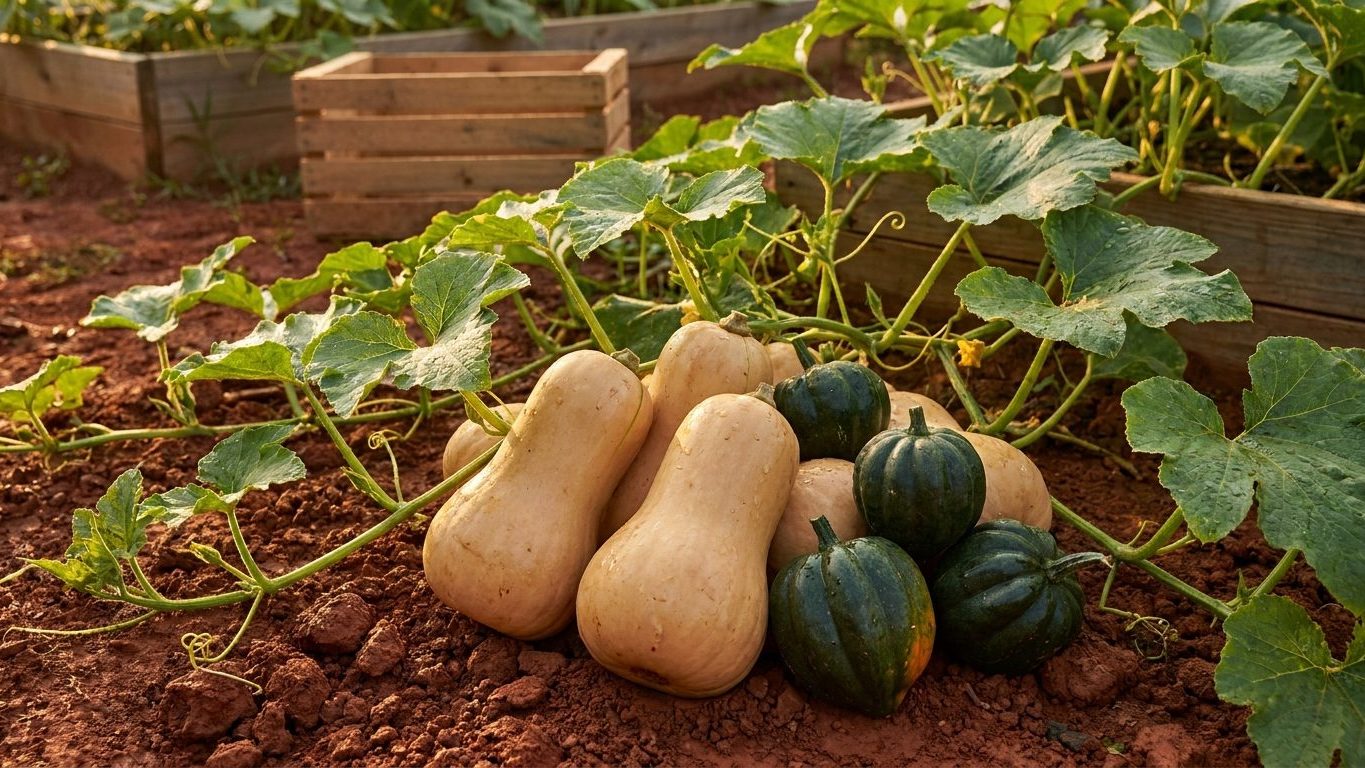

Manitoba gardeners do best with short-season, cool-tolerant squash: acorn, delicata, buttercup and the smaller kabocha types. They finish in 80 to 100 days and don’t need a long heat run. Butternut, giant Hubbard and other 110-day-plus types are a gamble here, because the province’s frost window is shorter and cooler than it looks on paper.
The short answer for Manitoba
Start with the two dates that frame everything else. At the Winnipeg Richardson reference station, the last spring frost falls on average May 23, and the first fall frost on average September 22. Subtract one from the other and you get 122 days. That number looks generous for winter squash, most of which finish somewhere between 80 and 120 days. The catch is the word “average.” These are mean dates from Environment and Climate Change Canada, not guaranteed cutoffs. In roughly half of all years, the spring frost lingers past May 23, or the fall frost arrives before September 22. Plan around the mean and you’re planning around a coin flip, not a safe margin.
Why heat, not just days, decides the outcome
Manitoba’s Canadian hardiness zone at the reference station is 3b, a short and cool growing zone by any measure. Add to that a mean of 0.0 days a year reaching 90°F, and you get a season with almost no real heat spike to push fruit through its final ripening push. That matters more for winter squash than for most vegetables, because the crop doesn’t just need frost-free days, it needs accumulated warmth to size and cure the fruit. Two squash with the same “days to maturity” label on the seed packet can behave very differently once the days are cool ones instead of hot ones.
Which types actually fit the window
Species matters as much as the days-to-maturity number. Cucurbita pepo types (acorn, delicata, most spaghetti squash) and shorter-season Cucurbita maxima types (buttercup, smaller kabocha) tend to finish reliably within a cool 100 to 110 day window. Cucurbita moschata types, which include butternut, evolved for longer and hotter growing seasons and often need both more days and more heat units to cure properly.
| Squash type | Typical days to maturity | Heat need | Manitoba fit |
|---|---|---|---|
| Acorn | 80-100 | Low to moderate | Good |
| Delicata | 80-100 | Low to moderate | Good |
| Buttercup | 90-100 | Moderate | Good with transplants |
| Small kabocha | 90-110 | Moderate | Fair, watch the fall date |
| Butternut | 100-115 | High | Risky without transplants |
| Giant Hubbard | 110-120+ | High | Poor |
What will not work here
Direct-seeded long-season squash is the classic failure here. Sow a 115-day butternut outdoors after the mean last frost of May 23, and you’re already asking it to finish by September 22, on a heat budget of essentially zero days above 90°F. Push the math one bad spring further, say a frost that lingers to the first week of June, and that same butternut is racing a fall frost that could just as easily arrive early. The vine may still be flowering when the first cold night ends the season.
Giant Hubbard and other 120-day types
Giant Hubbard, some banana squash, and other Cucurbita maxima giants bred for long, warm seasons routinely need well over 110 days and real summer heat to cure a thick rind. In a zone 3b season with no 90°F days on record, these varieties are set up to fail more often than they succeed, even in a favorable year. The fruit can set, but the flesh often stays watery and the skin never hardens enough for long storage.
Where watering habits go wrong
Summer rainfall here averages about 9.7 inches across June, July and August, with August the driest month at 3.03 inches. That’s a moderate figure, not a drought figure, but it still catches gardeners who assume Manitoba summers are wet enough to ignore. Squash fruit are sizing hardest in July and curing through August, right as rainfall tapers toward its low point. A gardener who waters heavily in June and then stops, assuming the plant is established, can watch fruit stall right when it needs steady moisture most. The fix isn’t more water everywhere, it’s watching the driest weeks and adjusting rather than following a fixed schedule.
What changes across Manitoba
The 3b hardiness zone cited here belongs to the Winnipeg reference station, not to the whole province. Manitoba stretches from farmland along the US border to boreal forest and tundra near Hudson Bay, and a single zone number can’t describe that range. Natural Resources Canada’s hardiness zone map shows the province splitting across several zones, with milder pockets in the south and progressively colder ratings moving north.
What that means for planting decisions
A gardener working land north of Winnipeg, or at higher elevation, should assume a shorter effective season than the 122-day gap between the mean frost dates used here. That’s not a guess, it follows directly from how the Canadian zone system is built: it folds in seven climate variables, including minimum winter temperature and frost-free period, so a colder zone rating already reflects a tighter growing window before a single squash seed goes in the ground. The practical shift is toward the fastest-maturing end of the acorn and delicata range, and toward starting seedlings indoors rather than direct-seeding, to buy back the days a shorter local season doesn’t offer.
The zone that covers an individual yard is a local question. That answer sits on Natural Resources Canada’s Plant Hardiness Zone map, searchable by municipality, and it’s worth checking before choosing between a 95-day and a 110-day variety.
Where to check this for your own county
Manitoba Agriculture, the province’s extension service, publishes planting guidance at gov.mb.ca/agriculture. That’s the right next stop, because a provincial extension resource pulls together local trial data, soil bulletins and regional planting timing gathered from growers and research stations spread across Manitoba’s different growing districts.
What to look for once you’re there
Two things are worth searching for specifically. First, any planting calendar or frost-date guidance built for your own region of the province rather than the Winnipeg-area figures used here. Second, variety trial results or recommended-variety lists for squash and other cucurbits, since provincial and university trial programs often test winter squash varieties under real Manitoba field conditions and report which ones cure reliably in a short season with limited heat.
A county or regional recommendation from an extension trial will always be more reliable, because it’s built from actual local outcomes rather than one weather station’s normals. Treat this article as the provincial-level starting point, and the extension service’s own guidance as the correction for wherever you actually garden.
Checking this against your own garden
Three signs are worth tracking, and none of them need a thermometer or any tool you don’t already have.
First, soil warmth by feel. Winter squash seed germinates poorly in cold soil, so press a bare hand into the top couple inches of your planting bed before sowing. If it feels cool rather than mildly warm to the touch, the soil likely hasn’t caught up to the season yet, regardless of the calendar date.
Second, watch for the first flush of male flowers, which typically open before the female flowers that actually set fruit. Their appearance tells you the plant has moved out of pure vegetative growth and into its reproductive stage, a useful check on whether your local season is running ahead of or behind the averages used here.
Third, note how fast true leaves develop after the seedling’s first pair of round seed leaves. Quick, sturdy true-leaf growth suggests warm, settled conditions; slow or pale growth suggests the microclimate in that particular bed, shaded by a fence or sitting in a low, damp corner of the yard, is running cooler than the rest of the garden. That one detail, more than any provincial average, decides which squash variety actually has time to finish there.