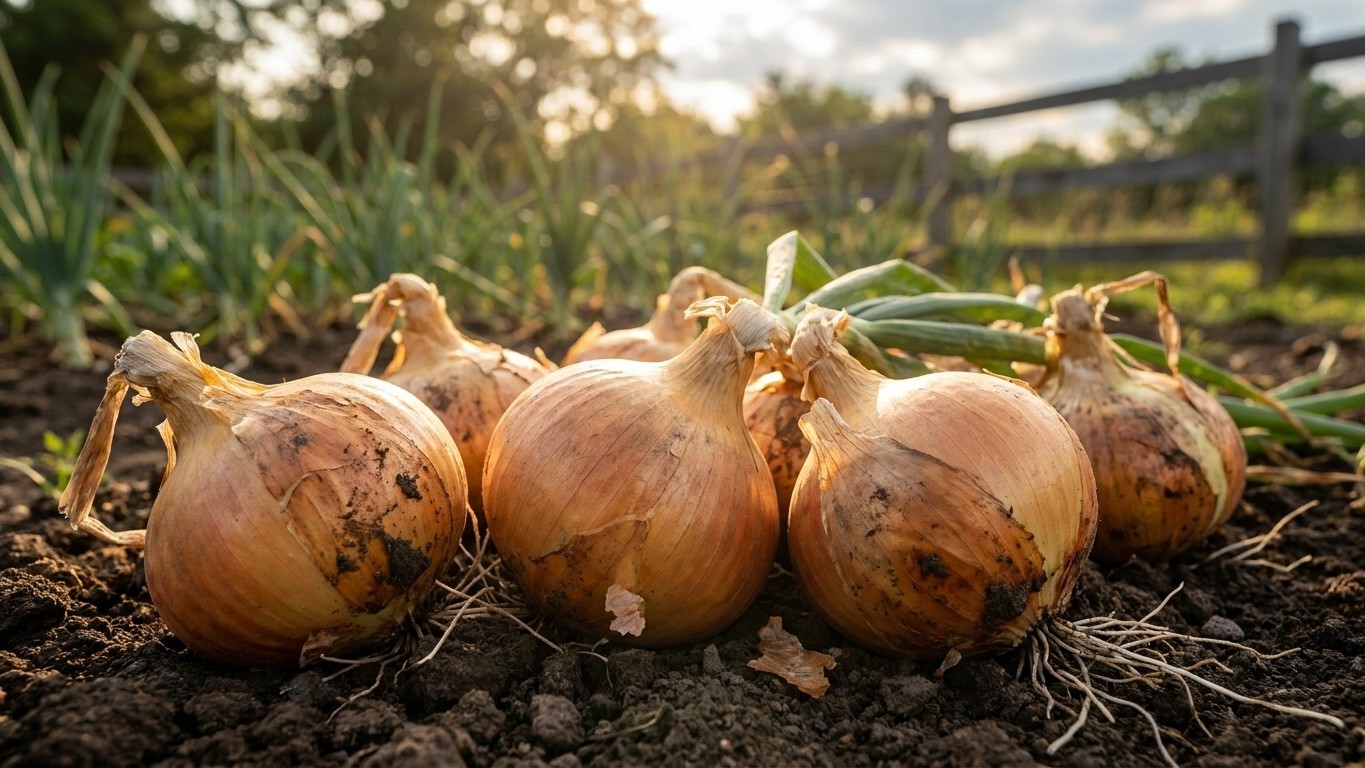

Only three of the pests New Hampshire’s extension service tracks actually bother onion: Asiatic garden beetle, flea beetles, and tarnished plant bug. They show up at different points in the season, feed on different parts of the plant, and none of them touch the bulb itself the way onion maggot would elsewhere. Here’s what each one does, when it does it, and how to tell its damage from something that isn’t a bug at all.
Which pests attack onion in New Hampshire
UNH Cooperative Extension documents nine garden pests for the state: Asiatic garden beetle, Brown marmorated stink bug, Flea beetles, Japanese beetle, Lily leaf beetle, Rose chafer, Squash vine borer, Striped cucumber beetle, and Tarnished plant bug. That’s the full list for New Hampshire gardens generally. Onion, though, is a narrow-leaved bulb crop with no fruit, no vine, and no flower to speak of in its first year, and that rules out most of the names on the list before you even get to symptoms.
Brown marmorated stink bug pierces and sucks on fruiting structures, tomatoes, peppers, tree fruit, and finds nothing to want on a plant grown for its underground bulb. Japanese beetle skeletonizes broad, thin leaves like roses, grapes, and beans; onion’s narrow, waxy foliage simply isn’t on its host list. Lily leaf beetle sounds like a match given the old shared plant-family history, but it’s locked onto true lilies and fritillaria specifically, alliums don’t register as food. Rose chafer goes after flower petals and soft foliage in sandy soil, mostly roses and peonies, and a bulb onion offers no flowers for it to reach. Squash vine borer needs a hollow vine to tunnel into, which onion doesn’t have, and striped cucumber beetle is a cucurbit specialist that also spreads bacterial wilt among squash and cucumbers, unrelated botanically to anything in the onion bed.
That leaves three of the nine species UNH Cooperative Extension documents for the state as the ones actually worth watching in an onion patch. Asiatic garden beetle adults feed on foliage margins after dark and hide in the soil by day. Flea beetles chew small round holes across the leaf blade, usually on the youngest transplants. Tarnished plant bug feeds on tender new growth and the flower stalk if one forms, leaving behind twisted or distorted tips. None of these three destroy a crop outright the way a maggot in the bulb would, but left unchecked they slow growth right when the plant needs to be building leaf mass for bulbing later.
When each one shows up, and what it does first
Flea beetles are the first to arrive, and they don’t wait for the plant to get established. They often move in within days of transplanting, before roots have even taken hold, because young, stressed transplants are easier targets than a mature stand. The first sign is a leaf blade that looks peppered with tiny round holes, almost like it was hit with fine buckshot. On a small planting, a handful of leaves can look like this within a week of setting transplants out, and the beetles themselves are quick to jump or fly the moment a leaf is disturbed, which is often the only clue you get before you see the damage itself.
Asiatic garden beetle shows up later, once the season has warmed and the plant has more leaf surface to offer. Its feeding pattern is different from the flea beetle’s: instead of small round punctures, you get ragged notches chewed into the leaf margins, and the damage seems to appear overnight because it does. The adults feed exclusively after dark and retreat into the soil by morning, so a gardener checking plants at midday sees only the aftermath, never the insect responsible. A flashlight check after sunset is really the only way to catch this one in the act.
Tarnished plant bug tends to arrive when the onion starts putting up a flower stalk, or when nearby weeds and flowering plants draw it into the garden generally. Its feeding shows up as twisted, curled new growth at the tip of a leaf or stalk, sometimes with a slightly puckered or deformed look where the insect fed on actively growing tissue. Because the nymphs are small and pale, they’re easy to miss without a close look at the growing point itself, and the damage often gets blamed on something else before anyone spots the insect responsible.
Telling the damage apart from everything else
Not every ragged leaf or yellow tip in an onion bed is a pest. Check the growing point first, since insect feeding tends to concentrate there or on the youngest leaves, while nutrient and moisture problems usually show up more evenly across the whole plant.
| Symptom | Possible insect cause | What confirms it’s the insect | Common non-insect look-alike |
|---|---|---|---|
| Small round holes across the leaf blade | Flea beetle | Beetles jump or fly when the leaf is touched | Hail or wind-driven sand damage, which appears suddenly after a storm rather than building over days |
| Ragged notches at the leaf margin, worse overnight | Asiatic garden beetle | Adults visible with a flashlight after dark; none seen in daytime | Slug feeding, which leaves a slime trail the beetle doesn’t |
| Twisted or puckered new growth | Tarnished plant bug | Small pale nymphs found on close inspection of the growing tip | Nitrogen deficiency or onion thrips, both of which cause distortion without a visible bug feeding directly |
| Yellow, papery leaf tips | Not typically insect damage | No insects or feeding marks present | Drought stress, or natural dieback as the bulb finishes maturing |
A table like this narrows things down, but it doesn’t replace an actual look at the plant. If the symptom doesn’t line up cleanly with one of these patterns, or if it’s spreading in a way none of these explain, that’s a question for a local extension office rather than a guess made from a photo online.
What actually works here, and what is a waste of time
Timing beats treatment on a growing season this short. Cover the bed with lightweight row fabric the same day you transplant, before flea beetles or tarnished plant bug have a chance to find the young plants at all. Onion doesn’t need insect pollinators to form a bulb, unlike squash or cucumber, so the cover can stay on for the entire season without cutting off anything the plant needs. That single step handles two of the three pests on this list without any product involved.
Clearing flowering weeds from around the bed reduces the draw for tarnished plant bug, since it moves in from blooming plants nearby before shifting to the onion’s own growth. For Asiatic garden beetle, a nighttime check with a flashlight during the weeks it’s active lets you spot and remove adults by hand before their feeding adds up, since their damage tends to be limited to a few weeks of activity rather than a season-long problem.
What wastes time is treating the soil for grubs when the actual damage is adult beetles feeding on foliage above ground, or spraying on a fixed schedule without confirming which of the three insects is actually present. Broad treatments applied without an identification often knock back the insects that would otherwise be keeping flea beetle and plant bug numbers in check, which can make the next generation’s damage worse rather than better. Any product decision, including what’s actually labeled for use on onion in the state, belongs with a local extension office, not a general guess.
Where to check this for your own county
State-level documentation says these three insects are known to occur in New Hampshire. It doesn’t say whether any of them are active in a specific garden this season, and pest pressure inside one state can vary a lot between a coastal county and one further inland or at higher elevation. Call your county’s UNH Cooperative Extension office before treating anything, since staff there track what’s actually being reported locally and can confirm an identification from a description or a photo faster than guessing from a general list.
UNH Cooperative Extension maintains offices by county across the state, and that local contact is the resource this page points to for anything beyond general identification, since a state-wide list can’t account for a single backyard’s soil, exposure, or history with these insects. Bring a few affected leaves or a photo taken in good light, along with a note on when the damage first appeared, and let the office narrow it down from there.