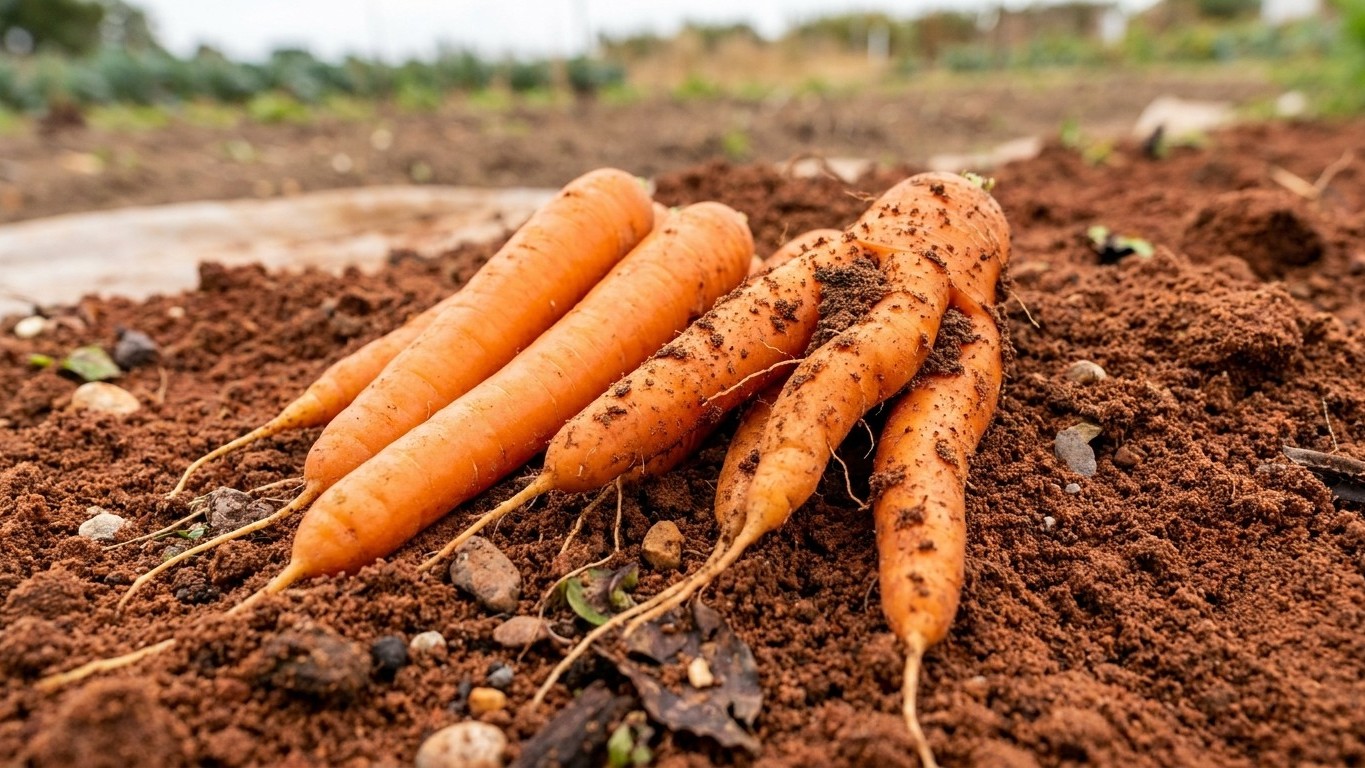

A carrot root sitting in North Carolina ground for two to three months faces two separate kinds of feeding: something working the leaves above the soil line, and something working the taproot itself once it thickens enough to be worth tunneling into. The sourced facts behind this page don’t hand over a fixed state pest list, they hand over soil and crop data, and that turns out to explain the “what eats it” question better than a species roster would, because it explains which roots are actually vulnerable in the first place.
Which pests attack carrot in North Carolina

The facts verified for this page carry no named, sourced insect list for carrot in North Carolina. What they do carry is soil and crop data, and that’s the more useful starting point, since most feeding damage on a carrot traces back to how the ground around it behaves, not to a fixed roster of bugs.
Start with the ground. The state’s representative soil, the Cecil series (an Ultisol), runs sandy: 68 percent sand, 13 percent clay, 20 percent silt, organic matter near 0.8 percent, surface pH around 5.5, and it drains well. That’s actually close to what Utah State University Extension says a carrot wants: deep, sandy, well-drained soil rich in organic matter. But “rich in organic matter” is the part the Cecil series doesn’t deliver at 0.8 percent, and a root growing in thin, fast-draining ground swings harder between wet and dry than one growing in a well-amended bed.
A root under repeated moisture stress is a softer target for anything already feeding on it below the surface than a root growing in steady, even ground. That’s the real mechanism worth remembering here, more than any single insect name: below-ground feeders exploit stressed, cracked root tissue, and above-ground sap feeders work the foliage regardless of what the soil is doing.
Sorting matters more than naming. A tree pest, a turf grub, or an ornamental-shrub insect has no business on a carrot page even if it shows up somewhere in a state’s broader pest records, because none of them feed on a root vegetable. The only sorting question worth asking at home is whether something feeds on root tissue, on foliage, or not on carrot at all. Anything in that third group doesn’t belong here no matter how common it is elsewhere in a North Carolina yard.
For a current, county-level species list, that has to come from Cooperative Extension, since only a local office tracks what’s actually active in a given season. Treat the soil and growth facts above as the explanation for why a root becomes vulnerable, and treat the extension office as the source for what’s feeding this year.
When each one shows up, and what it does first
Carrots go straight into the ground as seed, there’s no transplant date to count from, so every stage below runs from the day of seeding. Utah State University Extension puts full maturity at 70 to 100 days from seeding; Clemson Cooperative Extension’s harvest guidance lands at 65 to 75 days. That gap matters: a root pulled at day 70 in thin soil may not have finished sizing, and one left past day 100 in warm, wet ground is exposed longer than it needs to be.
The first two to three weeks after seeding, while the root is still a thin thread, is when foliage feeding shows up first, simply because there’s no root yet worth tunneling into. What a gardener sees at this stage is on the leaves: stippling, curling, or fine webbing on the undersides of young growth, consistent with sap-feeding insects working the canopy.
Root-stage feeding becomes possible only once the taproot has bulked up, somewhere past the one-month mark, and it stays a risk right through the 65 to 75 day Clemson window and beyond if the crop is left in place. From above, that stage is deceptively quiet: root feeding rarely shows on the foliage until it’s advanced. Pulling a test root partway through the season catches a problem sooner than waiting for the leaves to signal trouble.
Near the harvest window itself, from about day 65 onward, any feeding already present stops being just cosmetic. A chewed or split root won’t hold at the 33°F, high-humidity conditions carrots need in storage, and it breaks down faster in bunched storage than a clean root does over that 10 to 14 day window. Timing the pull to the sourced range, rather than to a fixed date on a calendar, is the one part of this a gardener actually controls.
Telling the damage apart from everything else
Not everything that looks like a bite is one. A forked or split taproot is the most common false alarm, and Utah State University Extension is direct about the cause: heavy or rocky soil makes the root fork, nothing to do with an insect. A root splitting into two or three legs is responding to something solid in its path, a stone, a clay lens, a hard clod, not to feeding.
Moisture swings cause their own look-alike symptom: fine surface cracking across the shoulder of the root, which can pass for feeding scars but runs in clean, mechanical lines rather than the irregular tunnels an insect leaves. Sandy soil with organic matter under 1 percent, close to the state’s representative value, holds water unevenly between waterings, which sets up exactly this kind of cracking.
The test that actually settles it at home is cutting the root open. Feeding tunnels are ragged and hollowed, often with a discolored trail, while forking and cracking are structural: the shape changes, but the tissue inside isn’t chewed out.
| Symptom | Likely cause | What distinguishes it |
|---|---|---|
| Root splits into two or more legs | Compacted, rocky or heavy soil | No tunneling inside; a shape problem, not tissue damage |
| Fine cracks across the root shoulder | Uneven soil moisture | Clean mechanical lines, no hollowing or frass |
| Ragged tunnel through the root interior | Feeding by a soil-dwelling insect | Hollowed path, often with frass, found on cutting the root open |
| Stippled or curled foliage, no root symptom | Sap-feeding insect on leaves | Visible above ground before any root symptom appears |
| Soft, dark, water-soaked patch | Disease rather than feeding | Spreads and discolors instead of tunneling; confirm with extension |
None of this replaces an identification. A county Cooperative Extension office can confirm what’s actually causing a specific symptom; this table only sorts out which category is worth asking about.
What actually works here, and what is a waste of time
On a root crop that runs 65 to 100 days from seeding depending on which sourced figure applies, timing beats intervention almost every time. A physical barrier set in place at seeding, before any feeding starts, works better than anything applied after damage is already visible, because once feeding has reached the inside of a root, nothing put on the surface reaches it there.
Soil work is the other lever within reach. Utah State University Extension’s own fix for heavy ground, compost worked in and double digging before the crop goes in, does two jobs: it straightens the root’s path so it’s less likely to fork, and it evens out the moisture swings that stress a root into a softer target. On ground close to the state’s representative surface value (68 percent sand, organic matter near 0.8 percent), adding organic matter ahead of seeding is the highest-leverage move available, more useful than anything applied mid-season.
What doesn’t work: treating a foliage symptom as if it explains a root problem, or the reverse. Sap feeders on the leaves and tunneling feeders in the root run on different timing, and aiming a fix at the wrong stage wastes the short window this crop has to work with. Late action is the other waste: once a root is already hollowed, nothing put on the bed reverses it, it only protects what hasn’t been reached yet.
Whatever control is appropriate has to be legal for a food crop in North Carolina specifically, and that changes as registrations are renewed or dropped. That’s not a call to make from a general guide. A county Cooperative Extension office is the current source for what’s labeled for vegetables in the state right now.
Where to check this for your own county
North Carolina Cooperative Extension works at the county level, not just the state level, and that’s the level this question actually needs. What’s documented for the state as a whole doesn’t say what’s active in one specific garden this season, since pest pressure moves with local weather, with what’s growing nearby, and with what a specific bed’s soil is doing that year.
A local office can confirm an identification from an actual sample or photo, report what’s currently active in the area based on recent grower reports, and confirm what’s legally labeled for carrot in the state right now. That last point shifts over time as registrations change, in a way no general guide can track in real time.
The soil and crop figures on this page (the Cecil series’ sand, clay and organic matter values, the 65 to 100 day seeding-to-harvest range, the 33°F storage figure) come from named sources and hold steady across the state. Pest presence doesn’t work that way. It’s the one thing here that genuinely needs a local check, because a state spans far more ground than a single figure can represent.
The next move for a gardener looking at an actual damaged root isn’t a broader search, it’s cutting that root open the way described above and taking it to the nearest county Cooperative Extension office.
Common questions
How soon after seeding can a carrot root actually be damaged by feeding?
Foliage feeding can show up in the first two to three weeks after seeding. Root feeding has to wait until the taproot has bulked up enough to be worth tunneling into, which is later in the 70 to 100 day maturity window Utah State University Extension describes.
Does a forked root mean insects got into it?
No. Utah State University Extension attributes forking to heavy or rocky soil forcing the root off its straight path, not to feeding. Cutting the root open settles it: forking is a shape change, feeding damage is a hollowed, ragged tunnel inside.
How long do harvested carrots keep?
Clemson Cooperative Extension’s figures are specific: store at 33°F with high humidity, and bunched carrots (tops still on) hold for about 10 to 14 days. Cutting the tops off before storage removes what’s drawing moisture out of the root, which is why trimmed carrots outlast bunched ones by a wide margin.
What’s the single best soil step for reducing carrot problems in North Carolina gardens?
Working compost into the bed and double digging if the ground is heavy, per Utah State University Extension’s guidance for heavy soils. On ground close to the state’s sandy, low-organic-matter representative value, adding organic matter ahead of seeding does more than any mid-season fix.