
Collards do well across western Washington’s mild, wet winters, planted as a cool-season crop that can go in from spring through midsummer for a fall and winter harvest. East of the Cascades, the short high-desert season changes that plan almost entirely. The details below cover timing, season length, heat and moisture, and the right type of collard for each side of the state.
When the soil is warm enough in Washington

Western Washington’s last spring frost lands somewhere between February 27 and March 18, according to NOAA’s 1991-2020 Climate Normals for station USW00024233, the reference station near Seattle. That range comes from a 30 to 70 percent freeze-probability band, not a fixed calendar day, so a year that runs early or late by a couple of weeks is well within the historical record.
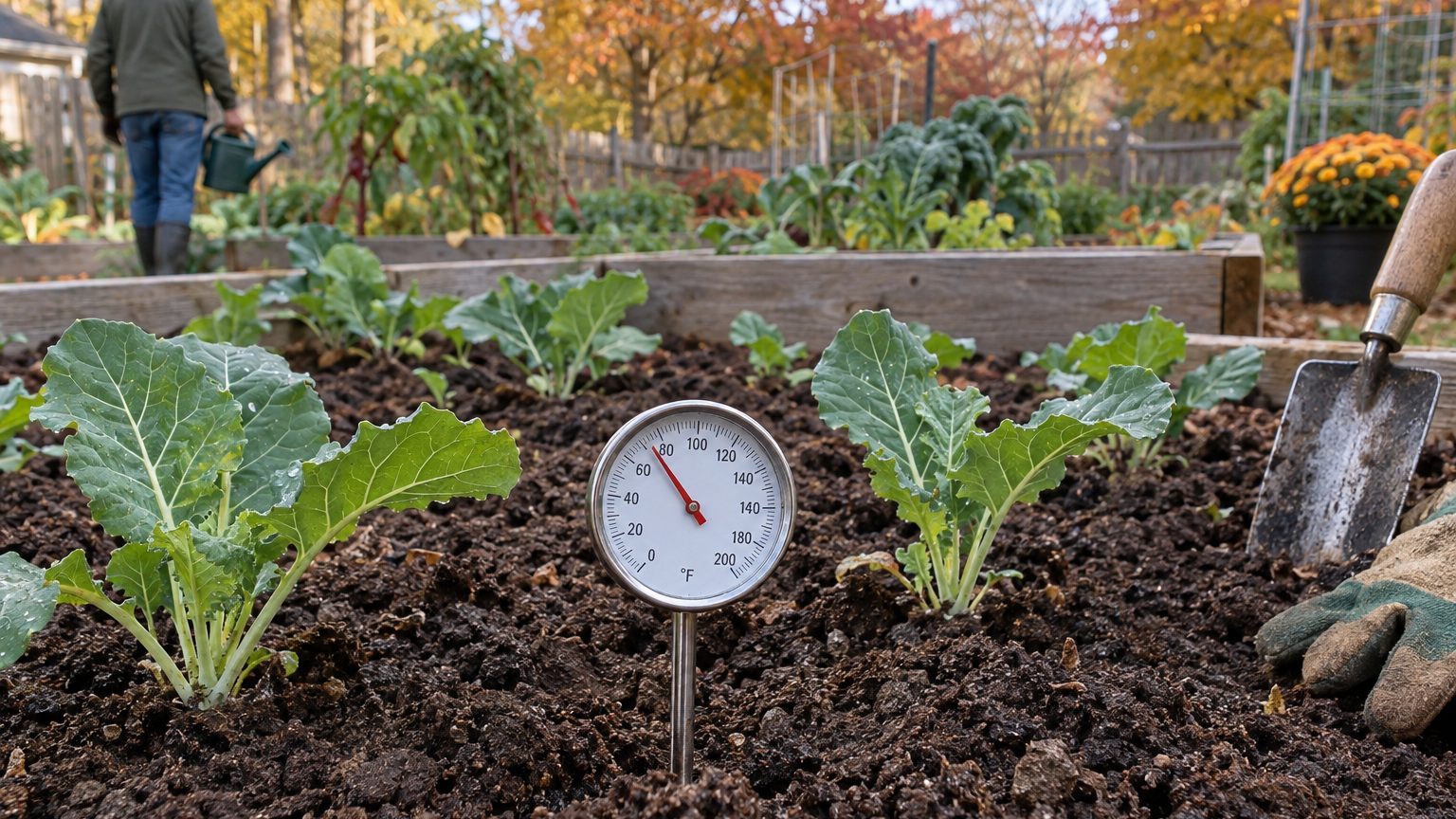
None of that actually tells a collard grower when to put seed in the ground. Frost is a proxy, and a fairly rough one. What decides planting timing is soil temperature, and in western Washington’s maritime climate the soil lags well behind the last freeze. Long after frost risk has passed, the ground stays cold, waterlogged, and short on light, and collard seed sown into that soil sits without germinating rather than coming up on schedule.
A few signs matter more than any date on a calendar:
- The soil crumbles instead of clumping when you squeeze a handful.
- Rainwater no longer stands on the surface a day after a storm.
- Weed seedlings have already started coming up on their own.
Eastern Washington doesn’t follow any of this. It’s high desert beyond the Cascades, with a shorter frost-free season and drier air from the start, and the Seattle-area window above describes the mild, maritime west side only. A gardener near Spokane or the Tri-Cities should treat that frost range as belonging to a different climate, not their own.
Collards are brassicas, in the same family as cabbage, kale, and mustard, and they carry the same soil-borne diseases and overwintering pests those crops leave behind. A bed that grew any brassica the year before hasn’t really been rotated if collards go in next. Pick ground that’s been out of the brassica family for at least three years, and lean on physical barriers like floating row cover as the first line of defense against cabbage worms and aphids, rather than reaching for a chemical treatment.
How long the season lasts here
Subtract one date from the other and western Washington’s frost-free window runs roughly 240 to 277 days, depending on where a given year falls within each probability band. Even at the shorter end, using the latest last frost of March 18 and the earliest first fall frost of November 13, that still leaves close to eight months of open ground.
That’s a wide window, and it changes the whole approach to collards. A season that long doesn’t force a grower into a single planting. It allows a spring sowing for a summer harvest and a second, mid-to-late-summer sowing timed for a fall and winter harvest, which suits collards well since the crop actually sweetens with a bit of cool weather rather than suffering from it. The general collards growing guide on this site walks through the mechanics of timing that second sowing.
A window this long also changes whether starting seedlings indoors is worth the trouble. Where the season is short, the first sowing is often the only one, and transplanting can buy a few extra weeks that matter. In western Washington, with two sowings realistically on the table, direct seeding the second round is usually simpler, since there’s enough season left to let it catch up on its own.
Eastern Washington’s shorter, drier season doesn’t offer that same flexibility. Without a comparable frost-date pair from the same station, the honest answer is that a single planting timed to the local frost dates, checked with the county extension office, is the safer bet there rather than assuming a second sowing will have time to mature.
Heat and water in Washington

Two figures usually drive this section: the count of days above 90°F and summer rainfall totals. Neither is part of the dataset behind this page, and rather than guess at a number, it’s worth saying plainly what the pattern looks like instead. Western Washington’s marine layer keeps summer highs mild, days that reach 90°F are uncommon in the Puget Sound lowlands, and summers there run cool and often damp, especially near the coast. That combination doesn’t stress collards with heat. It stresses them with mildew, slower ripening, and the fungal diseases that thrive when leaves stay wet.
The number that actually decides how to plan a collard bed here is the winter low, not the summer high. Seattle’s coldest month averages a daily minimum of 37.1°F, per NOAA’s 1991-2020 Climate Normals, a mild reading that keeps hard freezes from being a regular event. Where winter stays that mild, collards behave as a standing crop, picked leaf by leaf from November into March rather than harvested all at once. Where the coldest month runs noticeably colder, and parts of Washington away from the immediate coast do, collards behave as a straightforward autumn crop that ends at the first hard freeze.
The USDA Plant Hardiness Zone Map puts Washington across a very wide 4a to 9a range, built on the average annual extreme minimum temperature alone. That range spans the mild Puget Sound lowlands and the much colder mountain and high-desert interior, so it’s not useful for a specific planting decision without narrowing to a place. For anything dated, the Seattle-area figures above are the more honest reference point, and a gardener elsewhere in the state should expect their own numbers to differ, sometimes by a lot.
Which collards suit Washington
The honest answer here is that no cultivar name belongs on this page, and that’s not a dodge. Variety trials run by state extension services test dozens of collard types against local disease pressure, local heat, and local season length, and that trial data is the only recommendation that actually means something for a specific yard. WSU Extension publishes exactly that kind of local guidance, and it’s worth checking before buying seed.
What does transfer is reasoning by type rather than by name. A short season, the kind eastern Washington’s high desert imposes, favors the earliest-maturing types available. A hot, dry summer favors types known to hold up with good airflow and some shade at the root zone, again more relevant on the east side of the Cascades than along the coast. A damp, mild-summer climate like western Washington’s makes disease resistance, especially against downy mildew, the first thing to ask WSU Extension about before anything else.
| Type | Where it fits in Washington | What to ask extension about |
|---|---|---|
| Early-maturing | Eastern Washington’s shorter, hotter season | Heat tolerance and bolt resistance |
| Disease-resistant | Western Washington’s damp, mild summers | Downy mildew and other foliar disease ratings |
| Cold-hardy, standing types | Coastal areas with mild winter lows | Performance held through a Puget Sound winter |
Comparing across the region helps make sense of why one recommendation doesn’t fit the whole state. In a genuinely hot, humid climate like Mississippi’s, growers lean on types bred for a much longer, harsher summer, covered on the Mississippi collards page. At the other extreme, a short-season climate like Newfoundland and Labrador’s puts all the weight on the earliest types available, discussed on the Newfoundland and Labrador collards page. Washington sits between those two pressures depending on which side of the Cascades a garden happens to be on, which is exactly why the local extension trial data matters more here than a single statewide answer ever could.