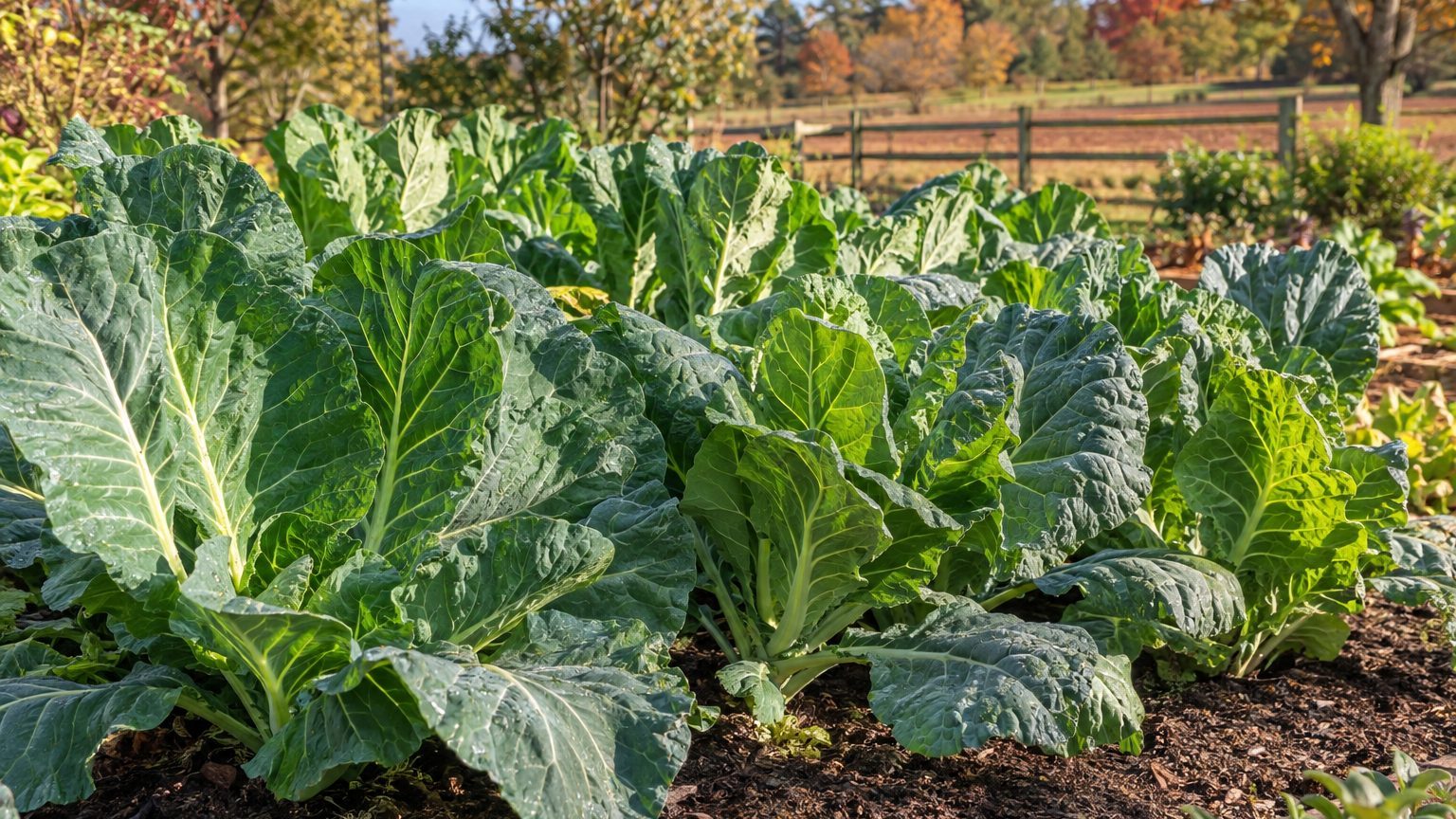

California doesn’t have one collard season, it has three. Coastal and Southern California gardens run frost-free all year, so the winning varieties there are slow-bolting and heat-tolerant. In the Central Valley and Sierra foothills, where real frost shows up, fast-maturing types that beat the cold matter more than anything else.
The short answer for California
Start with where you garden, because the state splits into two entirely different growing problems. Along the coast and through Southern California, NOAA’s 30-year station record for Los Angeles shows zero days at or below 32°F, and the frost-free season is listed as a full 365 days. That means the plant you choose never has to survive a freeze. It has to survive summer heat, tight water budgets, and the temptation to bolt the minute the days get long.
For those frost-free zones, the smart pick is a slow-bolting, heat-tolerant collard type, the kind bred to hold its leaves through warm stretches without throwing a flower stalk. Compact varieties such as Vates fit this well because they tolerate irregular watering better than looser, leafier types, an important trait when a household is on a summer water-restriction schedule. Georgia Southern and similar heading types also handle heat, though they want more consistent moisture to stay tender.
In the Central Valley, the Sierra foothills, and inland Northern California, the calculation flips. These areas do freeze in an average year, sometimes hard, and the growing question becomes how fast a planting can size up before winter cold shuts things down. There, a faster-maturing, standard collard works better than a slow, heat-bred one, because the priority is finishing a harvestable crop within the frost-free window that particular county actually gets, not surviving August.
The other California variable worth writing down is winter warmth itself. The Los Angeles reference station’s coldest month has a mean daily minimum of 49.1°F, which is the number that decides whether greens simply keep growing through winter in coastal and southern gardens rather than going dormant. That’s mild enough that many gardeners there treat collards as a year-round crop, staggering plantings every few weeks instead of picking one single date. Inland and at elevation, that mean minimum runs colder, and the growing window narrows accordingly, so the same staggered approach doesn’t apply, and a single, well-timed planting matters more.
So the short version by type: heat-tolerant, slow-bolting collards for frost-free coastal and southern gardens; fast, standard-season collards for the Central Valley, the foothills, and inland Northern California, timed around each area’s own frost dates rather than the coast’s.
What will not work here

The variety that fails hardest in California is the slow, cool-climate collard planted in a hot, dry inland garden and then watered on a once-a-week schedule. Collards need steady soil moisture to stay tender, and a slow-growing type asked to sit in Central Valley summer heat for extra weeks, on infrequent watering, turns bitter and tough well before it’s worth picking. That combination, a slow variety plus sparse irrigation, is the single most common reason a California collard patch disappoints.
In the frost-free coastal and southern zones, the opposite mistake shows up: gardeners treat these greens like a one-shot crop, sowing once in fall the way a colder-climate guide would suggest, then wondering why the bed sits empty by spring. Because no freeze occurs in an average year along that reference station’s record, there’s no hard stop forcing a single planting window. A gardener who plants once and walks away is leaving months of frost-free growing time on the table.
Where humidity and heat combine
Close spacing is the other trap, and it plays out differently depending on where you are. In the fog-belt coastal strip, humid, mild air sitting between crowded plants encourages the same fungal leaf problems that cause trouble in the humid South, even though California’s overall climate reads as dry. Inland, where the air is hot and dry rather than humid, tight spacing causes a different failure: plants shade and stress each other, bolt faster, and produce smaller leaves. Neither region gets a pass on giving collards room to breathe, just for different reasons.
A last one worth flagging: assuming the whole state shares Los Angeles’s frost-free record. It does not. Northern California, the Central Valley, and the Sierra foothills freeze in an ordinary year, and a variety chosen for a Southern California backyard, one bred to just keep cranking through mild winters, gains nothing there and may not even mature before the cold arrives. Matching the variety to the actual local frost pattern, not the state’s most famous climate, is what separates a full harvest from a disappointing one.
What changes across California
California’s USDA Plant Hardiness Zone range runs from 5a to 11a, which is one of the widest spreads any single state carries. That’s not a rounding error, it’s the difference between a garden that can lose plants to hard winter cold and one that essentially never sees frost at all. A single “California” answer for which collard variety to plant simply doesn’t exist across that range.
Zone 11a sits at the warm end, largely coastal and southern lowland areas, where winter cold barely registers and heat-tolerant, slow-bolting varieties do the most work all year. Zone 5a sits at the opposite extreme, found at higher elevations in the Sierra Nevada and other mountain pockets, where winters are genuinely harsh and the growing season for any collard variety compresses sharply. Between those two extremes lies most of the Central Valley and inland Northern California, land that freezes some winters but nowhere near as severely as the high Sierra.
What that means by region
| Region | Frost pattern | Variety priority |
|---|---|---|
| Coastal & Southern CA | Frost-free in an average year | Heat-tolerant, slow-bolting types |
| Central Valley | Freezes some winters, moderate season | Standard-season, heat-adaptable types |
| North CA & Sierra foothills/elevation | Regular winter freeze, shorter season | Fast-maturing, cold-hardy types |
A gardener at elevation or in the far north should shift toward faster-maturing varieties and plan around a genuine frost date, not the mild, frost-free pattern that defines the state’s coastal image. This page can’t tell an individual reader which of those zones they’re standing in. The USDA’s own hardiness zone map, searchable by ZIP code, settles that question in a few seconds and is the right next stop before picking a variety off any general list.
Where to check this for your own county
This page describes California as a whole, and California, as the zone spread above shows, is not one garden. The reliable next step is University of California Agriculture and Natural Resources, at ucanr.edu, the land-grant extension service for the state. County-level UC Cooperative Extension offices, reachable through that same site, publish planting calendars and variety notes built around local trial data rather than a statewide average.
Two things are worth hunting down once there. First, the local planting calendar for greens and collards, which will reflect the actual frost pattern of that specific county rather than the Los Angeles reference station used for the statewide figures on this page. A Sacramento Valley calendar and a San Diego County calendar will not agree, and neither should they. Second, look for any variety trial results or master-gardener recommendations naming collard or collard-type greens that performed well in regional field conditions, since local trial data accounts for microclimate quirks, like coastal fog or valley heat pockets, that a state-level page can’t capture.
A county-level recommendation will always outrank a state-level one, and this page is deliberately the state-level one. It’s built to explain the mechanism, why frost-free coastal zones favor slow-bolting types, why the Central Valley and Sierra behave differently, so that a county calendar makes more sense once you’re reading it. Treat this article as the reasoning and the extension office’s county page as the specific date and variety list to actually act on.
If a specific county page doesn’t mention collards directly, ask the local master gardener help desk, staffed through the same UC ANR county offices, which greens varieties local gardeners have had success with. That kind of on-the-ground answer, gathered from actual local gardens, beats any general list, including this one.
Checking this against your own garden
No calendar or zone map replaces walking outside and looking at the bed itself, and three simple checks tell you more about your own microclimate than any statewide figure can.
Start with the soil. Push a finger a couple of inches down; if it feels cool and damp rather than cold and wet, collard seedlings will settle in without stalling. In the dry inland regions this also flags whether your irrigation schedule is actually reaching root depth, not just wetting the surface, which matters more here than in wetter climates.
Next, watch the plant itself for the first sign of bolting, a tall central stalk with small yellow flower clusters. In hot inland gardens this can show up fast once day length and heat both climb, and it’s the clearest local signal that a slow-bolting variety, not a standard one, is what your particular yard actually needs. Catching it early also means you can still harvest the leaves before they turn bitter.
Last, check leaf color and thickness on new growth. Leaves that stay pale, thin, or ragged despite a full-sun spot usually point to water stress in dry inland heat, or to crowding in a foggier coastal bed where plants are competing for light and airflow. Either way, that’s your own garden telling you something no state page can: whether the next planting needs more space, more water, or simply a different variety than the one already in the ground.