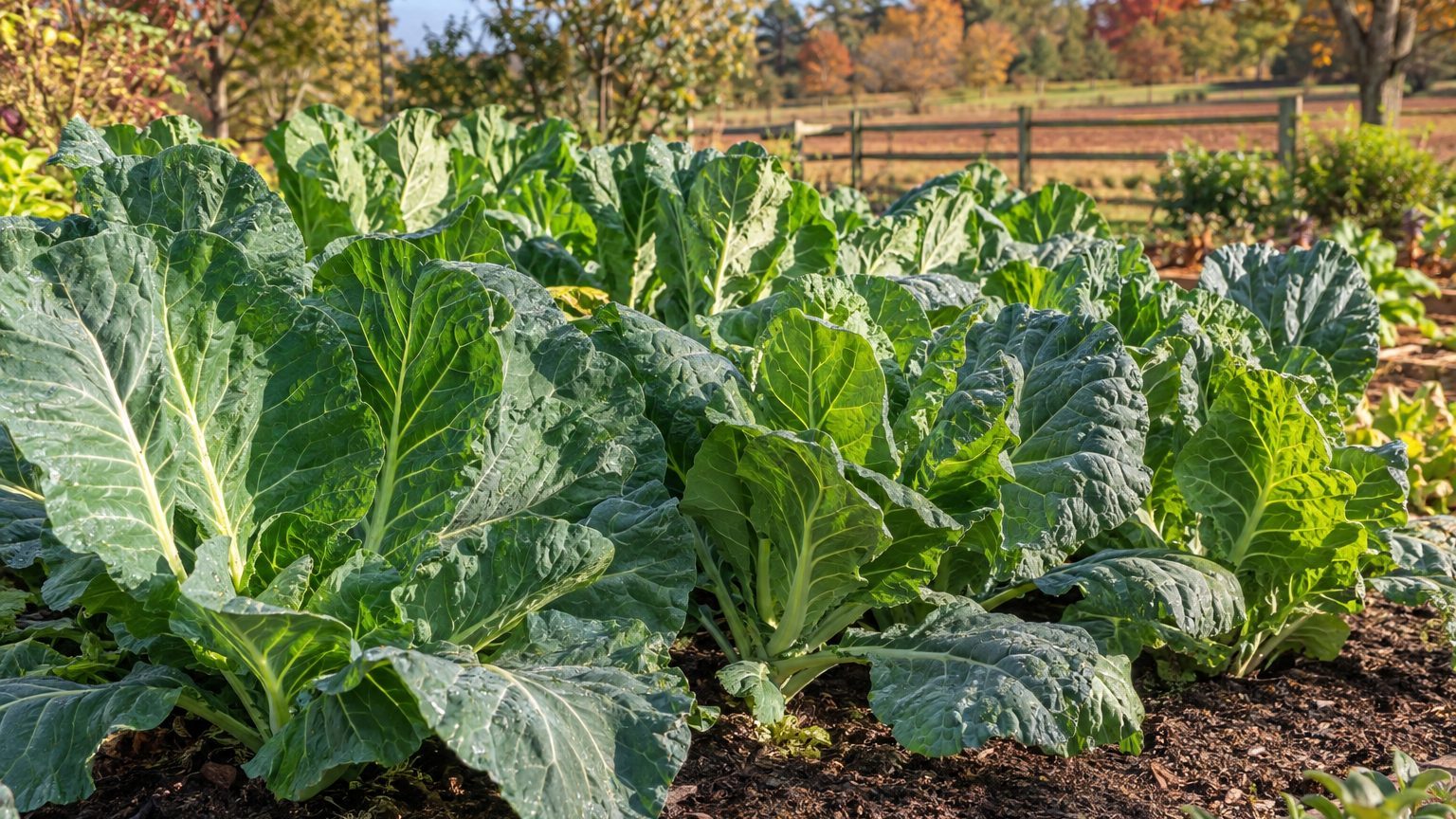

Idaho’s answer depends entirely on where in the state a garden sits. In the mild Boise valley, a fast collard like a Vates or Georgia Southern type and a slower heading variety both have room to mature. Above roughly 4,000 feet, or north into the Panhandle’s colder pockets, the safer bet is a quick-maturing green, mustard, turnip tops, or a fast looseleaf collard, that finishes well before an early frost closes the season.
The short answer for Idaho
Boise’s frost-free window runs from the latest safe spring frost to the earliest fall frost, roughly 153 days between May 7 and October 7, using the conservative end of NOAA’s 30-70% probability band for station USW00024131. That’s enough time to carry almost any collard variety from seed to a full head, with room left over for a second planting of quick greens after the first harvest comes in. But the Boise Airport station sits in one of the lowest, mildest spots in Idaho. Push north into the Panhandle or up into a mountain valley and that math shifts fast.
The decision by type comes down to season length and heat, not personal taste. Where the frost-free run stretches close to five months, as it can across the Treasure Valley floor, a slower heading type in the 75- to 85-day range has time to fill out into a full leafy stand, and a gardener can still succession-plant a fast green in August for harvest after the first light frost. Where the season shrinks to three months or less, which describes a lot of Idaho once you leave the valley floors, the safer play is a fast-maturing, loose-leaf collard or a quick green like mustard or turnip tops, ready in under two months.
Timing inside that window matters as much as the variety itself. A spring-sown collard has to mature before summer heat turns the leaves bitter and tough, so a fast type sown as soon as the soil works gives the best shot at a clean harvest ahead of July’s peak. A fall crop, sown in mid-summer for harvest after the first frost sweetens the leaves, can afford a slower variety because it’s racing toward cooler weather instead of away from it. In Boise’s valley, where frost doesn’t reliably arrive until early-to-mid October, that fall window is wide enough for either strategy. Higher up, it usually isn’t.
For the specifics of which types handle Idaho’s dry heat well and which sowing windows fit each region, see Growing Collards in Idaho and When to Plant Collards in Idaho.
What will not work here

A full-season, 85- to 90-day collard variety is the first casualty at elevation. Even Boise’s frost-free run of roughly five months leaves little slack for a cool June or a slow germination; a garden at 5,000 feet, where the growing season can run two months shorter, simply doesn’t have the days left for a long-hauler variety to head up before frost cuts it down.
Treating collards as a perennial that shrugs off winter is the second mistake. Boise’s coldest month averages a nightly low of 25.4°F, and that’s the mild end of the state. Repeated nights at that temperature through December and January kill unprotected collard plants outright. The plant tolerates a light frost fine, and even sweetens after one, but it isn’t built to overwinter in Idaho soil without a thick mulch and some kind of cold frame, so most gardeners replant every spring instead of counting on last year’s crop.
Watering on a weekly schedule, a habit that works fine in the humid Southeast, fails just as reliably here. Idaho’s summers pair low humidity with long dry stretches, and a bed soaked once a week and left to bake in between will bolt early or turn tough and bitter days before it would in a wetter climate. Steady, more frequent moisture, not one big weekly dose, keeps the leaves tender through the hottest weeks.
Tight spacing meant for a humid climate’s disease pressure doesn’t map cleanly onto Idaho’s dry heat either. Fungal crowding is less of a risk here, but plants packed too close in a sun-baked, reflective bed compete hard for the limited water each one needs, and small, stressed leaves are the more common result. Direct-seeding a slow variety in early spring, expecting a long taproot to establish before the ground warms, underperforms for the same reason: transplants started indoors and set out once frost risk has passed give the plant a four-to-six week head start that direct seeding in a short window rarely allows for anything but the fastest greens.
What changes across Idaho
Idaho’s USDA hardiness zone spans 3b to 7b, one of the widest ranges of any state. That gap covers everything from cold pockets typical of interior mountain terrain to mild lowland conditions found near the Pacific Northwest, and it all sits inside one state’s borders. A single “best varieties for Idaho” answer doesn’t really exist; it depends on which end of that range a given garden falls into.
The warmer end, 7b, describes sheltered low-elevation pockets like the Boise valley used as the reference point throughout this page, where the frost-free season stretches close to five months and collards behave much as they would in a mid-Atlantic garden. The colder end, 3b, describes high mountain valleys and much of the Panhandle’s higher ground, where a growing season can close in under 100 days and winter lows drop far past anything even a hardy collard plant survives unprotected.
Elevation drives more of this variation than latitude does. Two gardens at the same latitude can differ by a full USDA zone or more depending on whether one sits in a river valley, where cold air pools on clear nights, and the other sits on a bench a thousand feet higher, where the season itself simply runs shorter. The practical result: choosing between a fast 55-day green and a slower 75-day collard depends far more on elevation and local topography than on which county line a garden happens to fall inside.
This page can’t place an individual garden on that map. The USDA’s own hardiness zone lookup does that county by county, and it’s the right next stop before picking a variety based on anything written here.
Where to check this for your own county
The University of Idaho Extension, at https://www.uidaho.edu/extension, is the next stop after this page, and a more useful one for any specific garden. The facts above come from a single weather station in Boise and a hardiness zone map built on one statewide variable; a county extension office works from local trial data and local growers, which beats a state average every time.
Two things are worth hunting for once there: a county or regional planting calendar, and a list of collard and greens varieties actually trialled under Idaho conditions rather than just described on a seed packet written for a national audience. Extension offices in agricultural counties, especially those tied to irrigation districts along the Snake River plain, often publish exactly this kind of localized variety guidance for market growers, and most of it applies just as well to a backyard bed.
Search for the office covering your own county specifically, not a neighboring one. A planting date or variety recommendation built for Ada County’s mild valley floor is close to useless for a garden near the Canadian border in Bonner County, even though both are technically Idaho. The county office can also confirm the current season’s frost forecast, which shifts year to year around the long-term averages cited on this page.
Treat this page as the statewide starting point that explains why the range is wide and what drives it, and treat the county extension office as the source that narrows it down to your own frost dates and the specific varieties worth planting this season.
Checking this against your own garden
Every date and zone figure on this page comes from averages spanning three decades and a single weather station. A gardener’s own observation, made right in the bed, overrides all of it.
Soil warmth is the first check, and it needs nothing more than a bare hand. Collard and greens seed germinates reliably once the top couple inches of soil feel consistently cool rather than cold, more like a spring morning than the lingering chill of late winter. If the soil still feels like it did in March, seed sown now will sit and rot before it sprouts, whatever the calendar says about average frost dates.
The first true leaves are the second signal. Collards send up two rounded seed leaves first, then a set of true leaves with the ridged, cabbage-family shape everyone recognizes. That first true leaf appearing within a week or two of sowing means the bed’s own microclimate runs close to the regional average; a much slower emergence suggests the garden runs colder than the nearest weather station, and future plantings should shift later.
The third thing to watch is bolting, when the plant sends up a central flower stalk instead of new flat leaves. This usually follows a stretch of hot days. A bed that bolts consistently earlier than the surrounding region’s reported heat arrival is running warmer than average, often from reflected heat off a south-facing wall or a gravel path, and that’s worth remembering when picking a variety and a planting date next year.