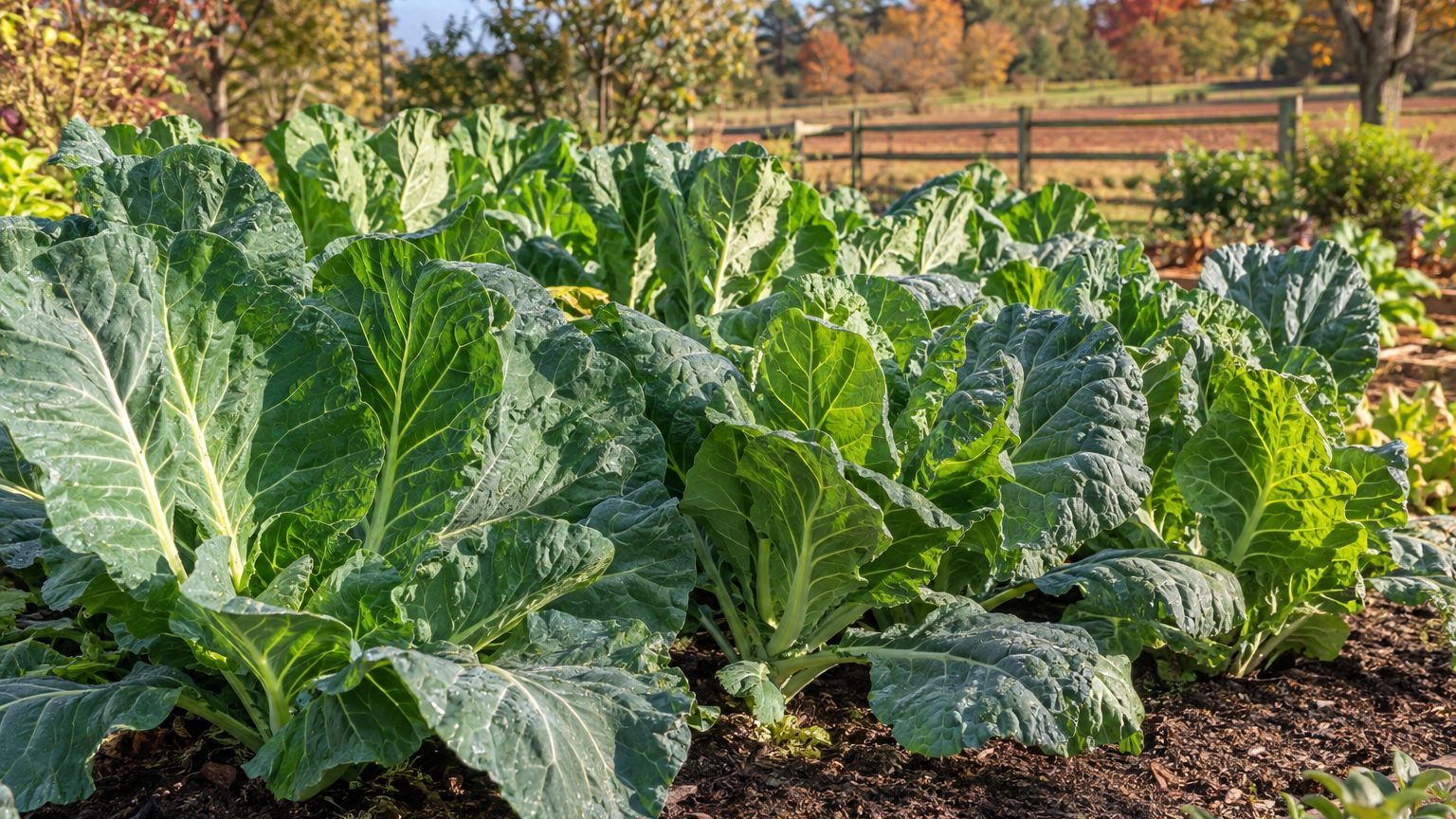

For most Wisconsin gardens, the best collards are the quick, cold-tolerant types, planted as spring transplants and harvested into fall. Kale, mustard, turnip greens and chard make good partners. Slow Southern heirlooms can work here, but only with a head start indoors. The season is long enough for a strong crop and short enough to punish the wrong variety, and the frost data below shows where that line falls.
The short answer for Wisconsin
Pick collards that reach harvest size without needing the whole season. Compact, uniform types sold under names like Vates or Champion fit that description. The classic tall Southern heirloom, Georgia Southern, is the one to gamble on, and only if you start seed indoors well ahead of transplant time. Check the maturity listed on each seed packet and choose the shorter one.
The reason is arithmetic. At Milwaukee, the reference station for this page, NOAA’s 1991-2020 normals put the last spring 32°F freeze between April 16 and April 29. The first fall freeze lands between October 17 and October 29. Both ranges come from the 30 to 70 percent probability band for a 32°F freeze. They are odds, not promises, and any given year can fall outside them. Between the two bands sit roughly 24 to 28 weeks, and a collard that needs most of that time leaves you no margin.
Collards tolerate light frost, so transplants can go out near the early edge of the spring band once they are hardened off. The fall crop is a bonus, since cold nights sweeten the leaves. For sowing dates, see When to Plant Collards in Wisconsin.
| Type | Fit for Wisconsin | What to know |
|---|---|---|
| Quick, compact collards (Vates, Champion) | Best all-around choice | Reach harvest size inside the season; suited to spring transplants and a fall harvest |
| Tall heirloom collards (Georgia Southern) | Workable with an indoor start | Needs the long end of the season, so late planting disappoints |
| Kale and Swiss chard | Dependable backup | Frost-tolerant and forgiving if collards stall |
| Mustard and turnip greens | Fast spring and fall fillers | Quick to harvest, so they suit the shoulders of the season |
Those names are examples of each type, not endorsements of one seed source. Two catalogs can list different maturity for the same variety.
What will not work here
Slow collards sown late fail first. A plant that has not reached size by mid-October will not catch up, because growth crawls once nights turn cold. Light frost will not kill it, but the days it needs are gone. A heirloom sown directly in the garden in late spring is the classic way to end up with a row of small plants in November.
Overwintering is the second failure. Milwaukee’s coldest month averages a daily minimum of 17.2°F. That is an average, so many nights run colder, and a fall planting left standing will not come back in spring. Southern gardeners cut collards all winter. In Wisconsin, plan on an annual, and treat anything that survives under snow as a surprise.
Planting on the first warm afternoon in April is the third. The spring band runs to April 29 because a freeze remains a real possibility until then. Hardened-off transplants shrug off a light frost, but a hard freeze or a long cold, wet stretch can stall or damage them. Prolonged cold can also push brassicas toward bolting, which wastes the plant before it produces much.
The fourth is borrowing Milwaukee’s fall date for a different part of the state. Lake Michigan delays the first fall freeze at the lakeshore. Inland southern Wisconsin typically freezes in early October, and the north far earlier. A gardener 60 miles inland who counts on October 29 may lose the fall crop two or three weeks before expected. Gardeners far from the lake should choose the quickest types and count backward from an earlier date.
This page has no summer heat or rainfall figures for the state, so it makes no watering or spacing claims. Those depend on your site and your county’s weather.
What changes across Wisconsin
Wisconsin is not one garden. The USDA Plant Hardiness Zone Map (2023, built on 1991-2020 data) puts the state at 3b to 6a. That spans several zones, so there is no single answer for the whole state. The map rates each spot by its average annual extreme minimum temperature, and the state has a wide spread of them.
Zone matters less for collards than for perennials, because collards are grown as annuals here. What zone tells you indirectly is how long and how cold the season is. A gardener in the far north, near the 3b end, should shift everything earlier and toward speed. Start seed indoors sooner, transplant as soon as the soil allows, and choose the fastest collards. Consider making kale or mustard the main crop and collards the experiment. The fall harvest window will close before it does in Milwaukee, and it may close in early October.
Near the southern lakeshore, the story reverses. The lake delays the first fall freeze, which gives slower varieties a better chance and extends the harvest of a fall planting. A gardener there can try a heirloom without much risk.
For a step-by-step approach to the crop itself, Growing Collards in Wisconsin covers planting and care in more depth. To find your own zone, look up your ZIP code on the USDA Plant Hardiness Zone Map rather than guessing from a neighbor’s garden. Zones can change over a few miles, near water, and with elevation.
Where to check this for your own county
A county recommendation beats a state one, and this page is the state one. The University of Wisconsin’s extension service lives at extension.wisc.edu. Start there and find your county office, which staffs people who know the local soils and frost pockets.
Look for two things. The first is a local planting calendar for leafy greens or collards specifically, not a generic vegetable chart. Extension calendars are usually written per crop, and a calendar for another plant will point you at the wrong months. The second is any list of varieties trialled in your county or nearby. Trial results show what grew well in local conditions rather than what a catalog promises.
This page has not verified a Wisconsin extension calendar for collards, so it does not quote one. If the calendar you find disagrees with the dates here, trust the calendar. The dates on this page come from a single Milwaukee station, and the frost dates for your yard may run two weeks or more away from it.
If your county office has a master gardener program, ask them directly. They tend to know whether the nearest lake or hillside makes fall frost arrive early or late in your area.
Checking this against your own garden
Your own observation outranks every date on this page. Three things are worth watching, and none needs equipment.
- Soil warmth. Push your hand into the bed in early spring. Soil that feels cold and clammy tells you the spot warms late, so hold off transplanting there. A sunny, drained corner that feels noticeably warmer is your early bed.
- The first true leaves. Seedlings first show two rounded seed leaves, then true leaves that look like small collard leaves. How fast they appear indoors tells you whether your start date was right for your window.
- The first frost. Note the morning white frost first covers the grass or your car windshield, and where it hits first. Low spots frost early, and a bed by a south wall may stay clear for weeks.
Then write down the date of your first frost this fall and keep it. The NOAA bands are normals from 1991-2020, so one season can run early or late. Three or four years of your own notes will beat any table for your yard.
Common questions
Can collards survive a Wisconsin winter?
Not reliably. Milwaukee’s coldest month averages a daily minimum of 17.2°F, and colder nights are common. Treat collards as an annual and plant fresh each spring.
Are collards worth growing in northern Wisconsin?
Yes, with adjustments. The state spans USDA zones 3b to 6a, and the north has a shorter season and earlier fall frost. Choose the quickest varieties, start seed indoors sooner, and consider kale or mustard alongside them.
Which greens are the easiest alternatives?
Kale, Swiss chard, mustard and turnip greens all handle cool weather and mature quickly, which suits Wisconsin’s shoulder seasons. Check each packet’s maturity and match it to your window.
Does frost hurt collards?
A light frost does not, and it often sweetens the leaves. The NOAA bands on this page mark 32°F freezes, from October 17 to October 29 at Milwaukee. A hard freeze is harder on them, and inland and northern gardens reach that point earlier than the lakeshore.