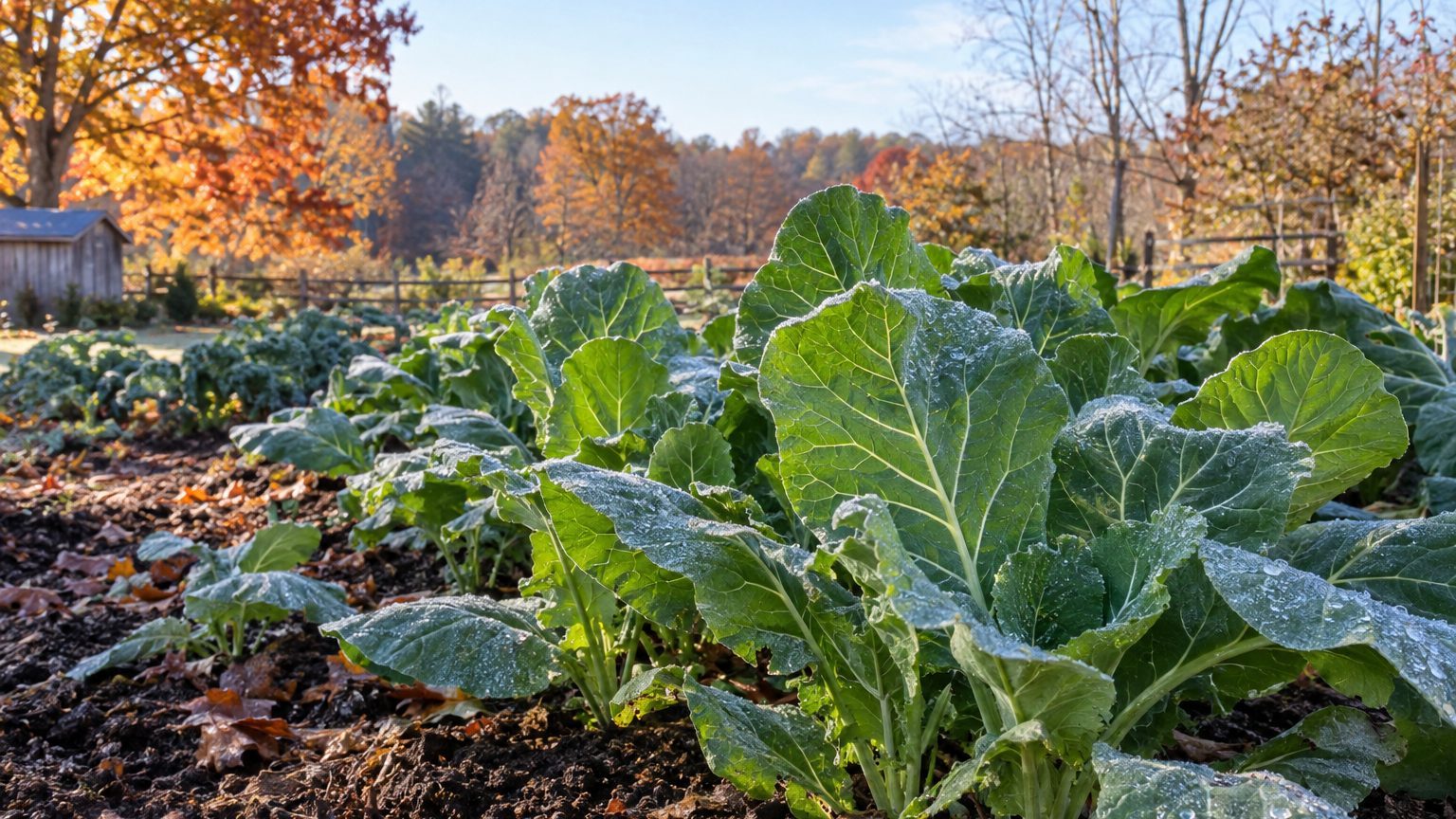

Wisconsin collards go in the ground in two windows. Set transplants out around the spring frost band of April 16 to April 29, then time a second planting to reach harvest size as the first fall freeze arrives, which NOAA data puts at October 17 to October 29. Collards shrug off light frost, so cold is a smaller threat than a calendar counted from the wrong end.
The short answer for Wisconsin
Move collard transplants outdoors in the last spring frost band, April 16 to April 29, and sow a fall planting so it reaches harvest size before the first fall freeze band of October 17 to October 29. Those two bands frame the whole season.
Both ranges come from the NOAA NCEI 1991-2020 Climate Normals for station USW00014839. They are not the dates a freeze stops or starts. They mark the stretch where the probability of a 32F freeze sits between 30 and 70 percent. Inside the spring band, nobody can promise a frost-free night, and inside the fall band nobody can promise a freeze-free one.
Spring: transplants at the frost band
A tomato grower has to wait for the far edge of that spring band, and often past it. A collard grower doesn’t. The plant tolerates light frost, so hardened-off transplants can go out inside the band, with a row cover or an old bedsheet handy for a night that threatens to dip well below freezing. Seed sown directly into cold April soil is a slower bet, because seedlings sit and sulk. Most Wisconsin gardeners get a better start from transplants.
Fall: work backward from the freeze
Fall sowing runs the calendar in reverse. Take October 17 as your anchor, subtract the days to maturity printed on the seed packet, then subtract a little more for slower growth as days shorten. That is your latest sensible sowing date. A light freeze does not end the crop (cold often sweetens the leaves), but a plant still small when a hard freeze arrives simply stops growing.
| Planting | Anchor from the NOAA normals | How to use it |
|---|---|---|
| Spring transplants | Last spring frost band: April 16 to April 29 | Set out hardened-off plants in the band, with cover on hand |
| Fall crop | First fall frost band: October 17 to October 29 | Count back from October 17 using the packet’s days to maturity |
| Winter carryover | Coldest-month mean daily minimum: 17.2F (Milwaukee) | Plan on harvesting, not overwintering |
For the broader picture of soil, spacing and care, see Growing Collards in Wisconsin.
What will not work here
The Southern calendar fails first. In much of the South, collards go in during late summer and get harvested through winter. Wisconsin’s coldest month has a mean daily minimum of 17.2F (Milwaukee, NOAA 1991-2020), and that is an average of the lows, not the worst night. The hardiness zone system is built on the average annual extreme minimum, a colder number, so a January in the low teens or below is normal. A Wisconsin collard planted for winter picking becomes a frozen stalk. Treat the crop as an annual with two harvest windows.
Slow varieties fail second. The season between the spring and fall bands is long enough for a Wisconsin garden but not generous. A variety that needs nearly every day of it leaves no slack for a cold May, a late transplant, or a fall that turns early. Pick types on the faster end of the range and read the packet for days to maturity. The Best Collards and Greens for Wisconsin sorts them by how they handle a shorter season.
Third, do not plant a fall crop off the October 17 to October 29 band if you garden inland. Those dates are a regional reference. NOAA’s own caution is that Lake Michigan delays the first fall freeze at the lakeshore, while inland southern Wisconsin typically freezes in early October and the north far earlier. A gardener 60 miles from the lake who counts back from October 17 may find the freeze arrived two weeks before the plan said it would.
Fourth, do not chase the earliest possible spring date. Because the band carries a 30 to 70 percent chance of a 32F freeze, a transplant set out on April 16 is gambling on the low end of that range. Collards can take a light frost, but a hard freeze on a plant that has not been hardened off, or a tender seedling in soggy cold soil, is a setback that takes weeks to recover from. If you start on April 16, do it with row cover already on the bed, not in a shed.
What changes across Wisconsin
Wisconsin is not one garden. The USDA Plant Hardiness Zone Map (2023, built on 1991-2020 normals) places the state anywhere from 3b to 6a. That is six half-zones, so no single planting date fits everyone. The system rests on one variable, the average annual extreme minimum temperature, and it tells you about winter survival, not about how long your growing season runs. It is still a useful shorthand for how far apart Wisconsin’s gardens are.
The dates on this page anchor to one NOAA station, and the hardiness fact points to Milwaukee as the reference city. Treat Milwaukee-area conditions as the middle of the range, not as the state. A gardener in the Northwoods sits in a much colder zone, gets a later spring and a fall freeze that NOAA says arrives far earlier than the October band. Both ends of the season shrink at once, so nobody up there should copy the April and October windows.
What should a reader in the north shift? Transplant later, since the last spring freeze arrives later. Choose the fastest-maturing type available. Skip a separate fall sowing unless the packet’s days to maturity fit comfortably before an early freeze. The lakeshore has more room, because the lake holds off the first fall freeze and stretches the fall harvest.
Which zone are you in? That depends on your address, and the USDA Plant Hardiness Zone Map will tell you by ZIP code. Once you have that, count backward from the first fall freeze in your own area, not from October 17, and move the spring date later as you go north.
Where to check this for your own county
The University of Wisconsin-Madison Division of Extension, at extension.wisc.edu, is the state’s land-grant extension service, and it is the best next stop. Every Wisconsin county has an Extension office, and that is where a planting date stops being an estimate and turns into local knowledge.
Look for two things there. The first is a vegetable planting calendar written for your part of the state. Frost dates differ enough between the lakeshore, the Driftless area and the Northwoods that a county-level calendar will tell you something a state-level one can’t. The second is variety trial results. Extension staff and Master Gardener volunteers often test cool-season greens and cabbage-family crops, and a variety that thrived in your county’s soil and season is a better bet than one that looked good in a catalog.
A county recommendation beats a state one, and this page is the state one. Your county Extension office can tell you local freeze dates, common pests in your area, and whether anyone nearby has trialed collards at all. If nothing has been trialed locally, ask about kale or cabbage results, since those crops share the same season and the same cold tolerance.
Checking this against your own garden
Your own observations outrank every date above. A yard is a small climate of its own, and two things you can see or feel will tell you more than a state average.
First, soil warmth by feel. In spring, push your hand into the bed a few inches down. Soil that is cold and clammy, or that clumps into a wet ball when squeezed, will hold back transplants and rot seed. Soil that crumbles and feels merely cool is ready for collards. A bed against a south-facing wall will pass this test days before an open, shaded one, which tells you which spot to plant first.
Second, where frost lingers. On a cold morning in April or October, walk the yard and look at the grass. White patches that stay long after the sun is up mark your low, cold pockets, where cold air pools. Bare, green spots near the house or a fence mark the warmer edges. Put early transplants in the warm spots and plan to cover the cold ones. Note the date frost first blackens your tomatoes or basil each fall and keep it in a notebook. After a few years, that is your own first-freeze date, and it is worth more than any table.
Common questions
Can I sow collard seed directly in the garden in Wisconsin?
Yes, and it works best for the fall crop, when the soil is warm and the seed sprouts fast. In spring, cold soil slows germination, so transplants set out in the April 16 to April 29 band usually get a stronger start.
Will collards survive a Wisconsin winter?
Do not count on it. Milwaukee’s coldest-month mean daily minimum is 17.2F, and the hardiness zone range of 3b to 6a is based on colder extremes than that average. Plan to harvest before deep winter and replant in spring.
What if a frost hits after I transplant?
Collards tolerate a light frost, so a brief dip near freezing is rarely fatal. Because the spring band carries a 30 to 70 percent chance of a 32F freeze, keep row cover or an old sheet ready and put it on when the forecast calls for a hard freeze, especially over plants that were not fully hardened off.
Which varieties suit a short northern season?
Look at days to maturity on the packet before the variety name, and lean toward the faster types. The Best Collards and Greens for Wisconsin compares them. One caution: a packet’s days to maturity usually count from transplanting, not from seed, so add the weeks the seedling spent indoors when you work backward from a freeze date.