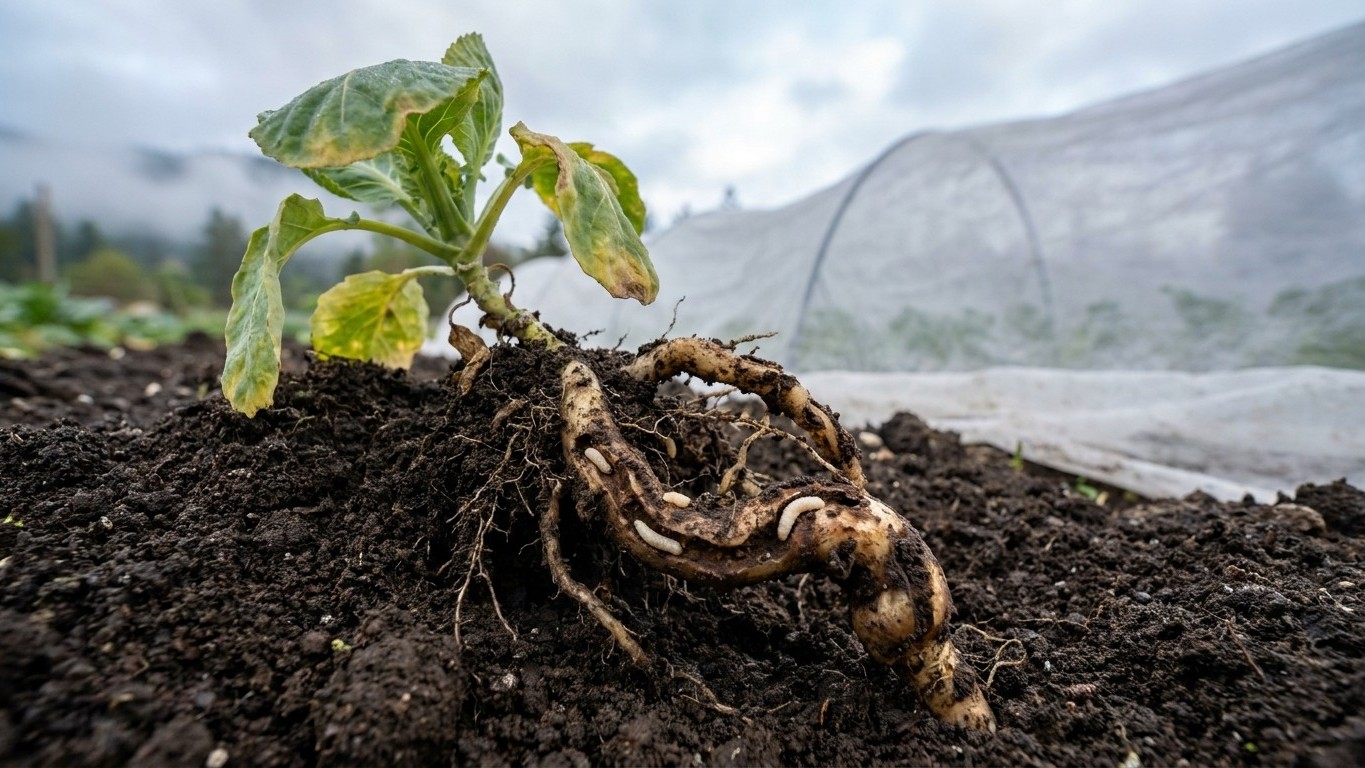

Pick the earliest-maturing, compact-vined sweet potato you can find, start from slips rather than seed, and give it soil warmed under black plastic or in a fabric pot. In Newfoundland and Labrador, earliness matters more than flavor, size or flesh color. This page has no provincial variety trial to crown a named winner, so it decides by type, using the season recorded at the St. John’s airport station.
The short answer for Newfoundland and Labrador
Choose early-maturing, short-vined types, and treat warmth as something you build rather than something the summer supplies. A slow, sprawling variety bred for a long Southern season is a bet against the calendar here. A quick, compact one at least gives the tubers a chance to bulk up before frost ends the season. For the wider picture of the crop in this province, see Growing Sweet Potatoes in Newfoundland and Labrador.
What the frost dates really say
At the St. John’s A station, Environment and Climate Change Canada’s 1981-2010 normals put the last spring frost on average on May 30 and the first fall frost on average on October 17. That leaves roughly 140 days between the two dates. It sounds workable until you remember what a mean date is. It is a midpoint, not a safe date. In about half of years the last spring frost lands after May 30, and a frost before October 17 is as likely as one after it.
Sweet potatoes also cannot go out on the frost date itself. Soil trails the air by weeks in spring, and a cold bed stalls slips that are already stressed from transplanting. The usable window is shorter than 140 days, and only an early type fits inside it.
The heat problem
The same station recorded 0.16 days a year above 30 °C across 1981-2010, and 0.0 days at 32 °C. That zero is measured, not missing: the daily series is complete, and thirty years never reached the threshold. Heat of that order does not occur at that station. It says nothing about the whole province, and it does not rule out warm-season crops. It does mean a July heat wave will not rescue a slow variety.
Type by type
| Type | Fit here | Reasoning |
|---|---|---|
| Early-maturing, compact or bush vine | Best bet | Finishes soonest and suits a mound, a fabric pot or a low tunnel |
| Standard full-season vining type | Gamble | Needs a long warm run, which only a sheltered, well-warmed spot might deliver |
| Late-maturing type sold for long hot summers | Skip | Runs out of season before the tubers size up |
When you shop, look for catalog wording such as “early” or “short-season.” I can’t point to a provincial trial that ranks named varieties, so any specific cultivar claim for this province would be a guess.
What will not work here
Anything that needs a long, hot season
The slowest sweet potatoes fail first. If slips go out in mid-June after the soil finally warms, and the mean first fall frost is October 17, a late variety has a few good months at most and then frost blackens the vines. Tubers left in cold soil afterward do not improve. You get a pile of finger-sized roots, which is a poor return on a bed you tended all summer.
Planting on the frost date fails too. May 30 is a midpoint, so half of years bring a frost later than that. Even in a frost-free year the soil is still cold. Gardeners in milder places can plant when the calendar says so. Here, the calendar is only a starting line for watching the soil.
Close spacing and a weekly watering habit
Summer is not dry. The St. John’s A normals for 1981-2010 show about 290 mm (11.4 inches) of rain across June, July and August, with July the driest month at 92 mm (3.61 inches). June runs 3.84 inches (about 98 mm) and August 3.94 inches (about 100 mm). Over the full year the station gets 1534 mm (60.4 inches). Dense vines packed close together hold damp air and stay wet long after a shower, which invites rot and mildew in leaf and stem.
A fixed weekly watering routine is the wrong habit for the same reason. Soil decides how that rain behaves. On clay, rain lingers for a week, and cold wet clay can rot roots. On sand it drains within the day, so a bed can dry out even in a wet summer. Watering should follow what your own soil feels like, not the calendar.
A few practical fixes follow from this:
- Plant on raised mounds or ridges so water drains away from the roots.
- Leave more room between plants than the seed packet minimum.
- Use black plastic over the bed to hold warmth and shed some rain.
These are normals for one airport station over 1981-2010, not a forecast. A slope, a river valley or the coast can shift the picture, and the US figures elsewhere on this site cover 1991-2020, so the two are not directly comparable.
What changes across Newfoundland and Labrador
One province, many gardens
Natural Resources Canada lists St. John’s at hardiness zone 6a, in the Canadian system, using 1991-2020 normals. That is the zone of one reference city, not of the province. This page holds no figures for other districts, so it cannot give a spread. What it can say is that there is no single answer for a province that runs from the island’s coastline up into Labrador, and that northern and upland districts run weeks behind St. John’s in both spring warmth and fall frost.
The Canadian zone is also not a USDA zone, and it does not convert into one. The Canadian system blends seven climate variables, and the USDA system relies on one. NRCan itself notes there are no simple conversions between them, and that Canadian zone 4a overlaps nine USDA zones, from 3a to 7a. Whenever a zone number appears, check which system it belongs to.
What to shift in the north or at altitude
For sweet potatoes, a hardiness zone matters less than it does for perennials. The crop is grown as an annual, so winter cold hardly matters. What counts is how early the soil warms and how late the frost holds off, and a zone number only blends those two together. A reader in a colder district should lean harder on everything above: the earliest type only, a later planting date once the ground has truly warmed, a low tunnel or plastic, and the warmest, most sheltered spot on the property. A container against a south-facing wall can outperform an open bed, because it warms faster and drains on its own.
To see where your own municipality falls, use the Natural Resources Canada plant hardiness map and look up your community directly rather than assuming. Then read the timing guidance in When to Plant Sweet Potatoes in Newfoundland and Labrador with your own district’s lag in mind.
Where to check this for your own county
The provincial address for farm and garden guidance is the Newfoundland and Labrador Department of Fisheries, Forestry and Agriculture. Start there and look for two things: a planting calendar written for your part of the province, and any variety trials run in your region. A trial from your own district tells you far more than a national seed catalog does. If the site has nothing on sweet potatoes specifically, look for material on warm-season or short-season vegetables, and ask whether anyone has tested them locally.
A county or district recommendation beats a provincial one, every time. This page is the provincial one. It works from one airport station, one set of 1981-2010 normals and one hardiness zone for one city. It cannot see your slope, your soil, your distance from the coast or the cold pocket at the bottom of your yard. Local frost dates, local trials and local advice should outrank anything here, including the dates above.
Neighbors matter too. A gardener two streets over who has grown a warm-season crop for a few years knows things no table records, such as which corner of a yard loses frost first and which one never warms up.
Checking this against your own garden
Your own observations outrank every date on this page, so here are three to watch.
First, soil warmth by feel. Push a bare hand several inches into the bed on a mild morning. If it feels cold and clammy, the slips will sulk, whatever the calendar says. Beds that pass this test early, often sandy and sunny ones, are your warmest microclimate. Beds that stay cold into June tell you to use plastic or a container instead.
Second, new leaf growth on the slips after transplanting. The first fresh true leaves mean the roots have taken hold and the plant is moving. If growth stalls for weeks, the spot is too cool, too wet or too windy, and that tells you where not to plant next year.
Third, the first blackened leaf on something tender nearby, such as squash or beans. Frost rarely arrives everywhere at once. Low corners go first and sheltered walls last. Note which plants get hit first and which are spared, and you have your frost map.
A straight-sided can set out in the bed works as a rain gauge. Check it after each shower and you will know whether your plot matches the station’s wet-summer pattern.
Common questions
Can sweet potatoes grow in Newfoundland and Labrador at all?
Only with help, and with modest expectations. The season at the St. John’s A station has a mean frost-free stretch of about 140 days, but almost no heat: 0.0 days a year at 32 °C. An early type, started as slips and grown under plastic or in a container, is a reasonable experiment. A good harvest is not guaranteed, and this page has no provincial trial to promise one.
Should I buy slips or start my own?
Slips are the standard way to start. Whether you buy them or sprout your own, time them so they are ready when the soil has warmed, not when the frost date passes. The planting calendar page covers timing in more detail.
Does hardiness zone 6a mean I can grow them?
No. Zone 6a is the Canadian system’s figure for St. John’s, and it does not convert to a USDA zone. It mostly reflects winter survival, which matters little for an annual crop. Season length and soil warmth decide the outcome.
How often should I water?
Less often than you might expect. The summer normal is about 290 mm (11.4 inches) across June to August, with July the driest month at 92 mm (3.61 inches). How long that water stays in your bed depends on the soil, clay holding it for days and sand letting it go within hours. Push a finger into the soil and let your own rain gauge be the judge. Those normals are from 1981-2010 at one station, and your yard may differ.