
Cut nothing for the first two seasons. Harvest starts in year 3, and the bed is not touched until then. Each season, stop cutting when most of the spears coming up are thinner than a pencil. Once cut, spears keep best at 32 to 35°F in near-saturated air, with the butts standing in water. The rest depends on the ground, the water and the planting date, all of which are covered below. The full picture is in Growing Asparagus in New York.
The short answer
A bed is a fifteen-year decision. Utah State University Extension puts the productive life of an asparagus planting at 10 to 15 years, and its only soil requirement is that the ground drains. Most soils will do, provided water does not sit. In a vegetable garden you can fix a heavy patch each spring. With asparagus you plant once, and the crowns stay put under that spot for a decade or more.
The soil USDA lists as representative of New York is the Honeoye series, and on paper it passes. It is an Alfisol, a forest soil of moderate fertility that holds nutrients reasonably well. The surface layer is a loam to silt: 26 percent sand, 19 percent clay and 55 percent silt, with about 3.0 percent organic matter. Surface pH comes out around 6.3, slightly acid, as a representative value for the series. It is classed as well drained. Those numbers are an average across 66 mapped components of the series, so they describe the soil that stands for the state, not the soil in your yard.
A silt-heavy loam with that much silt and only 19 percent clay tends to let water move through rather than hold it in a sheet. That is the quality an asparagus bed wants. If your garden sits on this kind of ground, the drainage question is probably settled in your favor.
New York has hundreds of soil series, though, and a lot of them look nothing like this one. River bottoms, hill country with a shallow pan, and any lot a builder has scraped, filled or driven equipment across can behave very differently. A new subdivision lawn often sits on subsoil that was pushed around and compacted. That ground can hold water like a bathtub, whatever the county soil map says.
Test it before you dig a single furrow. Dig a hole about a foot deep where the bed would go, fill it with water, let it drain, then fill it again. If water is still standing hours later on the second fill, that spot will not do. A county Cooperative Extension office can run a lab test for your own numbers, and that result is the one to trust over the state average. The published asparagus source says nothing about pH, so this page will not hand you a target.
If the spot fails, you have two honest options. Move the bed to the best-drained corner of the property, usually a slope or the high side of a flat yard. Or build the bed up above grade so the crowns sit over the wet layer. Do not plant and hope. Longer reading on this is in Will New York Soil Hold an Asparagus Bed for Fifteen Years?
Will the summer here water it for you?
Mostly, yes. The bed wants 1 to 2 inches of water every other week for the first two years, then every three weeks after that. The NOAA climate normals for the New York City reference station show about 13.7 inches of rain across June, July and August: 4.54 in June, 4.6 in July and 4.56 in August. Spread over a summer of roughly thirteen weeks, that is close to an inch a week on average, comfortably above the half-inch to inch a week the schedule works out to.
Averages hide the gaps, though. Rain in July often arrives as one thunderstorm that mostly runs off, and hot days at or above 90°F pull water back out of the ground fast. Here is how to turn the normals into a routine:
- Put a rain gauge on the plot. The normals come from one dense urban station and cover a past stretch of years. They are not a forecast, and a slope, a rain shadow or a city block changes the picture. A cheap gauge settles it.
- Count each two-week window. In the first two years, add up what the gauge caught. If it holds 1 inch or more, you are done. If it holds less, make up the difference with the hose, aiming for the 1 to 2 inch range.
- Soak, don’t sprinkle. A slow, deep watering lets the silt-and-loam ground take it in. A quick spray on a hot afternoon mostly evaporates.
- Check the ground, not just the calendar. Push a trowel in a few inches. On a well-drained soil like the Honeoye, the top can look dry within a day or two of rain while the layer below is fine.
- Stretch the interval after the second year. From then on the bed wants water every three weeks, so a normal summer will often cover it and a dry spell is when the hose comes out.
The heavier the soil, the longer a rain lasts. On a sandy spot the same inch is gone in a day, and that bed may need extra water in a dry stretch. The standard figures here assume the drainage that a loam to silt soil supplies. A gardener on clay has the opposite problem: rain stays, and the bigger risk is too much water, not too little.
The honest summary of the arithmetic is that in a typical New York City-area summer, you add little. In a dry month, you add whatever it takes to reach the 1 to 2 inches for that two-week window. Upstate and the Adirondacks are a different climate, and the station figures should not be read as theirs.
When to put the crowns in
Early spring. That is the guidance from Utah State University Extension, which has crowns planted in 8-inch furrows. For the New York City reference station, the last spring freeze at 32°F falls around March 23 to April 3, going by the NOAA 1991-2020 normals (the 30 to 70 percent probability band). A mean date is an average, so some years it freezes later and some years the ground is workable earlier. Central Park is also a dense urban site, and upstate New York and the Adirondacks frost later into spring, so those gardeners should shift the plan accordingly.
In practice that means the furrow gets dug as soon as the soil can be worked, which in much of the state is late March into April. A well-drained loam like the Honeoye is generally ready sooner than clay, which stays cold and sticky for weeks. Do not work wet ground. If a handful of soil smears instead of crumbling, wait.
Planting is not a single act of burial. The furrow is backfilled gradually through the year, 2 inches every other month, not all at once. Filling it in one go buries the new growth before it has anywhere to go. Backfill steadily instead, and the furrow gradually levels out as the plants establish.
The wait is the part that catches people. Nothing is harvested until year 3. Then the first cutting season runs 4 weeks, the next 6 weeks, and the one after that 8 weeks. There is no version of “take a few spears early.” Cutting from a bed that has not had its full two years takes energy from crowns that need it, and the planting is meant to produce for 10 to 15 years.
The seed route is the alternative to buying crowns. It starts the bed from a packet rather than a root. The sources behind this page do not publish a sowing date or a timeline for seed, so follow the packet, and check the same last-frost window above before you sow.
Four varieties are named in the Utah State University Extension source, and the only thing it says about them is their sex. Jersey Giant and Jersey Knight are all-male. UC 157 F1 and Purple Passion are male/female. No flavor, no yield and no reason to prefer one over another is published, so any claim you read elsewhere about which is best did not come from that source.
Common questions
How do I know when to stop cutting each season?
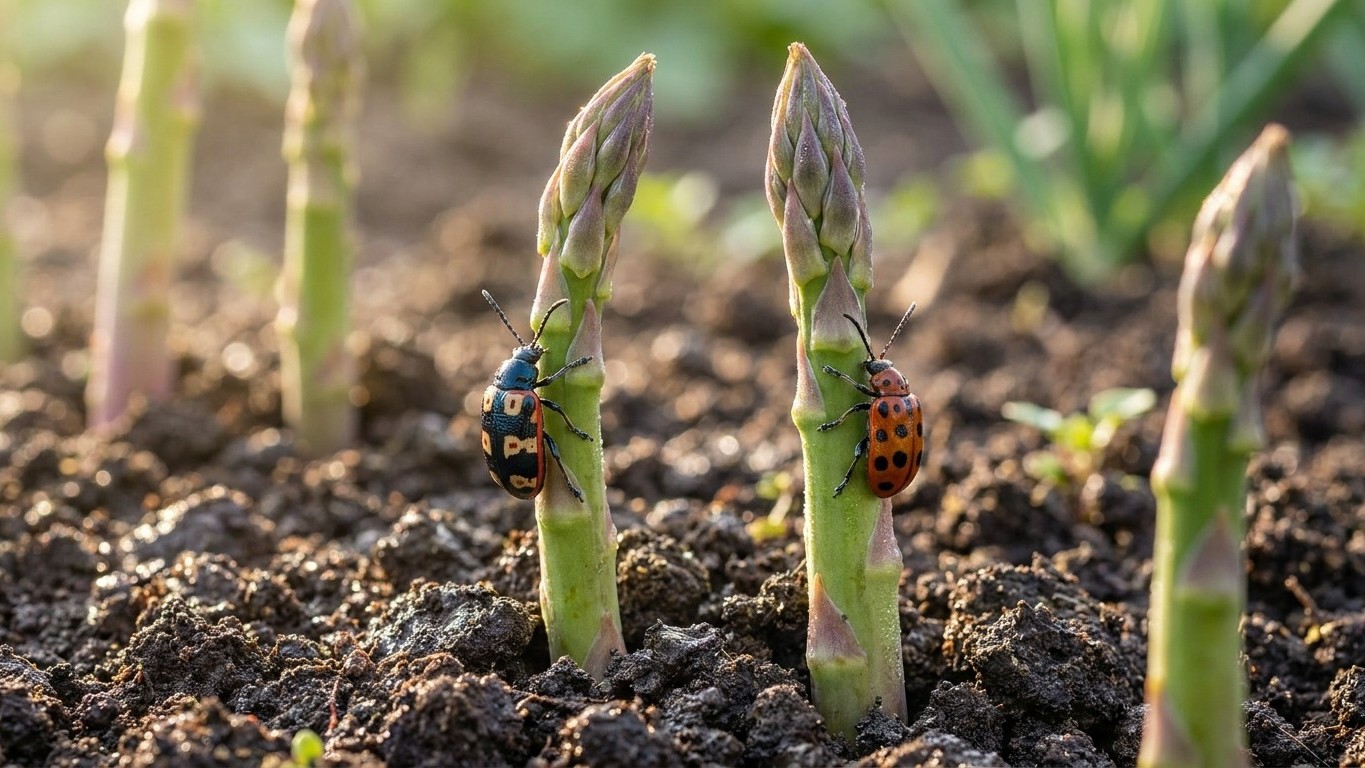
Stop when most of the spears coming up are thinner than a pencil. That is the rule, and it is a look at the bed, not a date on the calendar. Thin spears mean the crowns are running low, so leave them to grow into ferns and rebuild. If something is chewing the spears or the ferns, see What Eats Asparagus in New York, and When.
Can I cut a few spears in the first two years?
No. Harvest does not begin until year 3. After that the cutting window grows from 4 weeks to 6 and then to 8. Taking a spear early costs the crown energy it needs to last for a decade or more.
How do I keep cut spears fresh?
The target is 32 to 35°F with relative humidity of 95 to 100 percent, according to the UC Davis Postharvest Technology Center. Both edges of that window bite. Above 50°F the spears toughen within hours, and at about 31°F or lower they freeze, turn water-soaked and collapse when they thaw. Spears lose water fastest through the cut end, so in a home kitchen the practical fix is to stand the butts in an inch or so of water, or wrap them in a damp towel. A fridge thermometer will tell you whether your shelf sits in the window.
Does it matter which variety I plant?
The published source names four and lists only whether each is all-male or male/female. It gives nothing on taste or yield. Pick on availability and then spend your effort on drainage, because the spot matters more than the label on the crown.