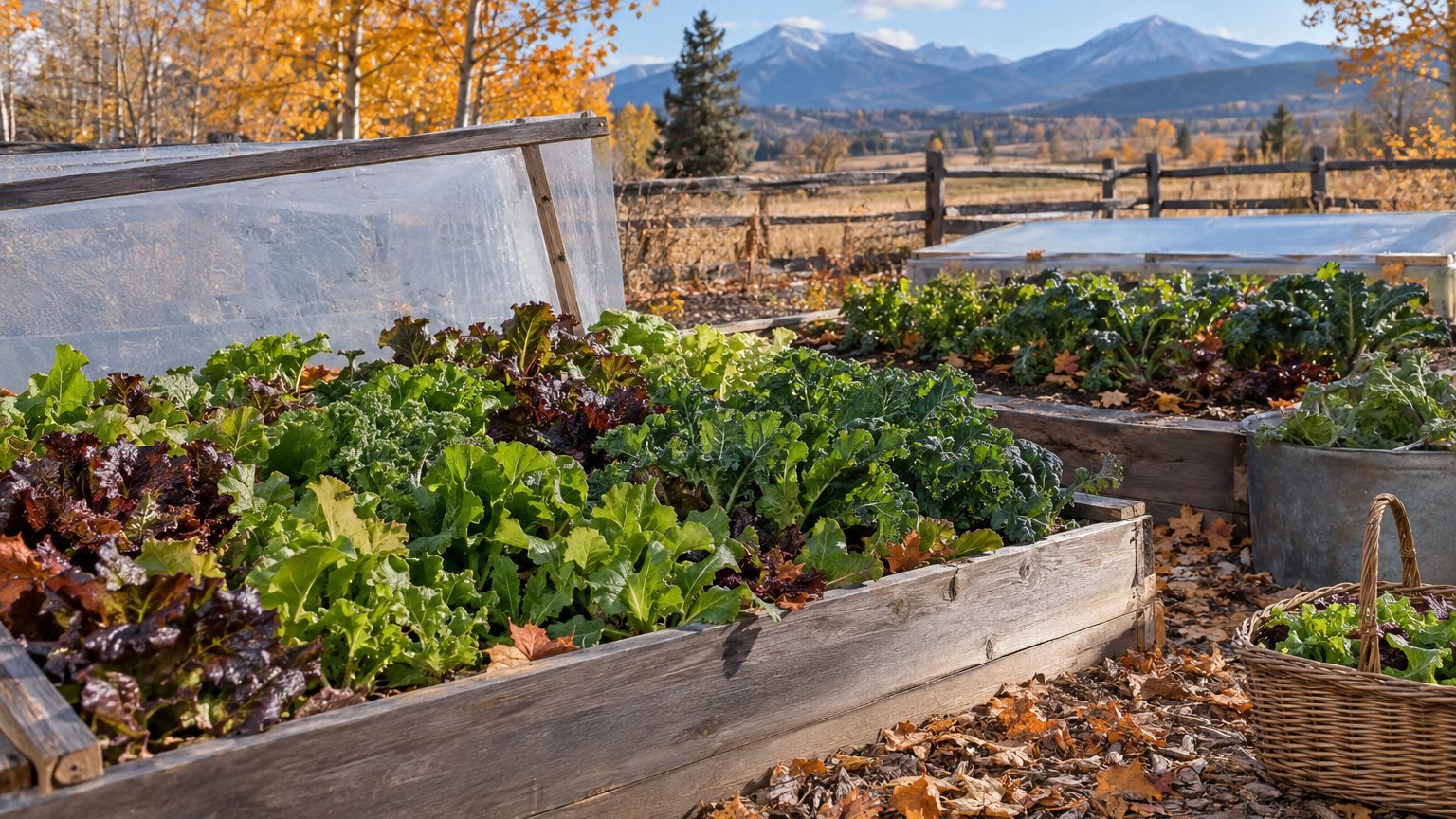

Nevada’s winter salads are decided by elevation. The month that leaves a Mojave Desert bed mild enough for open-air greens can freeze a Sierra-side or Great Basin bed hard. In the far south, hardy salad crops keep growing outdoors through most winters. Farther north and higher up, the same crops need a cold frame or row cover to stay cuttable. Before you buy a seed packet, find the first and last frost dates for your own garden, since a site ten miles and a thousand feet away can sit in a different season.
When the soil is warm enough in Nevada

What the frost date tells you
NOAA’s 1991-2020 climate normals for the Las Vegas airport station put the last spring freeze, in the 30 to 70 percent probability band, between January 7 and February 1. That is a chance, not a promise, so a 32 F night after that window is unlikely but not ruled out. Those dates come from one desert station and describe Las Vegas, not Nevada.
Do not carry them north. The airport sits inside the heat island of a large desert city, which makes it close to the mildest reference point in the state. Reno, Carson City and any garden at elevation see the last spring freeze months later and the first fall freeze months earlier. Your county extension office can give you the dates for your own address or the nearest reporting station, and those are the dates to plan around.
Why soil decides, not air
A frost date measures air temperature. Winter salads respond to the soil, and soil lags behind the air. Ground holds the winter’s chill long after the last freeze, so it warms enough for seed after frost risk ends, not at the same moment. Seed sown into cold, wet ground sits and rots, or comes up patchy and uneven. Treat the last frost date as the earliest you should start checking the soil, not as a sowing date.
In the Mojave, the problem runs the other way in fall. Soil that has baked all summer stays too warm for lettuce seed to germinate well, and the seedbed needs shade and a few cool nights before it cooperates. The principle is the same and the direction is reversed. The soil gives the go-ahead, not the calendar.
Check it directly. Push a soil thermometer to seed depth in mid-morning for several days running and compare the reading with the germination range printed on the seed packet. Believe the thermometer over the calendar. In a cool spring, a clear plastic tunnel or cold frame set over the bed for a week or so ahead of sowing warms the top few inches. Everything on this page is grown in beds, raised boxes and containers that you plant yourself. Pots warm faster than beds in spring and also heat faster in a desert fall, so they need the same thermometer test.
How long the season lasts here
Put the two Las Vegas figures side by side and the freeze-free stretch is long. NOAA’s 1991-2020 normals for the Las Vegas airport station give the last spring freeze as January 7 to February 1 and the first fall freeze as December 8 to December 23, both in the 30 to 70 percent probability band. Counting from the end of the spring range to the start of the fall range gives about 310 days. Counting from the start of the spring range to the end of the fall range gives about 350. The window therefore runs somewhere between ten and eleven and a half months, and both ends shift from year to year.
| Setting | Freeze-free window | What it allows |
|---|---|---|
| Las Vegas valley (NOAA airport station) | About 310 to 350 days by the arithmetic above | Several sowings across the cool months, direct seeding |
| Reno and Carson City area | Much shorter, get local dates from your county extension office | Fewer sowings, covers earn their place |
| High-elevation gardens | Shortest in the state | First sowing may be the only one, transplants gain weeks |
What a long window allows
A window that long is less generous than it looks. Most of it is summer, and lettuce and spinach cannot use summer. The useful part of it is the cool stretch, which is where the winter salads live. That still leaves room for a first sowing as the soil cools, a second a few weeks behind it, and a third to replace whatever bolts or tires. Direct seeding suits this setting. Nothing punishes a slow start, and you skip the root check that transplanting demands. The succession sowing guide on this site shows how to stagger the batches so cutting never stops.
What a short window changes
Where the window is short, the first sowing may be the only one. Miss it and the plants will not reach a size worth cutting before the winter light fails. That changes the transplant question. Starting seedlings indoors or buying young plants gains weeks, but only if the roots are sound. Slide one from its cell before you plant it. A tight white mat circling the plug means it was held too long, and it will sulk or bolt. Tease the roots loose or choose a younger plant.
A transplanted bed also depends on hardening off and spacing, steps that Winter Salads: What Grows When Lettuce Will Not walks through for the crop as a whole. If your garden sits high enough that winter looks like Wyoming’s, Winter Salads for Wyoming Gardens will give you more to borrow than any Las Vegas figure.
Heat and water in Nevada

What the heat does
This page does not print a count of days above 90 F or a summer rainfall total. A single station’s tally would mislead across a state that the USDA Plant Hardiness Zone Map 2023 spreads over zones 4a to 10a. The pattern is plain enough without one. Southern Nevada summers are long, very hot and dry, so nearly every drop a bed receives comes from your irrigation line. Northern valleys have hot days too, with cooler nights and a shorter season. Your county extension office can supply the numbers nearest you.
Heat matters for winter salads mainly at the start. Late-summer sowings must germinate in warm soil and survive hot afternoons. Shade cloth over the seedbed, a light mulch and a short daily watering until the seedlings are up do most of the work. When the weather cools, a drip line at the root serves better than overhead spray. Dry air also means the fungal problems that dominate humid places are a smaller worry here. Winter Salads for Tennessee Gardens deals with a wet climate where mildew and rot set the agenda, and Nevada seldom asks for that. Bolting, bitter leaves and stalled growth are the more likely troubles.
What the cold decides
After germination, the cold makes the decisions. NOAA’s 1991-2020 normals list the mean daily minimum of the coldest month at Las Vegas as 39.6 F. That is an average night, not a record low, and it means hardy greens in a Las Vegas bed rarely need protection on a typical winter night. It says nothing about Reno or the mountains. The USDA zone map, built on the average annual extreme minimum, gives the territory a range of 4a to 10a, and that gap sorts the crops:
- Stand uncovered in milder sites: spinach, kale, mâche (corn salad) and claytonia.
- Need a cover to stay edible: loose-leaf lettuce, endive and tender Asian greens, which brown or turn to mush after a hard freeze.
- Cannot manage: basil and other summer salad crops, and, in the coldest gardens, anything left in frozen ground with no structure over it.
The first fall frost then sets the last useful sowing. Growth slows sharply as days shorten. A plant that is still small when that happens sits until spring, while one near cutting size holds in the ground and can be picked leaf by leaf. Count back from your own first freeze date, not the Las Vegas one, and sow early enough that the plants are well leafed before the light fades.
Which winter salads suit Nevada
Choose by type, and let the cold and heat at your address decide. This page names no cultivar, and the reason is practical. A variety that thrives in a Las Vegas fall can fail in a Reno winter, and the only recommendation worth planting is one that has been grown where you live. This page does not have those local results, and guessing from a seed catalogue would be a bet with your season. Ask University of Nevada, Reno Extension, or your county office, which varieties have done well in your county.
| Type | Best suited to | Watch for |
|---|---|---|
| Spinach, kale, mâche, claytonia | Cold gardens, often without cover | Slow growth in the deepest cold |
| Loose-leaf lettuce | Mild sites, or cold sites with a cover | Freeze damage, bolting in warm spells |
| Mustards and arugula | Short windows, since they grow fast | Bolting when soil warms |
| Endive and radicchio | Fall sowings in milder sites | Bolting if sown too early in the season |
Reading the choice by climate
In the hot south, pick types that germinate reliably in warm soil and hold their leaves. Look for slow-bolting on the packet, and give the roots shade with mulch, with cloth overhead while the seedlings are small. Spread plants so air moves between them. In the cold north, favor the earliest and hardiest types, and sow as early as the soil allows so the plants reach size before the light shortens. A short season favors fast greens over slow heading types.
Humidity is not the first criterion in Nevada, unlike in a wet state, but it returns under cover. Row covers and frames trap moisture, so check the packet for mildew resistance if you plan to grow under plastic all winter. Vent a cold frame on sunny days, even in freezing weather, because a closed frame in winter sun can overheat and cook the leaves.
Common questions
Why won’t my lettuce seed sprout in late summer?
The soil is almost certainly too warm. Lettuce seed often refuses to germinate in hot ground, and desert beds stay hot long after the air cools a little. Shade the seedbed, water lightly every day, and sow in the evening. Some growers also chill the seed in the refrigerator for a day or two first, which can help it start.
Do containers work better than beds for winter salads?
Containers warm faster in spring and give you control, but they also freeze faster and dry out sooner. In the desert south, pots in full afternoon sun can overheat in early fall, so move them into shade until the weather cools. In cold areas, set them against a south-facing wall and cover them on hard nights.
Do I still have to water in winter?
Yes, when the soil is dry. Cold weather cuts the plants’ water use, but Nevada winters are dry, and roots in dry soil stop taking up nutrients and get stressed. Water in the morning so foliage dries before night, and check moisture with a finger before you add more.
Is a cold frame better than a row cover?
A cold frame gives more protection, and a row cover is cheaper, lighter and easier to shift. In the milder south, a row cover on the coldest nights is usually enough. In colder areas a frame carries lettuce further into winter. Whichever you choose, open it on sunny days so the plants do not overheat.