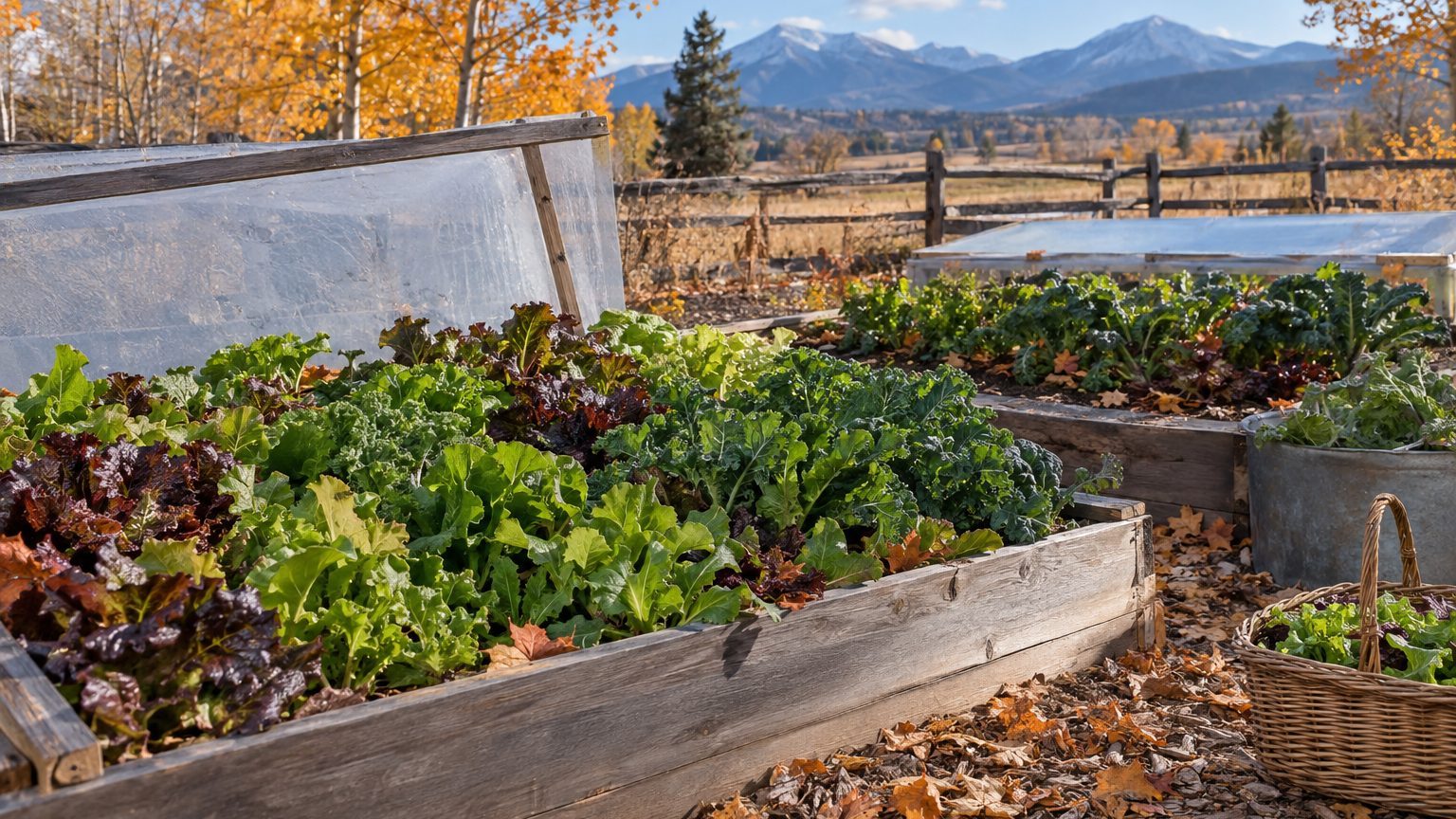

New Jersey winter salads are a late-summer job, not a winter one. The crop has to reach a useful size while the days are still long, then sit through the cold under cover or out in the open, depending on the type. Pull your seed packets now, find the days to maturity on each, and count backward from early November before you sow anything.
When the soil is warm enough in New Jersey

The frost date is a starting line
NOAA’s 1991-2020 climate normals for Newark put the last spring freeze at March 29 to April 6, using the band where a 32 F freeze still has a 30 to 70 percent chance of showing up. That is a probability, not a promise, and a cold night after the range is always possible. It is also a single airport station. Suburban and rural gardens in New Jersey typically see the last spring frost one to two weeks later, and hill country and the northwest see it later still, so check the dates for your own county before you plan around them.
Frost is only a proxy for what you actually care about. Winter salads wait for workable, warm-enough soil, and soil warms after the frost risk ends, not with it. A bed can be frost-free in early April and still be cold and sodden two inches down. Cool-season greens tolerate that better than tomatoes do, but a seed sitting in cold wet ground rots more often than it sprouts.
Two soil questions, not one
The spring question is about when to sow the early crop, and the answer is when the soil crumbles in your hand instead of smearing, and a soil thermometer reads within the germination range printed on the packet. Push the thermometer in at seed depth in the morning, when the reading is at its lowest.
The late-summer question runs the other way, and it matters more for winter salads. In the weeks when you would sow for a winter crop, New Jersey beds are often too warm rather than too cold. Lettuce seed in particular can refuse to germinate in hot soil. Sow in the evening, water the row before and after, and shade the bed with a board or a piece of row cover until the seedlings show. A shaded, moist seedbed can be several degrees cooler than the bare bed next to it.
Both questions get easier once you know the crop as a whole, which Winter Salads: What Grows When Lettuce Will Not lays out by type. What this page adds is the local clock. Note the frost range above, then run the soil check anyway.
For varieties, do not rely on a general list. Rutgers’ New Jersey Agricultural Experiment Station and the state’s cooperative extension trial and recommend what does well in New Jersey soils, and you should look there for named varieties before buying seed. You can start with Rutgers Cooperative Extension, where the county offices can also tell you how your own frost dates differ from the airport’s.
How long the season lasts here
NOAA’s same 1991-2020 normals for Newark put the first fall freeze at November 4 to November 16. Set that against the spring range and the arithmetic is simple. From April 6 to November 4 is 212 days. From March 29 to November 16 is 232 days. The frost-free window at the reference station is therefore roughly 212 to 232 days, a little over seven months, and your own garden’s window will be shorter by one to two weeks at each end if you are outside the urban core.
What seven months allows
That is a generous window for this crop, and it changes what you do with it.
- A spring sowing of the quick greens fits comfortably, well before summer heat.
- A second, late-summer sowing fits too, timed for the winter crop.
- Sowing direct beats transplanting for most of the roots-sensitive types, since the window is long enough not to need the head start.
In a place with a short season, the first sowing is often the only one, and gardeners transplant to gain weeks despite the root check. In New Jersey you have the room to sow direct, skip the check, and stagger small plantings instead. Succession sowing here means a short row every couple of weeks in late summer and early fall, so that one bad week of weather, or one flush of flea beetles, does not take the entire crop.
Counting back from the fall freeze
The fall freeze does not end the harvest for winter salads. It marks the point after which growth slows to a crawl and the plants live off what they have already built. The useful sowing date is therefore the one that lets a plant reach a cuttable size before the light fails. Find the days to maturity on the packet, remember that catalogue figures count from transplant or emergence depending on the seller and vary by a week or two with the weather, and count back from the freeze range: early November at the airport station, earlier for you if you garden inland or up in the hills. Then add a margin, because growth in October is slower than the packet assumes.
This page does not give a single sowing date, because the answer depends on the crop and on your county. What it gives is the method. Take the fall range, subtract the packet’s days, add two weeks for the slowing light, and you have a window rather than a day. If that window has already closed when you read this, the practical fallback is to sow the hardiest types anyway and cover them, accepting a smaller harvest that arrives in late winter and early spring.
Heat and water in New Jersey

The figures this page carries do not include a count of days above 90 F or a summer rainfall total, and it would be wrong to guess at them. NOAA publishes both for the Newark station and for stations nearer you, so look up the nearest one. What can be said without a number is what New Jersey summers do to a fall sowing. They are hot, humid and prone to sudden heavy downpours, and none of those help a seedling.
What humid heat does to a late-summer sowing
Hot soil holds back the germination of lettuce and some other greens. Humidity then favors damping off in the seedling stage and downy mildew on the young leaves. Heavy rain crusts the surface and splashes soil onto foliage. The fixes are unglamorous. Sow in a raised or well-drained bed, keep the rows thin enough for air to move, water in the morning so the leaves dry by evening, and lay a light mulch or shade cloth over the seedbed until the plants have two true leaves.
The cold decides the rest
Summer stress is a nuisance. The winter low is what sorts the crops. NOAA’s 1991-2020 normals put the coldest month’s mean daily minimum at Newark at 25.5 F. That is an average night in the coldest month, not the record low, and individual nights go well below it. The USDA Plant Hardiness Zone Map (2023 edition) puts New Jersey across zones 6a to 7b, so the state’s northwest and its coast are living in different winters.
That low sorts your beds three ways. The hardiest greens can stand uncovered through most winters. A second group survives only under a row cover, low tunnel or cold frame, and stays edible rather than frozen and limp. A third group, mostly the summer salad crops, cannot manage at all and should be finished before the first hard freeze. The first fall freeze, in turn, sets how late a sowing can still reach useful size.
Colder places lean harder on cover than New Jersey does. The comparison is worth a look in Winter Salads for Alberta Gardens, where the same crops need far more protection to stay usable.
Which winter salads suit New Jersey
The choice is by type. A humid state makes disease resistance the first criterion, so favor types that grow low and quick with open leaves, and give each row airflow. A long season makes the earliest types unnecessary, so you can choose for hardiness over speed. A hot late summer means the types that germinate in cooler soil go in last, once the beds have cooled.
By how they handle the cold
| Type | Uncovered | Under cover | Notes |
|---|---|---|---|
| Mâche (corn salad) | Usually fine | Cleaner leaves | Slow to start, low-growing |
| Spinach | Usually fine | Bigger leaves | Sow before the light fails |
| Claytonia | Usually fine | Cleaner leaves | Tolerates shade |
| Kale and collards | Usually fine | Optional | Cut young for salad |
| Arugula and mustard greens | Marginal | Recommended | Fast, but frost-burned in hard cold |
| Leaf lettuce | Marginal | Needed | Best in a cold frame |
| Basil and other summer herbs | No | No | Finish before frost |
The table is a general guide to the type, not a promise for your bed. A sheltered south-facing wall in the city will behave differently from an open field in Sussex County.
Why this page names no varieties
Within each type, cultivars differ in cold tolerance, mildew resistance and bolting habits, and those differences are what count. The varieties that hold up in New Jersey trials are the ones Rutgers Cooperative Extension and its county offices know about, and this page does not have those trial results. Naming a variety here would mean guessing, and a gardener who buys a guess in September finds out in February. Ask your county office, then read the packet for disease-resistance codes and days to maturity.
If you garden close to the state line, Winter Salads for New York Gardens covers the same crops for that side of the border, and the two pages together give you a range to test against.
Grow all of this in beds, raised boxes or containers, where you control the soil, the water and the cover. Keep the harvest in the garden you built, and keep the extension office’s number handy for the questions this page cannot answer.
Common questions
Can I grow winter salads in containers in New Jersey?
Yes, and containers suit the smaller, hardier types well. The catch is that pots freeze through faster than ground soil, so plan on a cover or a sheltered spot against a wall, and choose deep containers with drainage that will not hold water in a thaw.
Will spinach survive a New Jersey winter without a cover?
Usually, in most winters, but not in every one. NOAA’s Newark normals give an average coldest-month night of 25.5 F, and real nights go lower, so leaves may brown in a hard snap. The plants often regrow in late winter. A row cover costs little and keeps the leaves cleaner.
When do I take the cover off in spring?
Vent it on mild days first, then remove it once the last-frost range for your county has passed and nights are settling. At the Newark station that range is March 29 to April 6, but inland gardens run one to two weeks later. Keep the cover close by for a late cold snap.
Why did my late-summer lettuce seed not come up?
Hot soil is the usual cause. Lettuce seed can go dormant when the bed is too warm. Water the row, shade it until the seedlings appear, and sow in the evening. If nothing shows after the packet’s stated germination period, resow with fresh seed from a cooler spot.