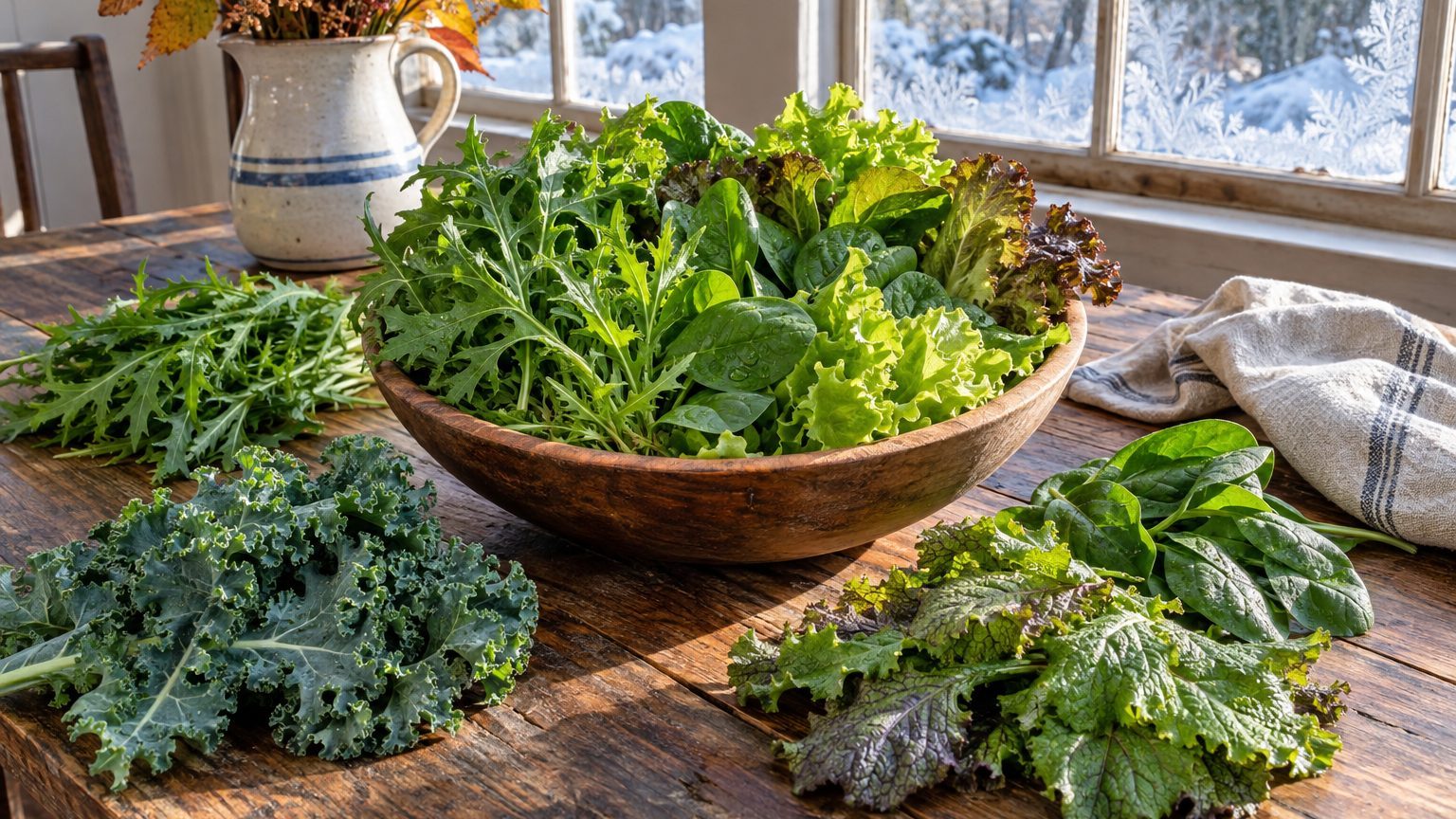

For an Alberta winter salad bed, choose by type rather than by seed-packet name. Spinach, mâche, claytonia and kale suit the cold end, fast baby-leaf mustards and lettuces suit the early fall flush, and anything that needs a long, slow run to size up stays out. Calgary’s average frost-free stretch is only about 118 days, and its coldest month has a mean daily minimum of -13.2 °C (8.2 °F, for readers comparing with US gardens).
The short answer for Alberta
The reference station is Calgary Int’l A, and its Canadian Climate Normals (1981-2010) put the last spring frost on average on May 21 and the first fall frost on average on September 16. Count the days between and you get about 118. Both are mean dates, the midpoint of a spread. In one year out of two, spring frost arrives after May 21, and in roughly half of years fall frost shows up before September 16. A seed sown on August 1 has about 46 days to reach that average fall date, and leaf growth slows well before it.
The decision, by type
That shortage of days sorts the options better than any variety list. Fast crops and very hardy crops are the two groups that fit the window.
| Type | Cold tolerance | Speed | Role in Alberta |
|---|---|---|---|
| Spinach | High | Moderate to fast | Backbone of late-summer sowings, can stand under cover into winter |
| Mâche (corn salad) | Very high | Slow to start, small rosettes | Best candidate for picking in deep cold under cover |
| Claytonia | Very high | Moderate | Tolerates cold and low light, good for protected beds |
| Kale and hardy brassica greens (baby leaf) | High | Fast as baby leaf | Frost-sweetened leaves, long harvest window |
| Mustards and mizuna | Moderate to high | Fast | Early fall flush, then protect or finish |
| Arugula | Moderate | Very fast | First sowing of the fall |
| Loose-leaf lettuce | Low to moderate | Fast | Early sowings, or inside a cold frame or tunnel |
| Heading chicories and head lettuce | Moderate | Slow | Usually out of time here |
This page has no verified Alberta variety trial results, so it names types, not cultivars. Within a type, the cultivar that wins is a local question, and the extension section below explains where to look. For the wider picture of how winter salads work in the province, see Winter Salads for Alberta Gardens.
What will not work here
Slow heading types lose first. Head lettuce, endive and most heading chicories want a long, steady run of growth. Sown in midsummer, they meet cold, short days long before they finish, and you end up with small, loose plants that never fill out.
Bare, open-bed lettuce comes next. With the coldest month averaging a nightly low of -13.2 °C, and individual nights running well below that average, soft leaves do not come through. Even the hardy types survive better than they grow. A common rule of thumb says growth nearly stalls once daylight drops below about 10 hours, which in Calgary’s latitude means roughly November into early February. Whatever you plant has to be close to harvest size before then, because after that you are picking from a standing crop, not growing new leaves.
Thin protection also falls short. A single layer of row cover is a tool for the frost season, not for January. It can stretch October and part of November, but across a month with a mean minimum of -13.2 °C you want a cold frame, a low tunnel with a second layer, or an unheated greenhouse.
Calendars borrowed from elsewhere fail too, and so does reading May 21 as a safe date. It is the midpoint of the spring frost window. Half of years still see frost after it, which matters for any early-sown crop you hope to follow with fall salads. The same goes for September 16 at the other end. If your first fall sowing assumes the average date, it will be caught out in about one fall out of two.
One thing this page cannot judge is summer heat and rainfall, because it has no verified figures for either. What can be said is that late-summer seed needs consistent surface moisture to germinate, so a bed watered once a week is a poor bet, whatever the summer turns out to be. The timing of that sowing is covered in When to Sow Winter Salads in Alberta.
What changes across Alberta
Everything above rests on one station, and Alberta is not one garden. The frost dates come from Calgary Int’l A, and the hardiness zone for the reference city is 4a in the Canadian system. That is not a USDA zone. Natural Resources Canada says the two systems have no simple conversion: the Canadian one uses seven climate variables, the USDA one uses one, and Canadian 4a overlaps nine USDA zones, from 3a to 7a. Carrying “4a” over to a US seed catalog will mislead you.
The province spans many zones, so there is no single answer. This page holds the reference-city value only, not the full spread, and the zone figures use 1991-2020 normals while the frost dates use 1981-2010. Read them as two separate pictures of the same place.
Northern districts and upland or foothill sites run weeks behind Calgary. With only about 46 days between an August 1 sowing and the average first fall frost in the reference city, a week or two of difference changes the plan. Readers in those places should sow earlier, lean on the fastest and hardiest types (spinach, mâche, claytonia, baby kale), drop the lettuces unless they have a tunnel, and treat protection as the default rather than the backup. Cold air also pools in low spots, so a hollow can behave like a district further north.
If you are in a milder pocket than Calgary, you gain days, not a different list. To find your own zone, use Natural Resources Canada’s Plant Hardiness Site and look up your municipality there, because this page cannot tell you which zone you are in.
Where to check this for your own county
Your provincial extension source is Alberta Agriculture and Irrigation. When you get there, look for two things: a planting calendar written for your area, and any vegetable varieties that have been trialled in your county or nearest region. A calendar tied to your frost dates is worth more than any date on this page, and a variety that has been grown through a local winter is worth more than one that merely sells well.
This page does not cite an Alberta winter-salad calendar, because it has not verified one. It would be wrong to substitute a calendar written for another climate, or for a different crop, and call it local advice.
A county recommendation beats a provincial one, and this page is the provincial one. It gives you a sensible starting shape: which types, how tight the window is, what protection to expect. It does not know your elevation, your slope or your nearest weather station. When your county source and this page disagree, go with the county. And if you want to compare the frost dates here with your own district, ask for the normals from the nearest station and check which years they cover.
Checking this against your own garden
Your own observations outrank every date above, and three of them cost nothing.
Soil warmth by feel. Press your hand flat into the bed, about 2 inches down, in the middle of the day in August. If it feels hot, lettuce and spinach seed will struggle to sprout, so shade the bed or water lightly until seedlings appear. In October, soil that still feels mild in the morning means growth has not stalled yet. Soil that is cold and stiff means it has.
The first flush of male flowers. If you grow zucchini or squash, the day the first male blooms open is a rough marker of how warm your site has run. Note it each year. If yours consistently opens earlier or later than a neighbor’s, your sowing windows should shift the same way.
The first true leaves. On a late-summer sowing, count the days from seed to the first true leaves (the second pair, after the seed leaves). That count is your growth speed. If it stretches longer as the weeks pass, you are approaching the stall, and it is time to put covers on.
Common questions
What is the hardiest winter salad green for Alberta?
Mâche and claytonia are generally the toughest salad types, followed by spinach and kale. This page has no Alberta head-to-head trial, so check county trials for specific cultivars.
Can I grow salads outdoors all winter without cover?
Not reliably. The coldest month’s mean daily minimum is -13.2 °C at the reference station, and hardy greens may survive but will not grow. A cold frame, tunnel or unheated greenhouse changes the odds a great deal.
Is May 21 a safe planting date?
No. It is the average last spring frost at Calgary Int’l A, so in one year out of two frost comes later. Treat it as the midpoint of a window, and expect northern or upland districts to run weeks behind.
Is Alberta zone 4a?
4a is the Canadian hardiness zone for the reference city, not for the province, and it does not convert to a USDA zone. Natural Resources Canada notes it overlaps nine USDA zones, from 3a to 7a, so look up your own municipality on its map.