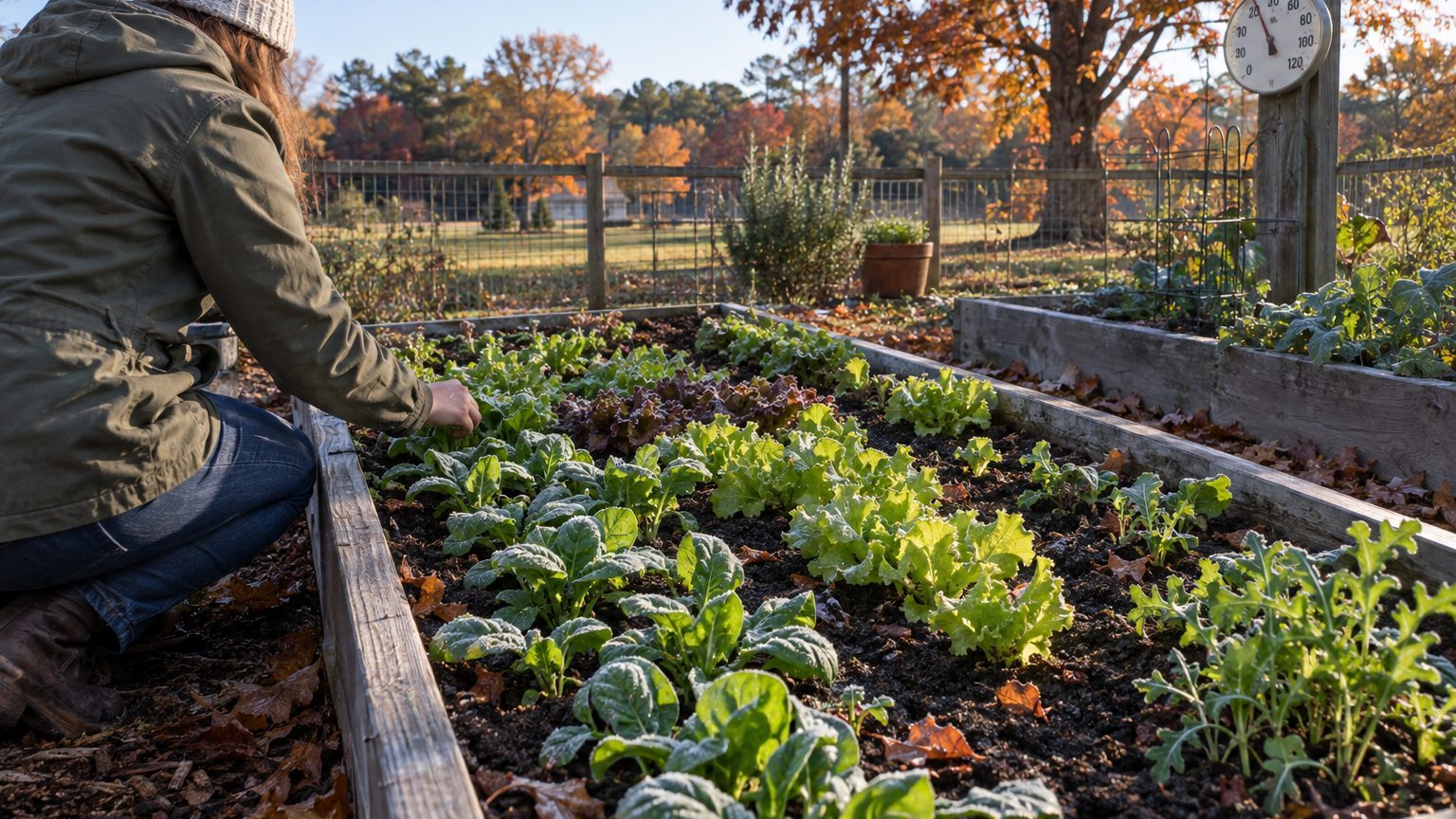

Sow winter salads in Alberta from early July to early August, counting back from a mean first fall frost of September 16. That date comes from the Calgary airport station, and the July-to-August window is my own arithmetic from it, not a published figure. Spring is the wrong season for these crops. Because the frost date is a midpoint, frost arrives earlier in about half of all years.
The short answer for Alberta
Environment and Climate Change Canada puts the average last spring frost at May 21 and the average first fall frost at September 16, both from the Calgary Int’l A station (climate ID 3031093) and the 1981-2010 normals. The frost-free stretch between them is roughly four months. Winter salads need to be nearly full-sized before that second date arrives, because growth slows to a crawl as the light fades in the fall.
Both dates are probabilities, and a mean is a midpoint, not a safe date. September 16 is the day by which frost has arrived in about half of years and has not yet arrived in the other half. May 21 works the same way: in one spring out of two, frost falls later. If you treat either one as a guarantee, you are betting on a coin flip.
So the practical method is to work backward. Take the days to maturity printed on the seed packet, add a buffer of about two weeks for slowing growth (a rule of thumb of mine, not a measured value), and subtract the total from September 16.
| Days to maturity on the packet | Buffer added | Latest sensible sowing date |
|---|---|---|
| 30 days | 14 days | About August 3 |
| 45 days | 14 days | About July 19 |
| 60 days | 14 days | About July 4 |
The packet figures in the table are examples, not products. Read the number on your own packet. And since half of years bring frost before September 16, a gardener who wants a margin for those years should sow at the early end of each row.
One more point on the calendar: nothing in this window happens in May. The May 21 date matters only as the start of the garden year. It tells you when beds are workable, not when to sow a crop meant for winter.
What will not work here
Sowing in spring for winter eating fails, and it is the most common mistake. Lettuce and arugula sown in May hit the long days of June and July and run to seed long before the cold arrives. By September you would be pulling bitter, bolted plants.
Sowing too late fails just as reliably. With only about four months between the mean frosts, a 60-day crop sown in mid-August has no chance of reaching harvest size. It will sit as a seedling through September and stay one. The slowest winter salads are the first casualty of a short season, which is why the best winter salads for Alberta lean toward quick, cold-tolerant types.
Treating September 16 as a deadline also fails. If your packet says 45 days and you sow on September 1, you have a plan that works only in the half of years when frost runs late.
Then there is the cold itself. The mean daily minimum of the coldest month at the Calgary reference station is -13.2 °C (8.2 °F). That is an average of the nightly lows, so plenty of nights run colder. Tender salad leaves left bare in a bed will not hold through that. Anything you want to eat in midwinter needs a cold frame, a low tunnel or similar cover, and even then you should expect slow growth and harvest what you can.
The last trap is borrowed advice. Plenty of winter-gardening guides are written around US hardiness zones and 1991-2020 frost normals. The Canadian figures here use 1981-2010 normals, and the two zone systems do not translate. A calendar that says to sow “in your zone” by a US number will put you off by weeks, in either direction.
What changes across Alberta
The reference city for this page, Calgary, sits in Canadian hardiness zone 4a, per Natural Resources Canada’s 1991-2020 data. That is the Canadian system, built on seven climate variables, and it does not convert to a USDA zone. NRCan itself notes that Canadian 4a overlaps nine different USDA zones, from 3a to 7a. The number describes one city, not a province.
Alberta runs from southern prairie to boreal forest, and from open plains to foothills and mountain valleys. This page does not have a zone-by-zone spread for the province, so there is no single answer to give. What the evidence does support is that northern and upland districts run weeks behind Calgary in spring, and they reach frost earlier in the fall. A shorter season squeezes the sowing window from both ends.
If you garden north of Calgary or at elevation, shift your plan in three ways:
- Subtract a larger buffer than two weeks, and sow earlier than the table suggests.
- Choose the quickest crops on the packet, since slow ones run out of time sooner.
- Have covers ready before the first hard frost, not after.
To find your own zone, use the Canada’s Plant Hardiness Site map by municipality from NRCan. It lists zones by place, so look up your town yourself rather than guessing from a neighbor’s advice or from where a nursery says it ships. For a wider look at the crops themselves, see Winter Salads for Alberta Gardens.
Where to check this for your own county
Start with Alberta Agriculture and Irrigation, the provincial agriculture department. Look there for a local planting calendar for your area, and for any list of varieties that have been trialled in your county or region. A trial matters more than a catalog description, because it tells you what actually survived and cropped nearby.
If the site does not publish what you need for your district, that is useful information too. Call or write and ask which frost dates and trial results they use for your area. Local agricultural staff, and in many districts garden clubs, often hold records that never reach a province-wide page.
A county recommendation beats a provincial one, and this page is the provincial one, built on a single station. It gives you a method and a reasonable starting window. If your county’s published dates disagree with the table above, trust the county, and use the backward-counting method with its numbers.
Checking this against your own garden
Your own bed outranks every date on this page. Three observations will tell you more about your microclimate than any average.
Soil warmth by feel. In late July and August, push your hand into the bed in the morning and again in mid-afternoon. Soil that feels hot to the touch is too warm for lettuce seed to germinate well. Shade the row with a board or cloth until it cools. A bed that stays cool all day lets you sow earlier.
First true leaves. The first pair of leaves after the seed leaves tells you how fast the crop is really growing. Note how many days it takes after sowing. If your seedlings reach that stage sooner than the packet implies, your site is warm and sheltered. If they lag, shrink the plan and sow earlier next year.
First frost damage on tender plants. Watch the squash, basil or any other frost-tender plants you have. The night they blacken is your real first frost. Write the date down. After a few seasons you will have a record that beats the September 16 average for your own yard.
Common questions
Is September 16 the last day I can sow?
No. It is the mean first fall frost at the Calgary station, and plants need weeks of growth before it. The latest sowing date for most crops falls in July or early August, depending on days to maturity.
Can I sow winter salads in May?
Not for winter harvest. May 21 is the mean last spring frost, and crops sown then mature in summer and tend to bolt in the long days. Spring salads follow a different calendar from the one on this page.
Does Canadian zone 4a equal USDA zone 4?
No. The two systems use different variables, and NRCan says there are no simple conversions. Canadian 4a overlaps nine USDA zones, from 3a to 7a.
Do these dates apply outside Calgary?
Only loosely. They come from the Calgary Int’l A station, and the 1981-2010 normals. Northern and upland districts reach frost sooner in the fall, so check your local conditions before committing to a date.