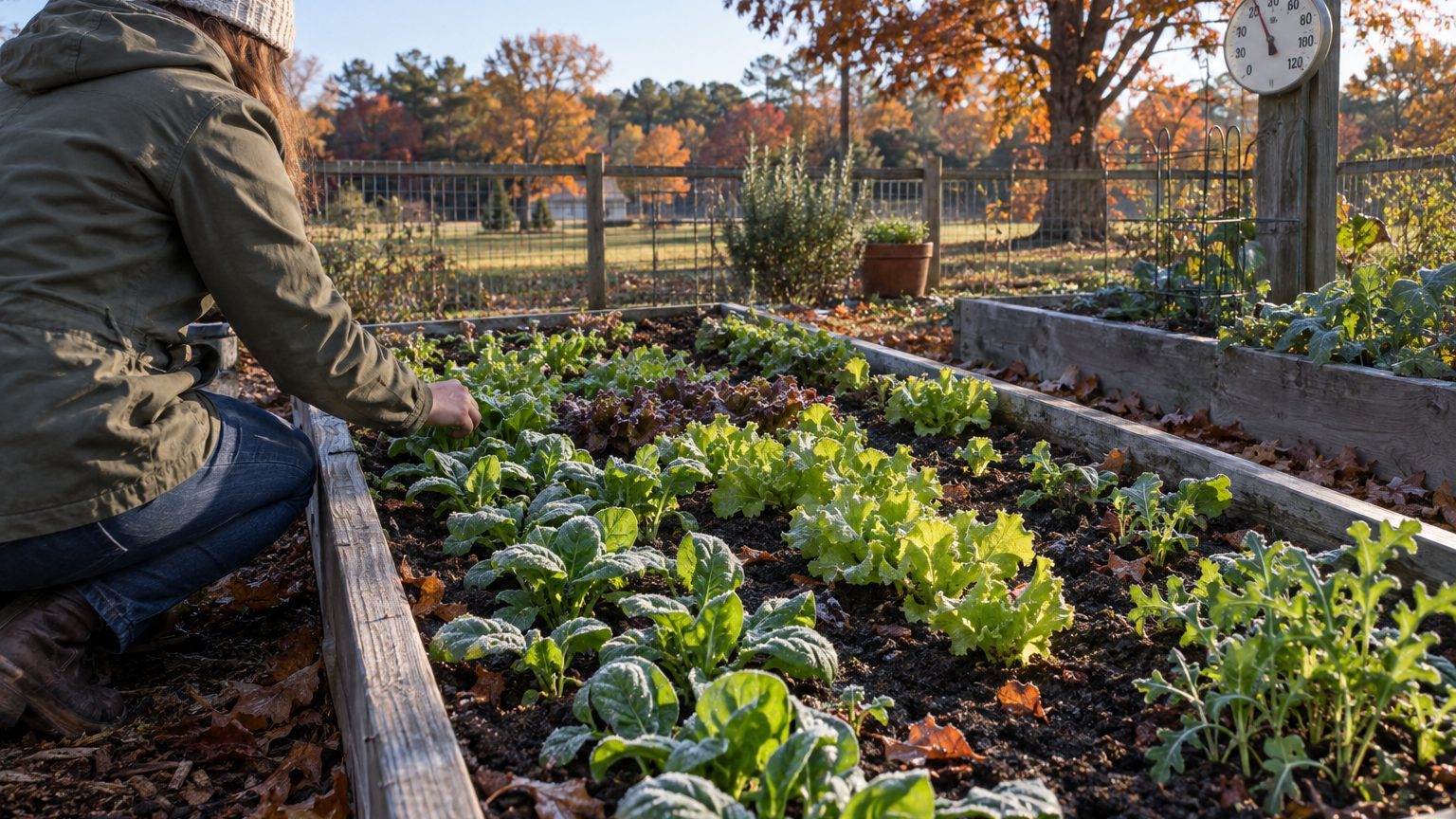

Sow winter salads in California when summer heat breaks, not when a frost date tells you to. Along the coast and across the south there is no frost date to count from, so cooler soil and shorter days are the signal. In the Central Valley, northern California and the Sierra, freezes are real, and the calendar works the way it does in most of the country.
The short answer for California
For coastal and southern gardens, start sowing once the heat eases and keep going through the cool months, because no freeze closes the window. For the Central Valley, northern California and the Sierra, sow in the weeks before your first fall freeze. This page does not have a first-freeze date for those regions, so it won’t invent one.
The frost data we do have comes from NOAA’s 1991-2020 Climate Normals, with Los Angeles as the reference station. In an average year there, no freeze occurs. NOAA’s daily records show zero days at or below 32°F in 30 years, and the frost-free season is listed as 365 days. A frost date is a probability statement about reaching 32°F or colder, not a guarantee. Where that probability is effectively nil, there is no date to print, and anyone who hands you one for a coastal garden is guessing.
The cold side tells the same story. The mean daily minimum of the coldest month at that station is 49.1°F. That is an average of overnight lows, not a record low, and it sits about 17 degrees above freezing. Lettuce and other leafy greens don’t need coddling at those temperatures. They need patience at the other end of the season, when the soil is still warm.
So the front edge of your window is set by heat, and the back edge is set by lengthening days and warming weather in spring, when salad plants bolt. Gardeners elsewhere plan around the cold. Here you plan around the end of summer. If you want the full picture of what grows through the season, Winter Salads for California Gardens covers it.
As of early October, the window is opening for many coastal and southern beds and is already underway for some. Inland and northern gardeners are closer to the clock, since a freeze can arrive on its own schedule.
What will not work here
Counting back from a last-frost date fails first. Seed packets and Midwestern or Northeastern calendars assume a frost that, in coastal and southern California, never comes. In a state where the reference station recorded zero freezing days in 30 years, “six weeks before last frost” has no starting point.
Sowing during a hot spell in early fall is the next trap. Warm days in September and October tempt people to plant because the calendar says fall. But seed sown into hot soil germinates unevenly, and the seedlings that do come up stall. Lettuce is the usual casualty. Waiting a week or two for the soil to cool costs you almost nothing and saves the seed packet.
Watering on a weekly schedule also fails. Salad greens have shallow roots, and a seedbed in a dry California fall can go from damp to crusted in a day or two. A deep soak once a week leaves seedlings stressed between waterings. Heat, drought and water restrictions are the real constraints here, not frost. The workable answer is small beds, mulch, drip lines or a hand-watering routine that fits your local rules, plus staggered sowings so one bad week doesn’t take everything.
Waiting for a freeze to sweeten the crop is another dead end in frost-free areas. Some greens taste sweeter after a cold snap, and in coastal and southern gardens that snap does not arrive. Choose varieties for how they behave in mild, long seasons and mild nights. The Best Winter Salads for California sorts that out by type.
The opposite mistake happens in the cold parts of the state. A bed in the Sierra or a hard-freezing northern valley that is sown outdoors with no protection will not carry salad through winter. The hardiness zone range for the state runs down to 5a, and plants that shrug off 49.1°F nights will not shrug off a deep freeze. Row cover, a cold frame or a sheltered south-facing spot is the minimum there.
Last, sowing late and hoping for the best. Because winter is mild on the coast, people assume the window never shuts. It does shut. Warming spring weather pushes salad plants to flower and turn bitter, so a late sowing gets a short harvest.
What changes across California
California has no single answer, and the numbers show why. The USDA Plant Hardiness Zone Map (2023 edition, based on 1991-2020 data) puts the state at 5a-11a. That is six full zones from the coldest corners to the mildest. The system is built on one variable, the average annual extreme minimum temperature, so it tells you about cold survival and nothing about summer heat or water.
That is why this page cites a reference city, Los Angeles, for its dated advice instead of the range. Other parts of the state differ, sometimes sharply. Elevation matters as much as latitude: zone numbers drop as you climb.
| Area | Freeze status | What to shift |
|---|---|---|
| Coastal and southern California | Frost-free in an average year | Sow when heat breaks; plan around water limits and spring bolting |
| Central Valley | Freezes occur | Sow early enough for plants to size up before the first freeze; keep cover handy |
| Northern California | Freezes occur | Treat the first fall freeze as your deadline and use protection in cold snaps |
| Sierra and higher elevations | Freezes occur | Shorter outdoor window; lean on cold frames or sheltered beds |
Nobody can tell you from here which zone your yard falls in. Look up your ZIP code on the USDA Plant Hardiness Zone Map and read the result for yourself. Then remember that the zone gives you the cold floor only. A garden at the cold end needs to think about freezing nights, and a garden at the warm end needs to think about the heat it has to outlast before sowing.
Where to check this for your own county
Your state extension service is the best next stop. In California that is University of California Agriculture and Natural Resources, which runs the extension network through county offices. A county page will know things a state page cannot: when local soil actually cools, which valleys catch cold air, and which fall rains matter.
Look for two things. The first is a local planting calendar for cool-season vegetables, ideally one written for your county rather than a statewide table. The second is a list of varieties that have been trialled in your county, meaning grown there and judged on heat tolerance, bolting and disease. A variety that thrives in a foggy coastal county can sulk in a hot inland one, and trial notes will say so.
If the county material gives frost dates, read them with the same question this page asked: a probability of what? A date tied to 32°F is a chance of a freeze, not a promise of one. A county that lists no freeze date is telling you the same thing the Los Angeles record does.
A county recommendation beats a state one, plainly. This page is the state one. It can tell you that coastal and southern California is frost-free, that the north, the Central Valley and the Sierra freeze, and that the hardiness range is wide. It cannot know your canyon, your fog bank or your well. When the two disagree, go with the county.
Checking this against your own garden
Your own observations outrank every date here, and three are worth watching. None needs equipment.
Soil warmth by feel. In mid-morning, push your fingers a couple of inches into the bed. If the soil feels warm, almost like a handled mug, hold off on lettuce seed. If it feels cool and damp, sow. Compare a sunny bed against a shaded one and you’ll see how far your microclimates differ.
First true leaves. The first pair that appears after germination are seed leaves. The next set, the true leaves, show how well the seedling is doing. If they come quickly, the spot suits the crop. If they are slow and pale, the bed is probably too cool, too shaded or too dry for that sowing, and you can adjust the next one.
The first flush of male flowers. On summer squash or cucumbers in spring, male flowers tend to open before female ones, and their arrival means the garden has warmed. Note the date. It tells you when your salad season is about to end, and an earlier date in a sheltered bed than in an open one shows how much warmer that corner runs.
Write all three down for a season or two. A notebook with a few dates will soon be more accurate than any state calendar.
Common questions
Can I still sow winter salads in October?
In many coastal and southern gardens, yes, as long as the soil has cooled enough to feel cool to the touch. In the Central Valley, northern California and the Sierra, sow soon and have protection ready, since freezes do occur there.
Do I need frost protection?
Not in coastal and southern California on average. At the Los Angeles reference station, no freeze occurs in an average year and the coldest month’s mean daily minimum is 49.1°F. In the north, the Central Valley and the Sierra, keep row cover on hand.
What is California’s last frost date?
The state has no single one. The Los Angeles reference record shows no freeze in an average year, while other regions freeze. The USDA hardiness range of 5a-11a shows how much the state varies.
Where do I find a calendar for my county?
Start at University of California Agriculture and Natural Resources and look for your county’s office, its cool-season planting calendar and its variety trials. A hot inland county and a foggy coastal one can give different advice for the same crop.