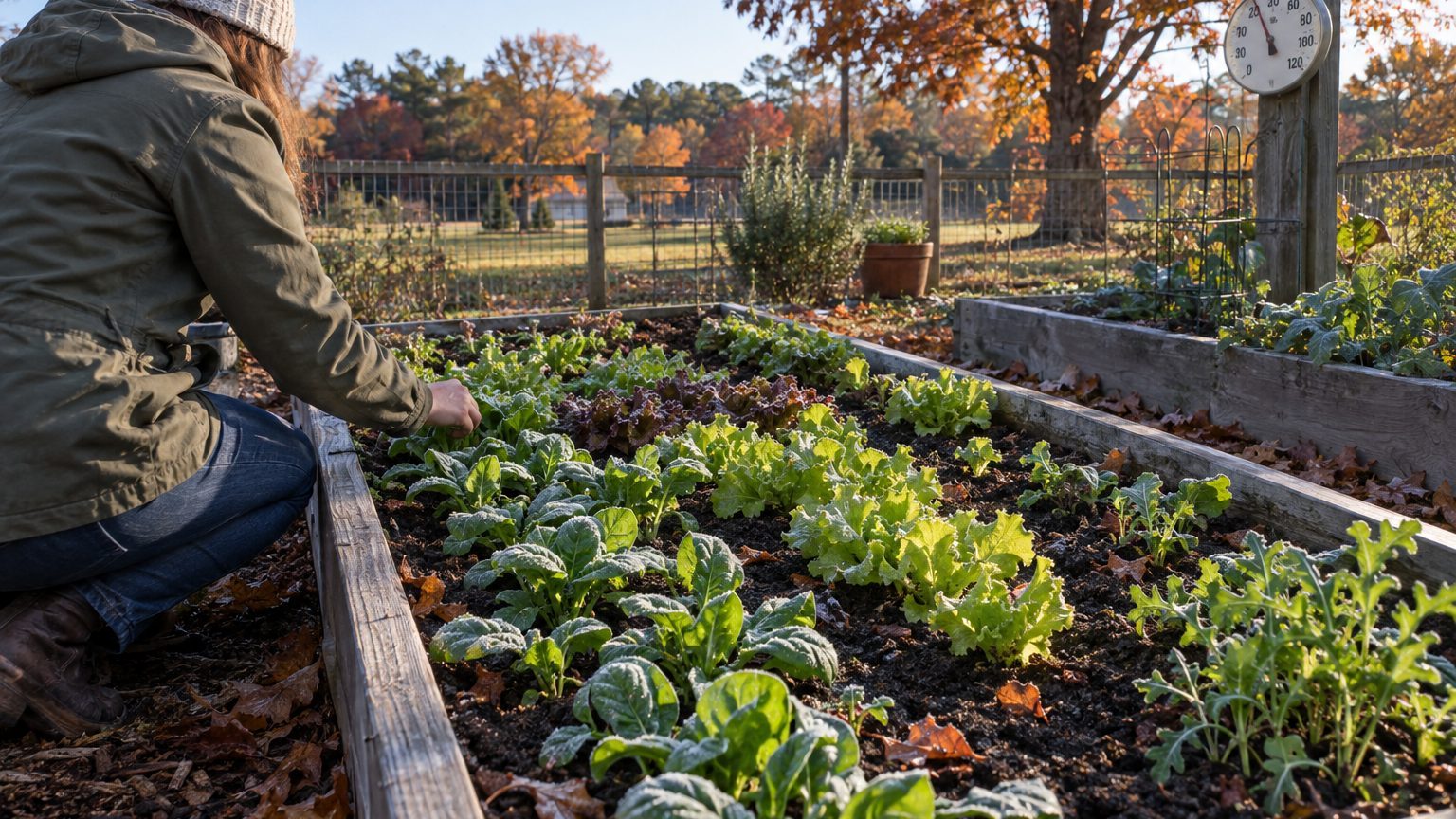

In the Boise valley, sow winter salad greens in late summer to early fall, counting backward from a first fall frost that arrives between October 7 and October 21. Higher and colder Idaho gardens need to sow earlier, sometimes by weeks. Because those dates describe a freeze risk rather than a calendar, the work is in the arithmetic around them.
The short answer for Idaho
Start from the frost dates, and read them correctly. For Boise, NOAA’s 1991-2020 Climate Normals put the last spring frost between April 23 and May 7, and the first fall frost between October 7 and October 21. These are not predictions. Each range is the band where the chance of a 32°F freeze sits between 30 and 70 percent. Any date inside it is a coin flip, more or less.
| Measure (Boise reference station) | Value |
|---|---|
| Last spring frost (32°F, 30-70% band) | April 23 to May 7 |
| First fall frost (32°F, 30-70% band) | October 7 to October 21 |
| Mean daily minimum, coldest month | 25.4°F |
| USDA hardiness zone, statewide | 3b-7b |
Turning the fall window into a sowing date
Take the seed packet’s days to maturity and count backward from October 7, the early edge of the window. Then add a cushion, because growth slows as days shorten and the number on the packet assumes summer pace. Using the early edge protects you in the years when the freeze comes first. Greens that need the longest to size up go in the ground earliest. Quick baby-leaf mixes can wait longer.
The spring window works in reverse. It marks when a cold frame can open up and when tender summer crops can move out. Between the late edge of spring (May 7) and the early edge of fall (October 7), the open garden gets five months. The wider span from April 23 to October 21 stretches that to about six.
Timing matters right now. As of early October 2026, a Boise-area gardener is at the edge of the fall window. Fresh sowings in open ground are late, and a cold frame or other cover is the realistic route for anything started this week.
Winter salads here means the cold-tolerant leaf crops you harvest from fall through the cold months. For the full idea, see Winter Salads for Idaho Gardens. For which types fit which conditions, see The Best Winter Salads for Idaho.
One caution comes with the data itself: the station is in Boise, a low valley. Most of Idaho is higher and colder, with far shorter seasons. These dates are the generous end of the state, not the middle of it.
What will not work here
The slowest crops fail first. A winter salad that needs a long stretch of mild weather to reach harvest size gets caught between a fall frost window starting October 7 and shortening days that barely move a plant forward. In a valley like Boise’s, that can be a squeeze. At higher elevation, where the season is far shorter, it is a wall. A late sowing of anything slow produces small seedlings that sit through winter and give you nothing to cut.
Sowing too early also fails, and it is easy to overlook. Lettuce and other cool-season greens resent hot soil, and southern Idaho summers run hot and dry. Seed scattered into a warm bed in midsummer germinates poorly or not at all, and the seedlings that do come up bolt or turn bitter when stressed. Starting a few weeks too soon can cost you more than starting a few weeks late. Shade cloth, a shaded bed on the east side of a building, or starting seed indoors helps bridge the gap.
Weekly watering does not hold up either. A hot, dry summer shrinks the root zone of a seedling bed fast, and young greens have shallow roots. A thorough soak once a week works for established tomatoes. It does not work for a bed of two-week-old seedlings, which need the surface kept evenly moist until the true leaves are established. Gardeners who water on a fixed weekly schedule through August tend to find patchy germination and wonder what went wrong.
Then there is the cold itself. The mean daily minimum of the coldest month at the Boise reference station is 25.4°F. That is an average low, so the coldest nights run below it. Hardy greens such as spinach, mâche, and kale shrug off a lot of that, but tender lettuce does not do well fully exposed through a hard stretch. Plan on cover for anything you want to eat in the middle of winter. That figure is also from a low valley. Colder parts of the state sit well below it, and an unprotected bed there is a gamble.
Finally, copying a calendar from a mild-winter region is a trap. A sowing schedule built for a coastal or southern garden assumes months of gentle fall weather that Idaho does not offer. Borrowing it will put your seed in the ground weeks past where it should be.
What changes across Idaho
Idaho is not one garden. The USDA Plant Hardiness Zone Map (2023 edition, built on 1991-2020 data) puts the state anywhere from zone 3b to 7b. That is four full zones apart, and the system measures a single thing: the average annual extreme minimum temperature. There is no single Idaho answer, and any page that gives one is smoothing over the part that matters most.
A reader in the north or at altitude should shift in three ways. First, sow earlier. The Boise window is the generous end, so a mountain valley gardener should treat October 7 as a date that may already be too late, and should count backward from a first frost that comes sooner. Second, lean toward the quickest, hardiest types and give up on slow ones. Third, plan for cover from the start, since a cold frame or low tunnel that is optional in the valley becomes the whole strategy where winters are long.
Hardiness zones also say nothing about frost timing, which is what a sowing calendar depends on. Two places in the same zone can have different first-frost dates, and the zone number does not capture heat, wind, or snow cover. Use it to judge winter survival, and use local frost dates to time sowing.
To find where your own garden falls, look up your location on the USDA Plant Hardiness Zone Map. This page will not tell you your zone, because a state page cannot know whether you garden on a valley floor or a bench two hundred feet above it.
Where to check this for your own county
Your state extension service is the best next stop. University of Idaho Extension runs county offices around the state, staffed by people who know the local frost pockets, soils, and snow loads. Look for two things there: the planting calendar for your county, and the varieties that have been trialled in your county’s conditions.
A trial matters more than a catalog description. A variety that performs well in a test garden near you has already survived the actual cold snaps and dry spells. Catalog claims are written for the whole country. If your county office has a master gardener program, that is also a good place to ask which fall sowings worked in recent winters.
This page does not hold an Idaho-specific county calendar, and it does not claim to. The only sourced dates here come from one valley station.
A county recommendation beats a state one, every time. This page is the state one: a starting frame built from a single reference station and a statewide hardiness range. Where the two disagree, believe the county.
Checking this against your own garden
Your own observations outrank every date above. Three are worth watching, and none needs equipment.
- Soil warmth by feel. Press your hand flat on bare bed soil in the morning and again in the afternoon. If it still feels warm to the touch in late summer, the bed is too hot for lettuce germination. A bed that cools sooner than your neighbor’s tells you it has more shade, more elevation, or better drainage.
- The first flush of male flowers. When squash and cucumber plants start putting out male flowers, summer is in full swing. Watching when that flush fades shows how quickly your site is tipping toward fall, and it varies from one yard to the next.
- The first true leaves. The first pair of leaves on a seedling are seed leaves. The second set, the true leaves, show the plant is actually growing. Note how many days that takes at different sowing dates. If true leaves are slow to show in late September, your site is losing daylight and warmth faster than the valley numbers suggest.
Jot down the date when each of these happens this year. Next year’s calendar will be better than anything printed here.
Common questions
Is it too late to sow winter salads in Idaho in October?
In the Boise valley, the first fall frost window runs October 7 to October 21, so open-ground sowing is late by early October. Fast baby-leaf greens in a cold frame or under cover are still realistic. At higher elevations, it is usually too late for open ground.
What does the frost date actually mean?
It is a probability. The Boise ranges mark where the chance of a 32°F freeze falls between 30 and 70 percent. A freeze can come before or after the range, so treat the dates as a planning edge, not a guarantee.
Do the Boise dates apply to the whole state?
No. Boise is a low valley, and most of Idaho is higher and colder, with far shorter seasons. The statewide hardiness range runs from 3b to 7b, so the Boise dates are the generous end of the spread.
Where can I find a calendar for my own county?
Start with University of Idaho Extension and look for your county office. Ask for the local planting calendar and for the varieties trialled in your county, since those recommendations outrank any statewide page.